Why the Future of Energy Storage is Spinning To Make a Comeback
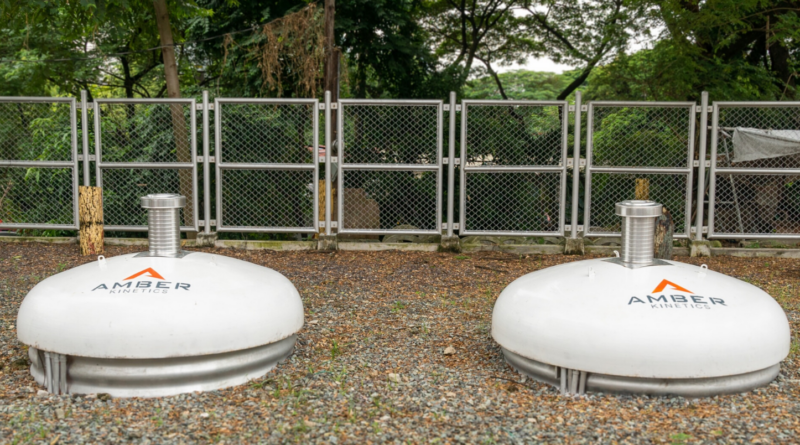 An test installation at the of a 16 kW/64 kWh flywheel system at the Meralco Power Tech Lab to serve as a proof-of-concept and testing site. (Photo from Meralco)
April 18, 20263 hours ago
Raymond Tribdino
0 Comments
Support CleanTechnica's work through a Substack subscription or on Stripe.
An test installation at the of a 16 kW/64 kWh flywheel system at the Meralco Power Tech Lab to serve as a proof-of-concept and testing site. (Photo from Meralco)
April 18, 20263 hours ago
Raymond Tribdino
0 Comments
Support CleanTechnica's work through a Substack subscription or on Stripe.
Seven months ago, Tina Casey wrote about the comeback of kinetic energy storage systems, pointing to renewed investment and attention after years of being overshadowed by batteries. Her piece, “$200 Million For Renewables-Friendly Flywheel Energy Storage,” captures a shift that has been building quietly: flywheels are no longer a niche technology confined to frequency regulation. They are being reconsidered as serious infrastructure for a renewable-heavy grid.
That reemergence is not about novelty. CleanTechnica has done a slew of stories on kinetic energy and energy recovery, going back 17 years!
Everything from claiming power from rain to flywheels.
Thus, in their most basic form, flywheels are ancient. What has changed is the precision of engineering and the scale at which they can now operate. Of the many companies that have harnessed the power of the spinning flywheel, Amber Kinetics interests me for two reasons.
First, (based on published reports) it pushed the technology past its earlier limitations. Traditional flywheels delivered energy in short bursts measured in seconds or minutes. The newer systems extend that into hours, which changes everything. Once duration increases, the application shifts from grid “fine-tuning” to actual energy shifting—capturing excess renewable generation and releasing it when needed.
Second, though their headquarters are in the US, they set up shop here in the Philippines, just 33 kilometers from my home city. I am set to visit their factory one day, but I did see their functioning kinetic storage systems in a most public place—the campus of Dela Salle University, in my home province of Laguna.
Amber Kinetics started to prototype in Hawaii in 2017. The island state, much like the Philippine archipelago, is perfect for kinetic energy storage with its isolated grids with high-renewable penetration (or potential) where intermittency is immediate. Island grids, solar variability, and the constant need to stabilize supply create conditions where storage is not optional.
I am yet to find out why they chose this corner of the Philippines to build their long-duration flywheel energy storage systems (FESS). At a time when the global conversation is fixated on lithium and supply chains, this operation is moving in a different direction. Steel, vacuum, and physics are working quietly toward the same goal—keeping renewable energy available even when the sun and wind fall short.
The physics of the spin
The core of the Amber Kinetics system is a solid steel rotor. Unlike traditional flywheels designed for short, high-power bursts to regulate frequency, these units are engineered for a four-hour discharge duration. This transition from seconds to hours is a leap in energy density and mechanical efficiency. The energy stored in a flywheel is a function of its moment of inertia and the square of its angular velocity. For the geeks, here is the formula:
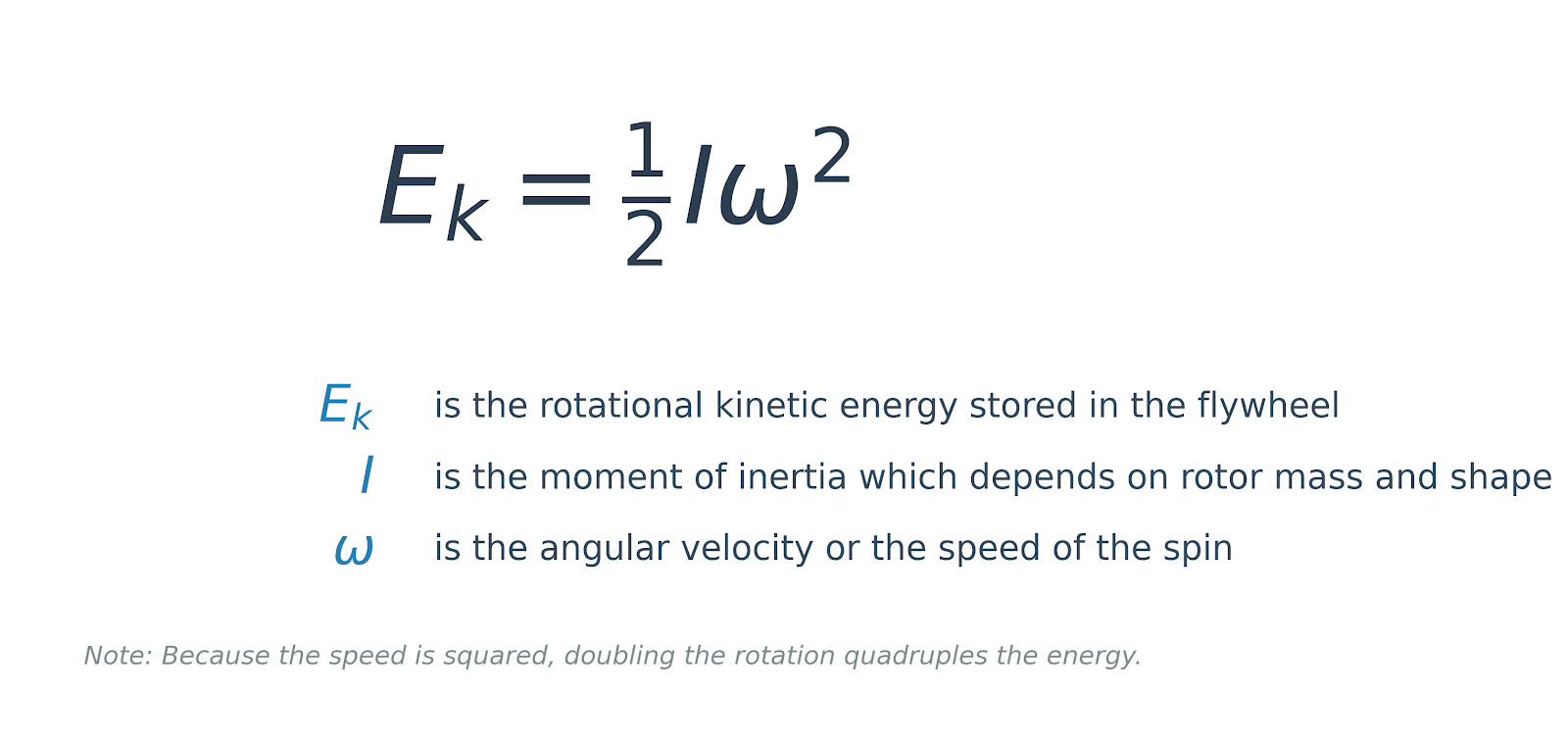
In prose less academic: how heavy it is, and how fast it spins. The formula operates on the same fundamental physics as a big truck’s flywheel—storing mechanical energy as rotational kinetic energy. The similar rule is that if you double the speed, you quadruple the energy.
Strip away the marketing language and what remains is surprisingly simple. The system stores energy by spinning a solid steel rotor. The heavier it is and the faster it turns, the more energy it holds. Increase the speed, and the stored energy rises dramatically. It is an old principle, but pushed to a level of precision that changes its relevance.
However, spinning a three-ton mass at several thousand revolutions-per-minute creates two immediate enemies: friction and drag. At these speeds, air acts like molasses, and traditional bearings would melt under the heat of friction. Amber Kinetics solves this by housing the rotor in a near-perfect vacuum and utilizing a proprietary magnetic levitation system. By eliminating air molecules and physical contact, the rotor can maintain its momentum for hours with minimal parasitic loss.
That difference—motion instead of chemistry—reshapes the economics of storage.
Batteries wear out. And chemically break down. Every charge and discharge cycle brings them closer to replacement. Heat accelerates that process, and in a tropical country, heat is unavoidable. Flywheels do not degrade in the same way. They do not rely on chemical reactions that break down over time. They spin, and they keep spinning, whether cycled daily or relentlessly over decades.
The result is not just longer life, but predictability. Amber Kinetics estimates its flywheels will last about 30 years. A three-decade asset that does not quietly lose capacity year after year changes how utilities think about cost, planning, and risk. For developing grids, that stability matters as much as the technology itself.
There is also a kind of toughness built into the system. During testing in Japan, an Amber Kinetics flywheel unit successfully withstood a 7.3 magnitude earthquake that occurred in Fukushima. The company reported that no damage was done to the unit, demonstrating its resilience to natural calamities. There are also installations at sites including the Mystar Engineering Corporation in Chiba and the Kashiwa-no-ha Open Innovation Lab (KOIL) in collaboration with Itochu Enex, a Japanese energy company.
The facility is already producing flywheels at industrial volume, but I am not yet sure if these will be distributed to the many solar and wind farms across the Philippines. But there are Amber Kinetics installations in Hawaii, Massachusetts, California, and Florida. There is an installation in Dazi, Lhasa, Tibet, in partnership with Yungao Renewables. This is part of the Tibetan government’s push for a reliable, emission-free, and safe energy storage solution suited for the region’s unique high-altitude challenges.
In Australia it has successfully commissioned several projects, including an 8kW/32kWh Flywheel Energy Storage System in Hidden Valley, Victoria. The company partnered with PTLK International Ltd, delivering the island’s first four-hour flywheel energy storage system.
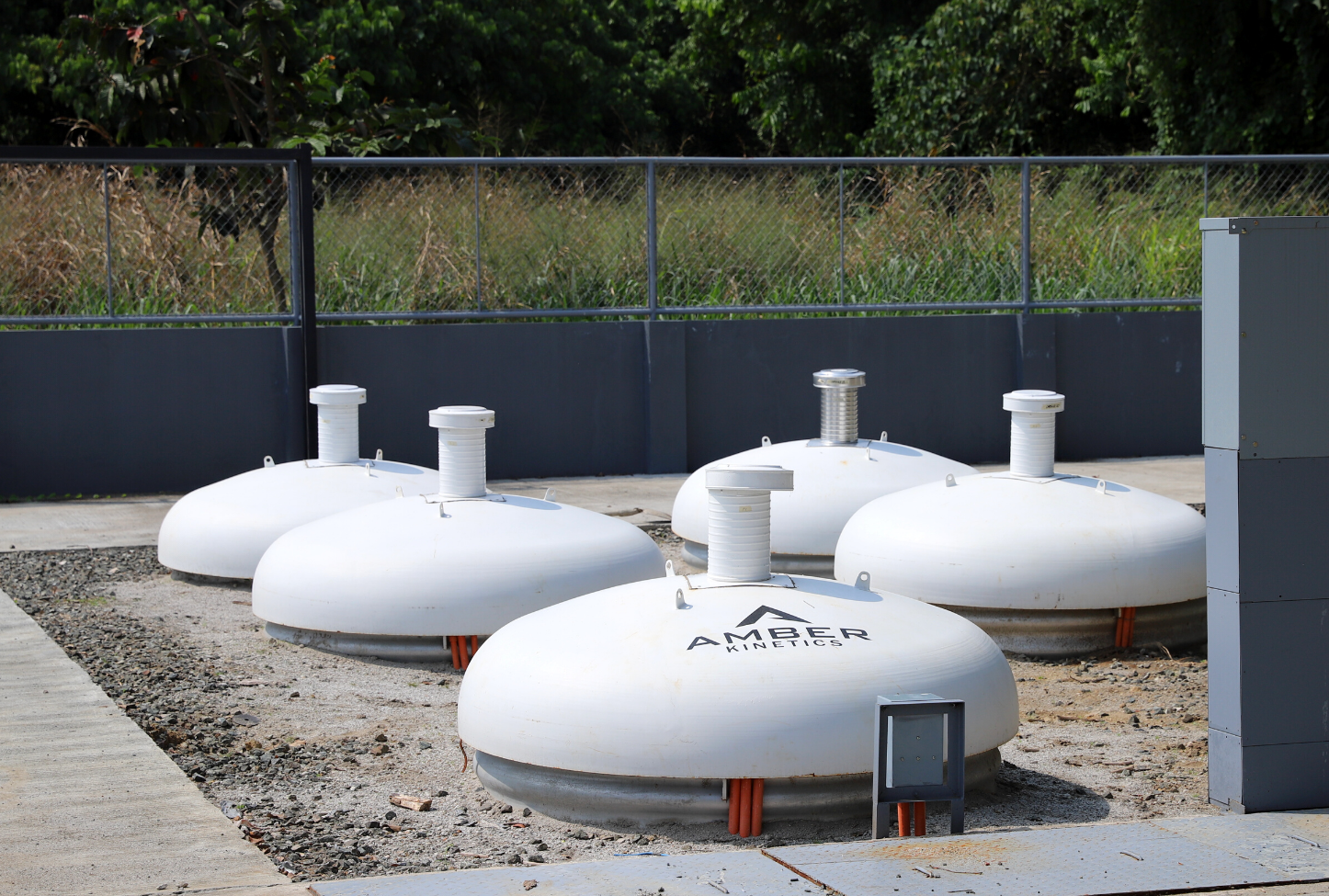
At the De La Salle University Laguna campus, the technology is quietly demonstrated and unseen. The installation commissioned in early 2020 is still running and functions primarily as a Flywheel Innovation Hub for extensive design, engineering, prototyping, safety tests and product verification and demonstration of long-duration FESS technology.
In addition to being an academic test bed for flywheels, DLSU is able to reap the benefits of this installation as it helps to reduce electricity costs by performing demand charge management when electricity demand is high.
Rows of flywheels operate as a working system, smoothing demand, shifting energy, and turning intermittent supply into something dependable. It is a quiet display, almost easy to overlook, but it represents a shift in how energy can be managed.
There is also an environmental clarity to the approach. A flywheel is mostly steel. It does not depend on rare minerals or complex extraction chains. It does not introduce the same disposal challenges at the end of its life. After decades of operation, it can be dismantled, melted, and reused. No special handling and no long-term waste problem. But at this moment, batteries cannot be taken out of the equation. Sodium-ion might be the technology to boot. But I am incapable of predicting that, just speculating.
The growing recognition now is that flywheels and batteries may work best together, each compensating for the other’s limitations. Flywheels handle rapid cycling and longevity. Batteries provide longer discharge windows where needed. The future, increasingly, looks layered rather than singular.
CleanTechnica's Comment Policy