Trump Makes The Case For SAF Stronger Than Ever Before
 April 17, 2026April 17, 20264 hours ago
Tina Casey
0 Comments
Support CleanTechnica's work through a Substack subscription or on Stripe.
April 17, 2026April 17, 20264 hours ago
Tina Casey
0 Comments
Support CleanTechnica's work through a Substack subscription or on Stripe.
Stakeholders in the global aviation industry have been inching their way towards SAF (sustainable aviation fuel) to replace conventional kerosene jet fuel, and US President Donald Trump has just handed them a good reason to pick up the pace. Take Europe, for example, where Trump’s war on Iran has bottled up fuel supplies, leaving the continent with about six weeks until the taps run dry on kerosene jet fuel.
Six Weeks Of Aviation Fuel Left In Europe
Don’t just take our word for it. Associated Press has the scoop on the jet fuel situation in Europe.
“Europe has ‘maybe six weeks or so’ of remaining jet fuel supplies, the head of the International Energy Agency said Thursday in a wide-ranging interview, warning of possible flight cancellations ‘soon’ if oil supplies remain blocked by the Iran war,” recounted AP reporter John Leicester on April 16.
“IEA Executive Director Fatih Birol painted a sobering picture of the global repercussions of what he called ‘the largest energy crisis we have ever faced,’ stemming from the pinch-off of oil, gas and other vital supplies through the Strait of Hormuz,” Leicester added.
The SAF Solution, Or Not
As for why Europe does not have a supply of alternative jet fuel on hand, that’s a good question. Nobody does. Following years of experimentation with various feedstocks, bio-based SAF has been achingly slow to find a competitive footing with conventional fuel.
In Europe, for example, a blending requirement of just 2% SAF took effect last year, with the range of feedstocks limited almost exclusively to used cooking oil and waste animal fats, much of it imported from China and Malaysia.
The news organization Farm Progress notes that the war in Iran has made the economic case for SAF more attractive in Europe, though not to the extent that the industry could ramp up substantially over the next six weeks. As if on cue, on April 15 the International Council on Clean Transportation issued a rundown on the state of play in Europe, and the picture is not pretty.
“In the near term, hydroprocessed esters and fatty acids (HEFA) fuel is the only commercially mature SAF pathway available,” ICCT explains, noting that compliance depends on a limited supply of waste fat and oils.
The near-term forecast for more advanced forms of SAF is not encouraging, either. ICCT drops advanced jet fuels into the long-term bucket, listing “cellulosic fuels made from solid waste or agricultural residues (known as advanced bio-SAF) and e-kerosene produced through electrolytic hydrogen and captured carbon dioxide.”
Meanwhile, Here In The USA
The e-kerosene angle is of interest in the US, where e-fuels investors have been attracted by the abundant wind and solar resources of Texas to produce green hydrogen, which as noted by ICCT can be combined with captured CO2 to make synthetic fuels including jet fuel. Still, the e-fuels industry is a long way from scale-up. The US was in a somewhat more competitive position just a few years ago, when former President Joe Biden launched a new $7 billion aimed at expanding and diversifying domestic hydrogen production. However, Trump took a chopper to the program soon after taking office last year.
That’s okay, SAF innovators in the US can just pack up their bags and go elsewhere. Take the Chicago-based startup Syntholene, for example. On April 14, the company announced that the pieces are in place to start construction on a new synthetic fuel demonstration facility in the the Municipality of Norðurþingi, Iceland.
Why Iceland?
If you’re thinking geothermal energy is in play, run right out and buy yourself a cigar. The new Syntholene SAF facility will be located at the Husavik Power Station in Norðurþingi, where geothermal power production was halted in 2010. However, the facility was preserved with all of its core systems intact, and Syntholene expects to get it up and running in short order.
“Such attributes are expected to reduce early-stage civil works, reduce schedule risk, and lower capital requirements compared to other comparable development sites,” Syntholene notes, by way of explaining why it tapped a defunct facility to support its operation.
Once operational, the power plant is expected to demonstrate that Syntholene’s “high-temperature Thermal Coupling and Solid Oxide Electrolyzer Cell (SOEC)” system can be integrated into an existing thermal facility. During its 12 months of operation, the system will run for approximately 1,000 hours, generating data and insights that support scale-up and commercial production.
The project will also showcase Syntholene’s modular, containerized go-anywhere system.
How Does It Work?
Syntholene provided many more details about the system in a Conceptual Design Report released on March 6. Without getting too deeply into the weeds, the basic idea is to deploy high heat to cut the cost of producing green hydrogen from water. The company’s Thermal Coupling System is designed to deliver steam at approximately 150°C (302°F).
“Current green hydrogen production costs of approximately US$4-6/kg are likely to render power-to-liquid eSAF pathways economically uncompetitive with fossil-derived jet fuel,” the company explains. “Syntholene’s conceptual design targets a scalable pathway to hydrogen production below US$2/kg, with a long-term objective of achieving sub-US$1/kg through thermal integration.”
According to the company’s calculations, deploying SOEC technology on high-temperature steam electrolysis can slash energy demand as low as 37 kWh/kg H₂, compared to roughly 65 kWh/kg H₂ for conventional systems.
In contrast to the 60-70% electrical efficiency delivered by conventional systems, Syntholene claims that its electrical-to-hydrogen conversion efficiency settles in the 85-90% range.
If all goes according to plan, the result of all this energy savings will be a 70% cut in costs compared to conventional water electrolysis.
SAF In The USA
Despite the sudden U-turn in federal energy policy under Trump, Syntholene may have an opportunity to bring its SAF technology home from Iceland after the demonstration period concludes. For reasons best known only to himself, Trump decided to kick the US wind and solar industries to the curb while continuing to provide federal support for other forms of renewable energy, including advanced geothermal energy systems.
With 300 gigawatts of geothermal energy potential lingering just below the surface of the US, there should be plenty of room for Syntholene to find a place for itself.
Image: A new demonstration facility in Iceland aims to validate a new, energy efficient process that slashes the cost of electrolysis-derived sustainable aviation fuel (SAF) by 70% (courtesy of Syntholene).
Sign up for CleanTechnica's Weekly Substack for Zach and Scott's in-depth analyses and high level summaries, sign up for our daily newsletter, and follow us on Google News! Advertisement Have a tip for CleanTechnica? Want to advertise? Want to suggest a guest for our CleanTech Talk podcast? Contact us here. Sign up for our daily newsletter for 15 new cleantech stories a day. Or sign up for our weekly one on top stories of the week if daily is too frequent. CleanTechnica uses affiliate links. See our policy here.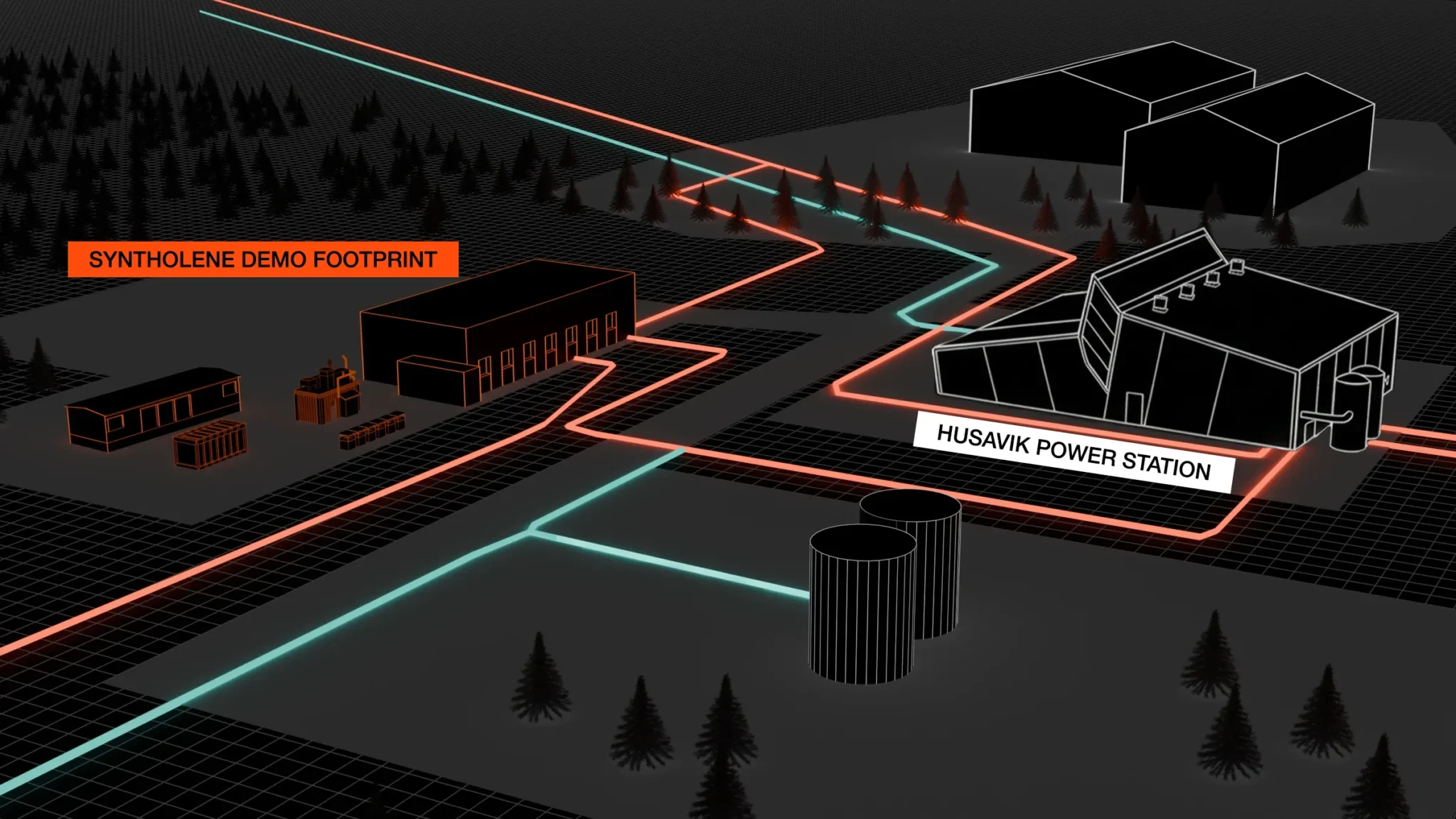
CleanTechnica's Comment Policy