Revise, recall, then rest - your exam season survival guide

 BBC
BBCExams season is upon us, which means after months of learning, revising and memorising it's nearly crunch time.
But it doesn't have to be a stressful experience.
BBC News spoke to teachers and tutors for their top tips on revising, sitting exams and how to take care of yourself too.
1. Get the most out of your revision
Simon Beale, a secondary school history and politics teacher, says you should try to improve your understanding of topics and commit key terms to memory to prepare for "differently phrased" questions coming up on exam day.
By doing this, Beale says students can ensure every minute of study is "targeted" to where it matters most.
He says there's a big difference between being able to read revision notes or a study guide, and truly understanding the concepts.
"If you cannot explain the causes of the Tudors' rise, or simplify the concept of photosynthesis, you don't understand it yet," he says.
Here are some of his pointers:
- Use a red, amber and green "traffic light" system to rate your knowledge and pinpoint where you should focus your revision
- Try to explain particular topics to a friend or relative in a simple way - and get them to test you
- Engage in discussion about a topic, looking at the "why" not just the "what"
- Memorise key terms so you don't lose marks on specific terminology in the mark scheme
- Break ideas into flash cards and test yourself by covering and recalling them
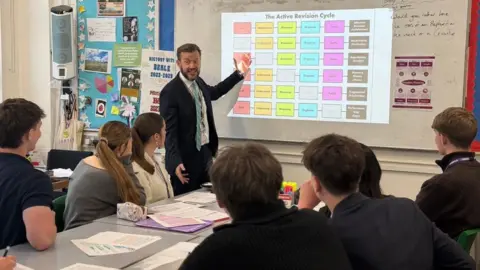 Simon Beale
2. Should I use AI to help me?
Ruth Havenga, a GCSE English tutor, says AI can be used in an educational way that can support students with revision. But she says it can also be disruptive if not used properly.
To get the most out of using AI in your revision, she says you should:
- Use assessment objectives for the correct exam board to help generate ideas of discussion on a particular topic
- Use AI to give past paper questions on a subject
- Let it support your analysis for essay-based subjects like English
- But don't use AI to search for answers after the exam, as this may cause you unnecessary stress
 Getty Images
3. Have your exam timetable in plain sight
Havenga says one of the easiest ways to keep organised and prevent exam stress is making sure you know your exam timetable.
She says it's "no good preparing for what's coming in the fourth exam and not what's coming in the first one".
She says you should:
- Make sure you've got your exam timetable up somewhere you can see it
- Before the exam, use the timetable to go over the assessment objectives
- Look at what the examiners are actually marking you on
4. Take care of yourself
Andrew Bruff, a GSCE English tutor, and Emily Merrison, a GCSE and A-level tutor, say the morning of the exam should be about getting the basics right, not last minute cramming.
These are their top tips for making sure you're focused on yourself, as well as your exams:
- Trust your revision - a quick look over your cue cards should be all you need
- Control what you can - prepare your uniform and books the night before to avoid any unnecessary rushing on the morning of an exam
- Have a proper night's sleep - putting your phone in a different room before bed, or moving it away from your bed, can help
- Eat a good breakfast - if you are feeling a bit anxious eating a little is better than nothing
- Don't try to recall lots of information the morning of an exam
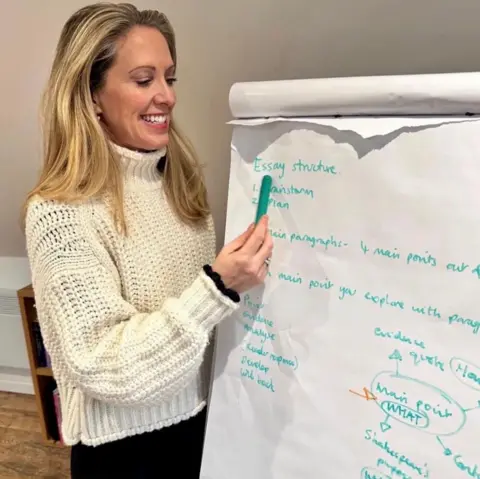 Ruth Havenga
5. What should you do after the exam?
Relax, it's done! Once the exam is over there is nothing you can change about it, Bruff says, and replaying it will only drain you.
Merrison says you should try to avoid comparing answers with friends, as "your answers are never going to be identical and it doesn't mean you've got it wrong".
They say after the exam is done:
- Don't pick apart the exam with friends or compare answers
- Relax, watch a funny program, see a friend or go for a walk
- Don't look online for answers and anxiously scroll on your phone
- Enjoy the fact you have ticked the exam off and that you are moving forward
While exams are important, Bruff stresses that "no grade is worth your wellbeing".
Havenga and Merrison point out there is the option of retaking the test if needed.
Merrison adds: "There are so many other ways into careers - even if it doesn't go how you thought it would."
You may also be interested in