Low-Cost Community Solar Keeps Growing Despite Tide Of Negative Federal Policy
 April 18, 2026April 18, 20263 hours ago
Tina Casey
0 Comments
Support CleanTechnica's work through a Substack subscription or on Stripe.
April 18, 2026April 18, 20263 hours ago
Tina Casey
0 Comments
Support CleanTechnica's work through a Substack subscription or on Stripe.
The community solar movement has emerged as a significant source of new generating capacity in the US. Last year the sector passed the 10-gigawatt mark, and an 8-gigawatt development pipeline of new projects is already in the works. Considering the sharp U-turn in federal energy policy last year, that’s a pretty good record, and that’s just the tip of the iceberg.
Community Solar Is A Money-Saver
Community solar refers to small-scale solar arrays that provide local ratepayers with shared access to solar power through a subscription-based program. The general idea is to provide the whole community with equal access to clean energy, pulling in ratepayers who don’t have the opportunity or inclination to install solar panels at their own property.
The shared solar arrangement requires enabling legislation from state lawmakers. Colorado was the first state to set up a community solar platform, in 2010. Back then, solar power was generally more expensive, and subscribers had to be willing to pay a premium in order to claim clean kilowatts on their electricity bills. With the cost of solar power dropping over the years, subscribers now stand to save money. That helps explain why 43 states and the District of Columbia now enable community solar projects (see lots more background here).
There is still plenty of room for the industry to grow, as uptake varies considerably among states. In a market report as of June 2025, the National Laboratory of the Rockies (formerly the National Renewable Energy Laboratory) calculated that the US had about 11 gigawatts (AC) installed, with just four states dominating 75% of the market. Florida took the lead at at 3,873 megawatts-AC, followed by New York at 2,410 MW, Massachusetts at 1,054 MW, and Minnesota at 932.
Gilding The Green Lily
Aside from saving money for beleaguered ratepayers, additional benefits of community solar have also emerged over the years. Repurposing local landfills and other community eyesores for clean power is one commonplace practice. The newly formed organization Farmers Powering Communities is also promoting solar as a land conservation measure that enables farmers to help local ratepayers reduce their bills.
Because local solar projects are relatively small, they can also be situated on warehouse rooftops, corporate campuses, and other facilities, providing the owner with a means of squeezing value from underused parts of their property while burnishing their reputation in the community.
Big Money For Small Solar
Over the years, community solar has also progressed from a niche sector to a high-dollar business. Take the Georgia-based firm Dimension Energy, for example. The company launched in 2018 and has already racked up more than 1 gigawatts worth of community solar projects. It currently has 3.5 gigawatts under development in 14 US markets.
On April 1, Dimension announced that it has secured a round of construction and term financing totaling $650 million, its largest such transaction to date. The funds are earmarked for 25 community solar projects totaling 132 megawatts all together, located in New York, New Jersey, and Illinois as well as Pennsylvania, where community solar legislation has been working its way through the statehouse.
“First Citizens Bank, Mitsubishi UFJ Financial Group, Inc., ING Capital LLC, and National Bank of Canada provided $415 million in debt financing, joined by first-time Dimension partner Franklin Park, which contributed $235 million in tax equity,” Dimension explained.
Dimension also used the opportunity to make a pitch for its industry. “The value proposition of community solar continues to grow as U.S. electric prices reach historic highs,” the company emphasized.
“Community solar projects provide subscribers with immediate savings on their utility bills and generate power close to where it is used, minimizing the need for costly long-distance transmission infrastructure,” Dimension added.
Dimension also drew attention to the quick turnaround time for solar projects, which in Dimension’s case can be as quick as 18 months from development to operation.
Warehouses For Good
The rooftop solar project at the top of this article showcases Dimension’s business model. The array was up and running in 2023 as the company’s first community solar project in New Jersey, where open space is at a premium.
“Our New Jersey projects utilize space on warehouse roofs across the state, minimizing land impacts,” Dimension explains. “At least 51% of project capacity goes to low- to moderate-income (LMI) households, delivering significant energy bill savings. To multiply the local benefits of these savings, Dimension enrolls households through campaigns with municipalities, community-based organizations, and affordable housing providers.”
In support of its New Jersey portfolio, the company has also engaged with workforce training programs, including partnerships with community colleges. “In order to build this pipeline of clean energy talent, our New Jersey community collaborations also provide STEM curricula and support to schools and after-school programs across the Garden State,” the company adds.
Next Steps For Community Solar
So far, so good, though a new report from Wood Mackenzie advises that the growth curve is complicated moving forward.
The report, prepared in collaboration with the organization Coalition for Community Solar Access, takes note of a steep, 25% contraction in the market in 2025, which had little or nothing to do with the sharp U-turn in federal energy policy. WM attributes the slowdown to a maturing environment in Maine and New York State.
On the plus side, the report calculates that the market hit the 10-gigawatt (DC) milestone in 2025, and parts of the country are still ripe for rapid uptake. Accordingly, WM anticipates a rebound to 12% growth through this year, with Illinois and markets in the Mid-Atlantic states driving much of the action.
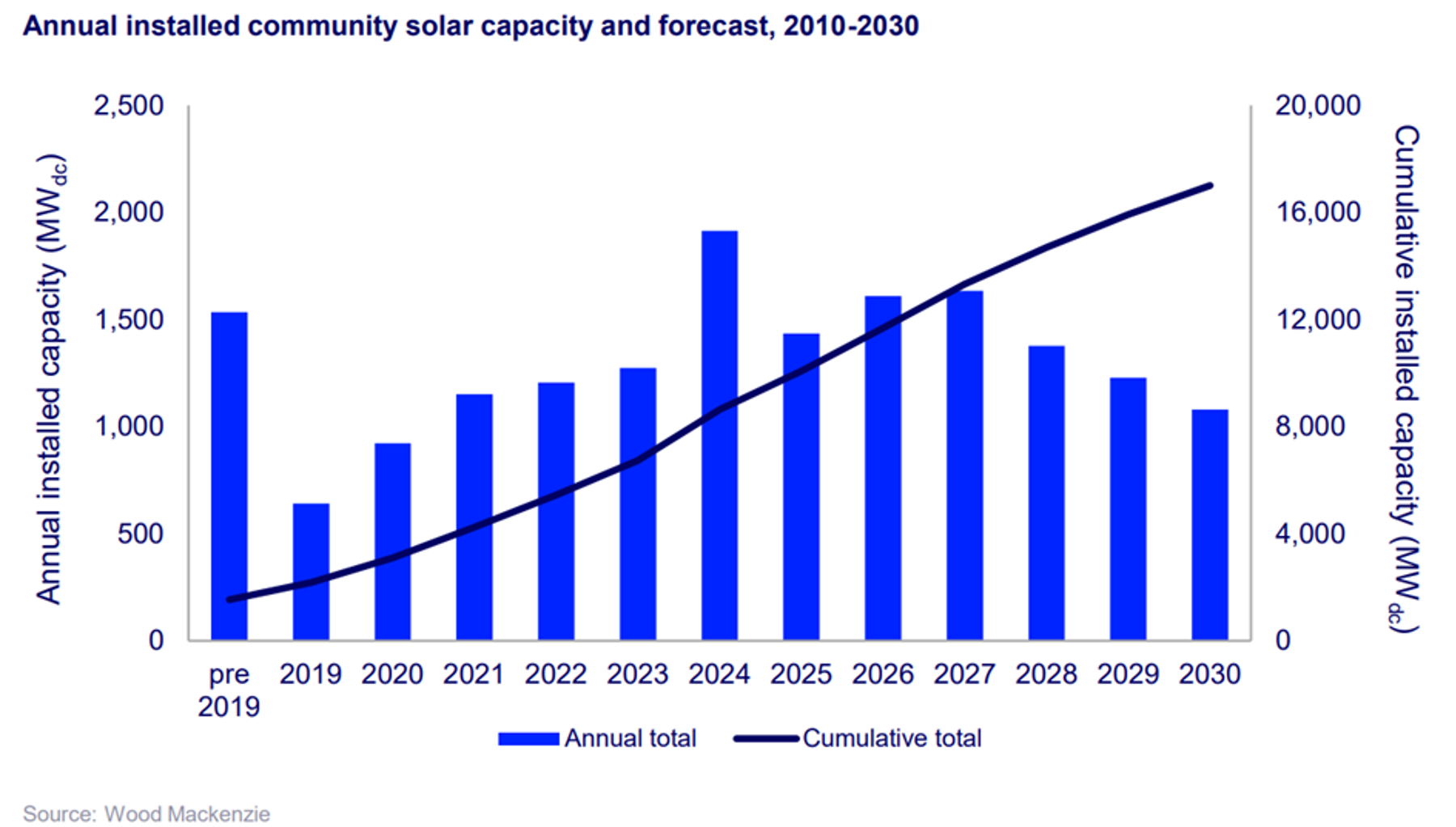
Moving forward through 2030, the report finds a 5% annual contraction in installed community solar capacity. Contraction doesn’t mean zero or negative growth, it just means a slowdown. With a development pipeline of more than 8 gigawatts (DC) in hand. the industry is all but certain to grow in the coming years, particularly because a full 29% of those projects are already under construction.
In addition, new markets in Ohio, Iowa, Pennsylvania, and Michigan will add to the action, if and when enabling legislation surfaces. That’s more of a “when” these days, now that Trump’s war in Iran has sent fossil fuel prices soaring through the roof.
Community solar projects are also all the more attractive because, unlike larger utility-scale projects, they are less likely to get stuck in interconnection limbo, waiting for a hookup to the grid at large. Instead, they can feed directly in to local distribution networks.
That helps explain why, outside of the traditional community solar model, stakeholders have also been focusing their attention on community-scaled solar projects, which the report describes as up to 20 megawatts DC. New regulations are not generally required for these sorts of projects, and the report notes that action is particularly strong in Ohio, where community solar legislation has yet to surface.
Photo: Invisible from the street, this warehouse hosts a sizeable rooftop community solar project that provides all local ratepayers with access to low-cost electricity (cropped, courtesy of Dimension Energy).
Sign up for CleanTechnica's Weekly Substack for Zach and Scott's in-depth analyses and high level summaries, sign up for our daily newsletter, and follow us on Google News! Advertisement Have a tip for CleanTechnica? Want to advertise? Want to suggest a guest for our CleanTech Talk podcast? Contact us here. Sign up for our daily newsletter for 15 new cleantech stories a day. Or sign up for our weekly one on top stories of the week if daily is too frequent. CleanTechnica uses affiliate links. See our policy here.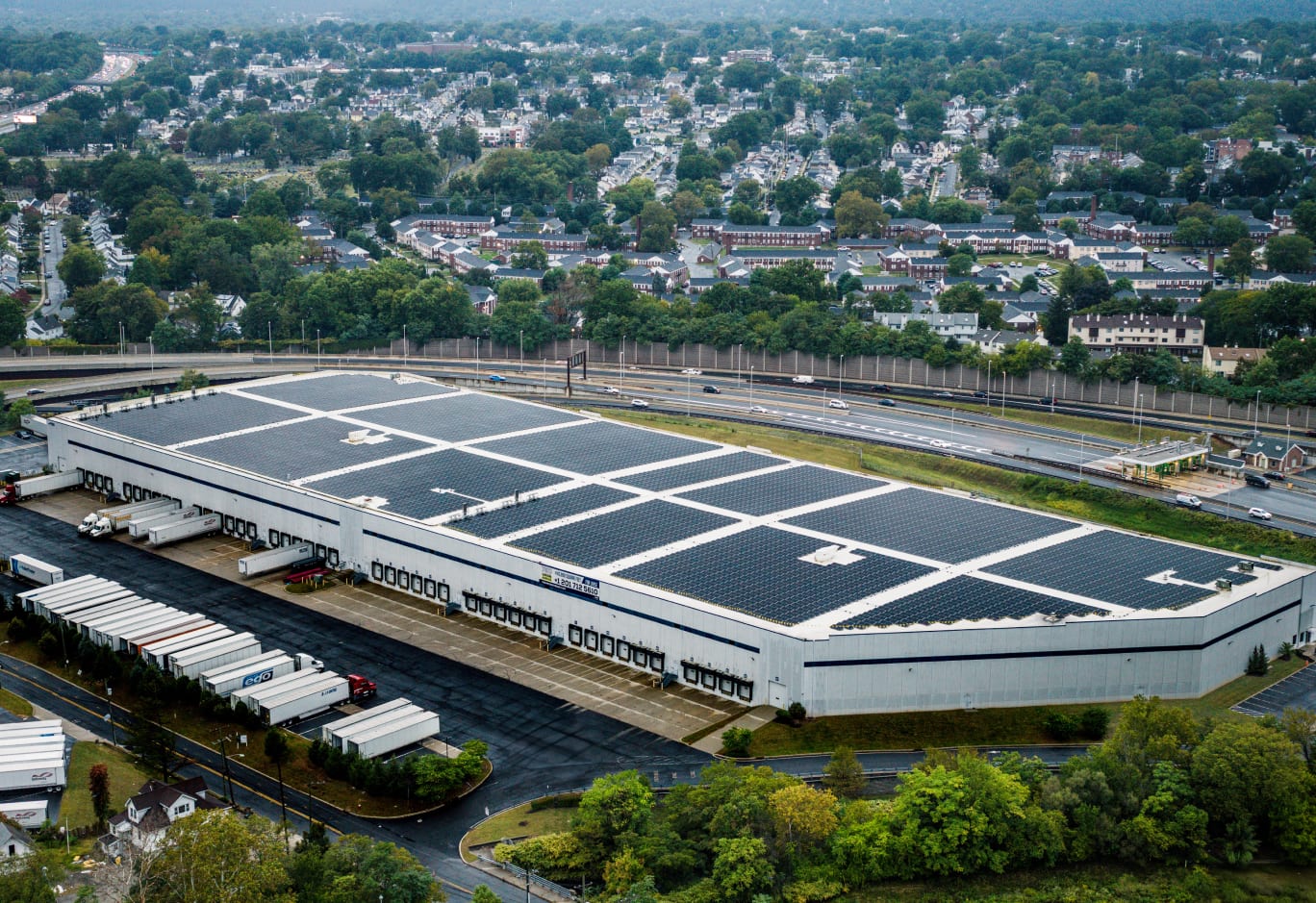
CleanTechnica's Comment Policy