To Glyphosate Or Not To Glyphosate — That Is The Question
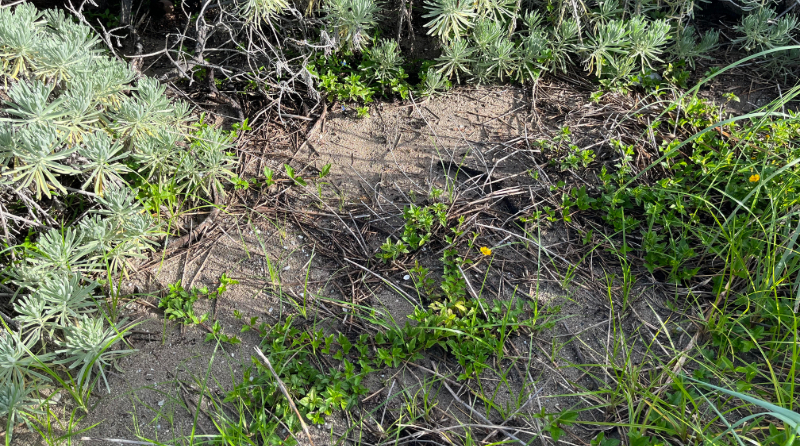 Photo by Carolyn Fortuna/ CleanTechnica
May 5, 20263 hours
Carolyn Fortuna
0 Comments
Support CleanTechnica's work through a Substack subscription or on Stripe.
Photo by Carolyn Fortuna/ CleanTechnica
May 5, 20263 hours
Carolyn Fortuna
0 Comments
Support CleanTechnica's work through a Substack subscription or on Stripe.
I supervise the health of our condo community’s private, half-mile dune. Our dune height ranges anywhere from 12 to 14 feet, and the width varies along the entire dune but averages about 150 feet. Invasive wedelia — once upon a time, it was the landscaping choice of developers due to its fast spread and pretty little yellow flowers — threatened the viability of our dune starting about three years ago. Dozens of volunteers tried to contain the wedelia by hand-pulling the rhizome (a vine that grows underground and spreads readily). Our well-intentioned owners hardly made a dent in the creeping carpet of wedelia. So a committee made the difficult decision to treat the first generation of wedelia with glyposate (colloquially known as Roundup) to save our carefully curated sea oats, saw palmettos, other natives, and rare plants.
As we treated the insidious weeds, we wondered, Are we removing the chance for birds, animals, butterflies, shrubs, and trees to thrive?
Wedelia and other invasives are quite insidious, and a second generation is sprouting up in small pockets. We’re hoping not to apply any more glysoate applications than is absolutely necessary; we are working diligently with our landscaping company to identify other eradication possibilities. Could finalsan be a less toxic alternative? Can more volunteer hand-pulling keep new sprouts at bay? Aren’t there any new products coming on the market that can replace glyphosate?
Invasives and Monsanto: An Unhealthy Relationship
Glyphosate has a high efficacy against a broad spectrum of annual and perennial weeds. It works by killing the entire plant through systemic translocation to the roots. And there is no other product on the market that is nearly as cost-effective.
Introduced in 1974 by agri-giant Monsanto, glyphosate is among the world’s most controversial herbicides. In the late 1990s, the organics movement emerged and made transparent the chemical’s ability to destroy whole ecosystems. Glyphosate had been thought safe for the environment because it is inactivated quickly after spraying as it is absorbed onto soil particles. It is also broken down by soilmicro-organisms, such as bacteria and fungi, that use glyphosate as a food source.
Then again, glyphosate-based herbicides may effect non-target organisms across terrestrial and aquatic ecosystems. Increasing evidence demonstrates that they have profound effects on ecosystem functions via altered microbial communities.
Types of soil or weather conditions can force glyphosate to leach out, which poses a potential pollution threat to water systems. Some additional effects are of concern to scientists, including impacts on the diversity, function, and structure of the communities of microbes that live in the soil and that are vital to soil health, especially when the herbicide is used regularly. Using glyphosate has increased the severity or the re-emergence of crop diseases, potentially by changing the balance between beneficial and harmful microbes in the soil. Another unsettling example is that of fungi that live near plant roots and provide crops with nutrients and access to water. They help protect against drought and disease, yet veungi has been found to be harmed by the use of glyphosate.
The World Health Organization’s cancer agency calls glyphosate a probable carcinogen.
Monsanto agreed with the New York Attorney General’s office to discontinue their use of the terms “biodegradable” and “environmentally friendly” in ads promoting glyphosate-based products, including Roundup.
How Will the US Supreme Court Rule on Glyphosate?
The Supreme Court on Monday heard argument in Monsanto Co. v Durnell. It’s a complex dispute over whether a federal law governing pesticide labeling and registration prevented a Missouri jury from awarding $1.25 million to a volunteer gardener who alleged that Monsanto had failed to warn that its popular weed killer Roundup causes cancer. According to Abbe R. Gluck, writing on the SCOTUSblog, it is important to understand the nuances of the filing — yes, there are billions of dollars at stake in the more than 60,000 Roundup cases proceeding across the nation.
But Gluck states, “The case raises bigger picture questions about the future of aggregate public harms litigation and federalism that we will surely see again.”
Bayer, which obtained Monsanto in 2018, says this litigation threatens the supply of the most used herbicide in the US. The company argues federal pesticide laws shield them and that the EPA has never declared their product contains cancer-causing ingredients. Maybe not the EPA — but increasing environmental and human health concerns, highlighted by its 2015 IARC classification as probably carcinogenic to humans, have placed glyphosate under global regulatory pressure.
It’s clear that overexploitation and chemicalization are major drivers of accelerating biodiversity loss, and these drivers present a tremendous global threat to functions and services in natural and agricultural ecosystems. Studies point to the heavy use of agrochemicals, such as glyphosate playing a critical role in the contamination, exposing non-target plants, animals, and humans.
The word among legal scholars is that the Supremes are expected to issue an opinion by the end of June, and they may not split neatly into conservative versus progressive sides. Weeds are widely recognized as the most significant biotic factor affecting crop production, report researchers on Agronomy, with average potential crop losses estimated at 34%.
Studies conclude that non-chemical alternatives may not suffice as a replacement for glyphosate, as they result in a pronounced conflict between toxicity reduction and climate goals. That means tillage, which is the most carbon-intensive method of weed removal of any option. Right now, if the judges were to approve the withdrawal of glyphosate from the marketplace, there would be a vacuum of weed killers — alternative weed control strategies that balance human health safety with environmental concerns are still in the R&D stage.
Nate Halverson writes in a recent issue of Mother Jones how California burn zones treated with glyphosate “lack signs of life even years after the fires.” (The Pacific Crest Trail passes through this area — California’s most heavily sprayed forestland in 2023.)
We who are dune caretakers are luckier — we are starting to see butterflies return to the dune. Understanding the equation of invasives to identify, eradicate, and replace, we plunged ahead with a subsequent and ambitious replanting project to fill in the areas where glyposate was applied and a barren sandy spot resulted. Now we must monitor and decide if we can use our muscles to keep new emergence of wedelia under control by ourselves.
Resources
- “Ecosystem consequences of herbicides: The role of microbiome.” Suvi Ruuskanen, et al. Trends in Ecology and Evolution. January 2023.
- “Replacing glyphosate shifts environmental burdens: Trade-offsbBetween ecotoxicity and climate impact in chemical and non-chemical strategies.” Michael Raimondi, et al. Agronomy. February 2026.
- “State and federal courts jockey for power in the Roundup case and other mass public harms.” Abbe R. Gluck. Clear Statements on the SCOTUSblog. May 1, 2026.
- “The impact of glyphosate on soil health: A summary of the evidence to date.” Soil Association.
- “We are bombarding America’s forests with Roundup.” Nate Halverson. Mother Jones. June 2026.
CleanTechnica's Comment Policy