The sea that is vanishing in real time
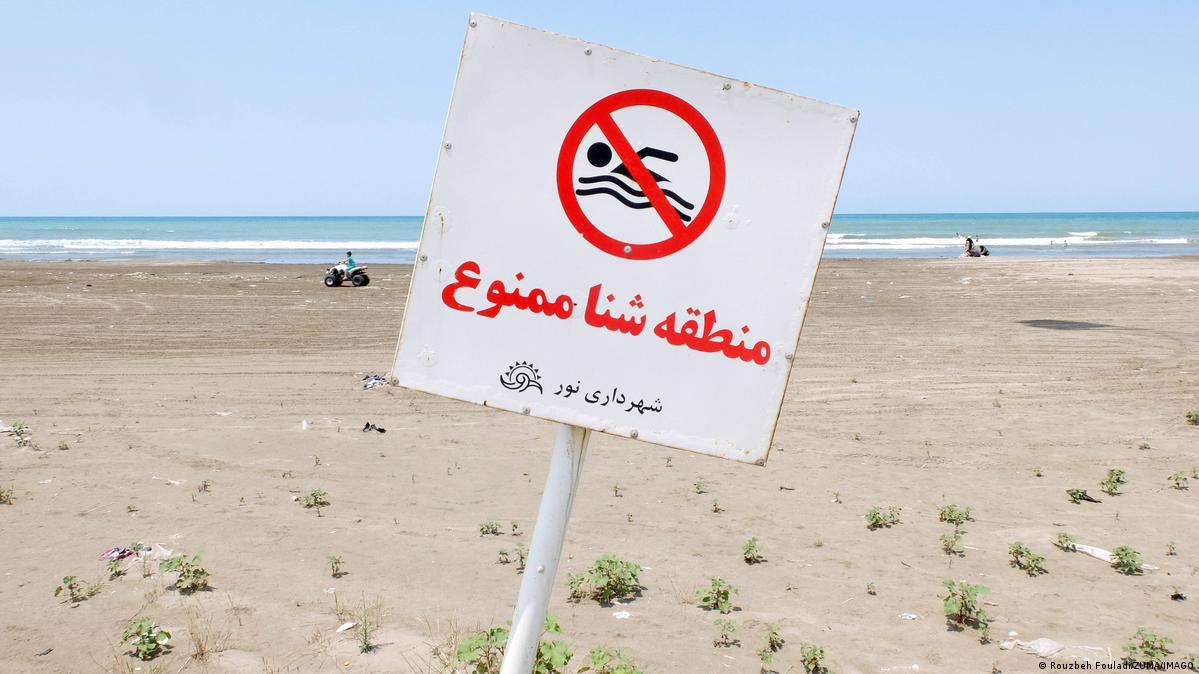
As a child, Iranian environmental journalist Maryam spent much of her time by the Caspian Sea. From her coastal home in the northern city of Rudsar, she witnessed how the water levels would fluctuate, so much so that in the 1990s, flooding along parts of Iran's northern shoreline left some of her relatives homeless.
All that shape-shifting felt normal, yet on a recent trip back to the area after years away, the body of water was suddenly very unfamiliar.
"I kept walking further from the shore, but the water only reached my knees," said Maryam, whose real name DW has chosen not to reveal for security reasons. "For someone who grew up by this sea, it was frightening."
What she experienced on that visit was not an anomaly. The Caspian Sea, the world's largest inland body of water, bordered by Iran, Russia, Azerbaijan, Turkmenistan and Kazakhstan is shrinking fast.
Although the brackish Caspian has fluctuated in the past, scientists say the current drop in water levels, which began in the 1990s, is unlikely to reverse. Predictions point to an even greater retreat this century, with some models indicating potential drops of up to 21 meters (about 70 feet).
"To put that into perspective, an 18-meter drop, for example, would be greater than the height of a six-story building," said Simon Goodman, an evolutionary biologist at the UK's University of Leeds. "That level of decline would have substantial impacts on ecosystems, as well as on human health, well-being and economic activity."
Why is the Caspian Sea declining?
Several factors are driving the retreat. Several rivers flow into the Caspian, but about 80% of its freshwater comes from the north via the Volga in Russia. For decades, the volume of incoming water has been influenced by dams, irrigation and other forms of water management — particularly in the Volga River basin — but Goodman said the situation ahead is more complex.
"Projections for the rest of this century suggest that ongoing declines will have a much stronger climate change component," he said.
Rising global temperatures connected to planet-heating emissions from the burning of oil, gas and coal are increasing evaporation from the sea's surface. Coupled with lower levels of precipitation and runoff into the Volga basin, more water is leaving the Caspian than entering it.
Declining fish stocks, blocked ports
And that, said Goodman, is a problem. "The impacts will apply across the entire Caspian Sea," he said, adding that some are already visible. That's especially true in the northern region of the massive lake, bordered by Russia and Kazakhstan.
"Many ports around the Caspian require significant dredging to maintain shipping access," he said, adding that such issues "are likely to intensify even within the next five to 10 years."
Fishing communities are also under pressure. In the shallow northern basin, continued decline could make fishing increasingly unviable, Goodman explained. And if levels drop as far as 10 meters, large parts of the northern basin could dry up entirely, eliminating nearly a third of the sea's surface area.
In some places, that process is already underway. A site in the northeastern Caspian, once used by tens of thousands of seals for spring molting, is now dry land. "We are already losing ecologically important habitats due to sea-level decline," Goodman said.
The effects are visible along the Iranian coastline to the south, too. With wetlands under pressure, fish stocks have declined and the markets Maryam remembers as once being big and vibrant are now a shadow of their former selves. And she has seen other undeniable changes.
"The coastline we saw as children is very different from what we see today," she said, adding that a cafe that once stood at the water's edge now sits several meters inland.
Could the Caspian face an Aral-style crisis?
Goodman said there are already early signs of the Caspian going the way of the Aral Sea, some 1,000 kilometers (600 miles) to the east.
Once one of the world's largest inland water bodies — located between Kazakhstan and Uzbekistan — it has largely dried up due to water diversion. Besides destroying livelihoods and ecosystems, the vanishing lake has had serious consequences for human health, including from toxic dust storms.
"We are absolutely already at the beginning of that process," Goodman said.
If the northern Caspian were to dry out, the consequences would extend beyond the loss of water. Large stretches of exposed seabed could alter the regional climate and release significant amounts of dust into the air, some of which could contain pollutants.
Policy action not keeping up with environmental change
As the Caspian spans five countries, meaningful management will require coordination.
Goodman said that although "governments seem to be at the beginning of developing collaborative frameworks," it is still at an early stage.
He said long-term adaptation will require sustained investment in scientific research and strategies that address both ecological and economic dimensions. And that it must happen quickly.
"The pace of policy must match the speed of environmental change," said Goodman.
Edited by: Tamsin Walker
AdvertisementСхожі новини

‘Protecting Britishers is our top priority’: Keir Starmer on hantavirus outbreak that killed 3 on cruise ship

Pakistani man pleads guilty for human smuggling in US, charged $40,000 to bring people on 'dunki route' for film work
