Officials knew carpet mill chemicals were polluting the region’s drinking water; they didn’t tell residents
Growing up in northwest Georgia, Stormy Bost’s life was intrinsically linked to water.
Summers were spent plucking crawdads from the neighborhood creek and playing in its cool depths, racing home for dinner as the sun set. Waiting for her were pitchers of sweet tea, brewed by her family using tap water.
"Your family’s going through a gallon every day or two, and it’s cheap," Bost recalled. "But it comes from the faucet."
As a parent, Bost continued this tradition for her own children until a few years ago, when she discovered the local tap water contained toxic chemicals known as PFAS.
Bost and her husband are raising two daughters in Calhoun, the same small river town dominated by the region’s multibillion-dollar carpet industry where she was reared.
For decades, textile mills relied on PFAS in popular brands like Stainmaster and Scotchgard for stain resistance.
Some of these chemicals, which didn’t adhere to carpets, were flushed with industrial wastewater into local sewer pipes and, eventually, the region’s rivers. The same odorless, colorless chemicals in the tap water have accumulated in Bost’s body, blood tests show.
Her PFAS levels are higher than national health guidelines consider safe, and at 34, she has been diagnosed with liver and thyroid conditions — ailments research has linked to PFAS.
Bost is not alone. Everyone in the region seems to know someone whose health problems, including certain types of cancer, could be caused by PFAS, commonly known as "forever chemicals" because they persist in people and take decades or more to break down in the environment.
This crisis was predictable. For more than two decades, scientists have warned of the risks to humans and animals posed by these chemicals spreading from the mills.
Even without federal limits on chemicals like PFAS, states possess the authority to protect public health and the environment.
 open image in gallery
Instead, Georgia’s Environmental Protection Division (EPD) did little to confront the problem, issuing neither fish advisories nor do-not-drink orders to the public, even as concerns grew among scientists and federal regulators about the dangers of PFAS, an investigation by The Atlanta Journal-Constitution, The Associated Press, and FRONTLINE (PBS) has found.
Testing by the University of Georgia in 2008, when Bost was in her teens, alerted the industry and state that the local Conasauga River, which supplies the region’s drinking water, was polluted with "staggeringly high" levels of PFAS.
That same year, the state’s environmental director told carpet manufacturers the agency would not take action on the chemicals. The state’s own testing, which did not occur until 2012 and 2016, when Bost was a young mother, confirmed the university’s results.
In 2019, as her daughters turned 8 and 9, federal tests still detected PFAS.
Along the way, Georgia’s EPD deflected efforts by neighboring Alabama and the U.S. Environmental Protection Agency (EPA) to track the chemicals more closely, even as PFAS migrated more than 100 miles downriver and across the state line, according to detailed court records and interviews with former regulators.
When PFAS began appearing in Alabama’s drinking water in 2016, local utility officials looked to Georgia for answers. Eastern Alabama and northwest Georgia share a river system that originates in the Blue Ridge Mountains and flows through both states, feeding the region’s carpet mills and serving as a source of drinking water for hundreds of thousands.
After tests showed PFAS in Alabama’s water exceeding EPA’s voluntary health guidelines at the time, Alabama’s environmental regulators alerted their federal counterparts and asked Georgia’s EPD for help identifying the source. Despite Alabama’s urgent request, Georgia’s environmental regulators did not respond in kind.
Jim Giattina, former director of EPA’s Water Protection Division, who organized a call between the two states, noted, "EPD was very defensive. There was certainly no commitment on their part to do any more monitoring." Alabama sent letters to Georgia in 2017 and 2018 requesting data, with officials noting Georgia’s regulators did not require industrial users to monitor for PFAS. EPD’s Truszczynski, who joined the agency in 2016, said she found no record of Georgia’s response to Alabama.
In 2008, an EPA panel had determined the type of stain-resistant chemicals used by carpet manufacturers were likely carcinogenic. Environmental groups wrote a letter imploring EPA leaders and then-EPD Director Carol Couch to regulate PFAS more aggressively, noting other states had begun to act.
 open image in gallery
"The residents of Georgia deserve no less protection than what has been afforded to residents in other states," a coalition of 21 organizations wrote in March 2008. Months later, Couch met privately with carpet company representatives and their trade association, the Carpet and Rug Institute. Werner Braun, then the institute’s director, later informed his board that EPD "has no plans to initiate regulatory action" on PFAS, and that Couch indicated EPD "would probably look at the issue again in five years." Braun noted the subject of drinking water never came up. Couch later stated that PFAS were only an "emerging concern" at the time and that EPA had not established drinking water standards, adding that EPD "had neither the sufficient science, expertise nor resources to undertake action independent of USEPA."
Today, Georgia is still not regulating PFAS, in contrast to other states that have invested tens of millions of dollars in cleanups and sued polluters to recoup costs. Georgia environmental officials offered several reasons for their approach. EPD Deputy Director Anna Truszczynski said her agency looked to federal regulators for guidance and waited for scientists to better understand the risks of PFAS.
She said EPD helped several cities struggling with contamination by providing testing support, connecting them to potential funding sources, and advising them on possible filtration technologies. "We believe that there can be a good balance between environment and economy," Truszczynski said. "We don’t have to sacrifice one for the other." The agency is also considering rules limiting the amount of certain PFAS in public drinking water, following federal standards set to take effect in several years.
Although officials with major carpet manufacturers say they stopped using PFAS in 2019, without extensive cleanup the chemicals will remain in the region's water and soil for generations. No one has taken responsibility to date. The country’s two largest carpet companies, Shaw Industries and Mohawk Industries Inc., both based in the region, blame their chemical suppliers, 3M and DuPont, which they said for years hid the dangers of PFAS in their products.
The carpet companies said they followed regulators’ guidance and pointed out that there are still no enforceable limits on the chemicals. In court filings, 3M and DuPont said it was ultimately the carpet industry, not them, that put PFAS in the water of northwest Georgia. An EPA spokesperson, Jake Murphy, said the federal agency is working to offer technical and financial support in the region.
"EPA’s focus today is forward‑looking: working with Georgia, Alabama, affected communities, and water systems to identify PFAS contamination, reduce exposure, and hold polluters accountable where the law supports it," Murphy wrote in an email.
While tracing the cause of Bost’s thyroid and liver conditions is difficult, what she and her doctor know is that the drinking water and the river contained PFAS. "There’s a lot of us and we’re sick," Bost said. "We don’t know what’s next."
During the nearly two decades since the 2008 meeting with carpet executives, Georgia regulators intermittently tested the waters south of Dalton, confirming time and again the extensive contamination. Despite these results, and the discovery of PFAS in the drinking water of several northwest Georgia towns, EPD did not post this data on its website until 2020. By that time, EPD testing had found PFAS in Calhoun’s drinking water — the same water that Bost, her husband, and two daughters relied on. When EPA in 2022 issued stricter guidelines for the amount of PFAS in drinking water it considered safe, the city of about 20,000 was several times above this new limit.
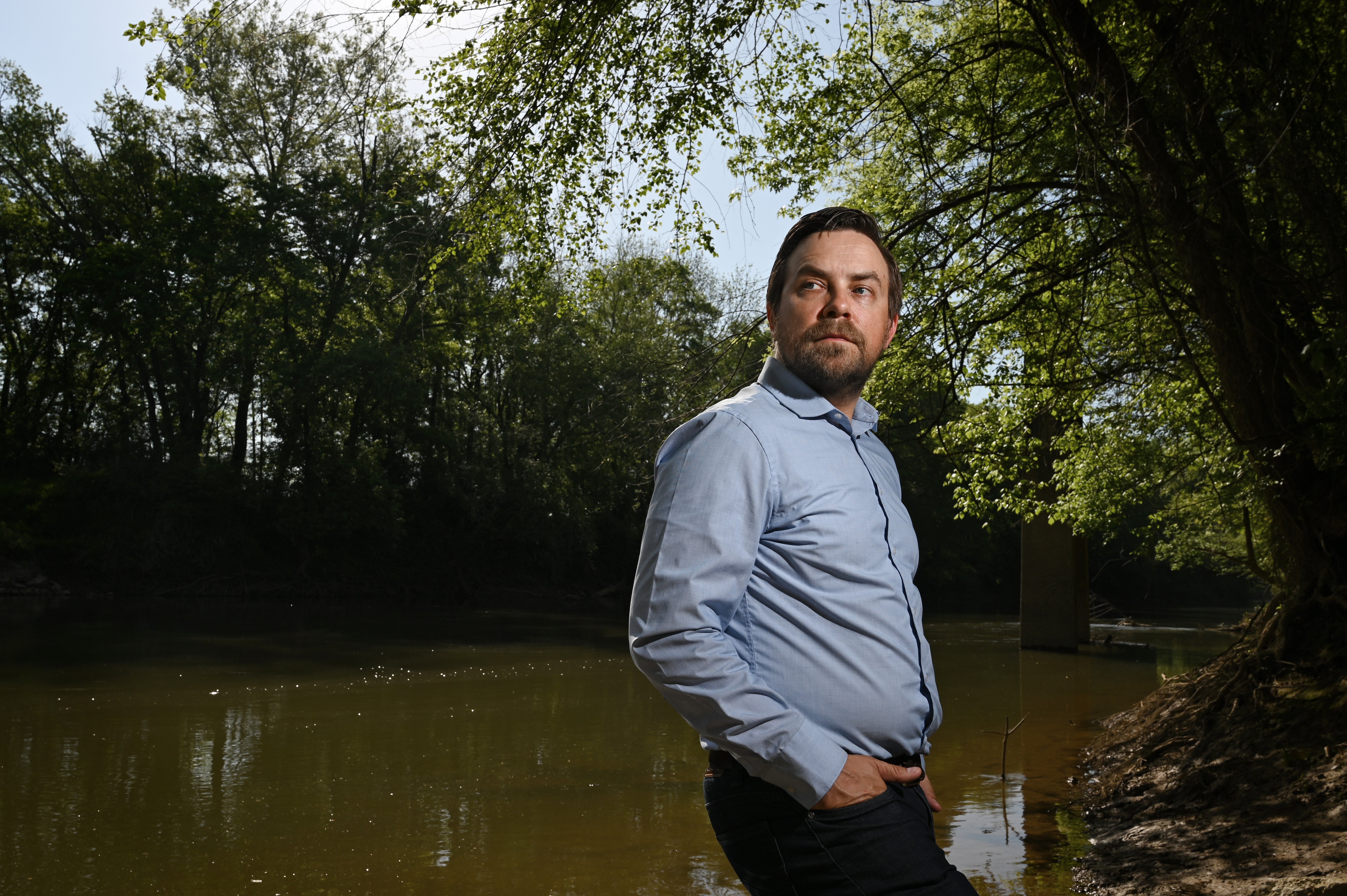
The local riverkeeper, Jesse Demonbreun-Chapman, took action. On a cold, drizzly December day in 2022, Demonbreun-Chapman idled his boat on the Coosawattee River, a waterway that feeds into the Conasauga near Calhoun. He suspected a massive farm was contaminated by PFAS-laden sludge, or biosolids, made from wastewater and spread on land. Downstream from the farm is where Calhoun’s municipal water system draws river water. The test results alarmed Demonbreun-Chapman: water running off the farm tested thousands of times higher than federal drinking water standards for forever chemicals. The city had no effective system to remove PFAS. "That was the smoking gun," Demonbreun-Chapman said.
The samples collected became key to a lawsuit his organization, the Coosa River Basin Initiative, filed along with the Southern Environmental Law Center against Calhoun. The complaint alleged stain-resistant chemicals from carpet mills contaminated the sludge, which in turn polluted the water. In a victory for environmental groups, Calhoun settled the case in 2024, agreeing to filter its water for PFAS, stop spreading sludge, test private drinking wells, and keep the community informed of risk. The city did not admit liability. EPD requires none of these actions. Demonbreun-Chapman and others criticized the EPD, citing static budgets, staffing turnover, a culture of industry deference, and a sluggish federal response. "Nobody else was coming," he said.
EPD has a broad mandate, with a $128 million budget from fees, state, and federal funds. A spokesperson for Gov. Brian Kemp stated that PFAS contamination is a top priority for the state and EPD. However, in 2022, then-EPD Director Richard Dunn told state lawmakers the agency’s high turnover rate, with staff leaving for higher-paying positions, was "almost an existential challenge." Truszczynski countered that the agency is adequately funded and has made strides in staff retention, adding that EPD was "directly involved" in addressing Calhoun’s contamination.
In the vacuum left by the state, questions about responsibility and cleanup costs are being hashed out in the courts as cities and counties face hundreds of millions of dollars in expenses. In 2016, the Alabama cities of Gadsden and Centre sued Mohawk, Shaw, 3M, DuPont, and others, settling for an undisclosed sum. Other cities in Alabama and northwest Georgia have followed.
Rome prevailed in its own lawsuit, filed in 2019, and is using the funds to build a $100 million water treatment plant. Calhoun, following its settlement with environmental groups, sued carpet manufacturers and their chemical suppliers in 2024, as did Dalton. "It remains our goal to hold those that contaminated our water supply with PFAS responsible for all past, present, and future costs," wrote Erik Henson, Calhoun Water and Wastewater Director.
 open image in gallery
Shaw and Mohawk maintain they are not to blame, pointing the finger at chemical companies and asserting they followed state and federal regulations. The wave of lawsuits has expanded in recent years as dozens of residents and farmers allege PFAS contamination has devalued their properties and put their health and livelihoods at risk. "People don’t want to put their health on the line and wait for the state to catch up," said April Lipscomb, an attorney for the Southern Environmental Law Center.
Some northwest Georgia lawmakers sought to counter these lawsuits by introducing state legislation that would restrict the ability of cities and residents to sue carpet companies. These bills drew bipartisan condemnation and failed, as PFAS emerged as a key issue in local elections. Protests erupted in February against Republican Rep. Kasey Carpenter, who sponsored a bill to shield carpet companies. A few weeks later, a bill co-sponsored by state Sen. Chuck Payne, another Dalton Republican, which would have given authority to EPD and Georgia’s attorney general to handle PFAS lawsuits, also failed. In March, environmental activist Erin Brockovich told crowds at town hall meetings, "You need to rise up. That’s the only way this is going to work, and it’s the only way it has ever worked."
Other states are taking a more aggressive approach to PFAS. Wisconsin, Michigan, and Maine have each committed millions of dollars for cleanup, started robust testing programs, and sued to hold polluters and manufacturers accountable. A bipartisan group of Wisconsin lawmakers earlier this year approved $133 million for PFAS cleanup. Jill Billings, a Democratic state assembly member whose district discovered contaminated drinking water in 2019, emphasized state-led action as the federal government retreats from environmental regulations.
While EPA has still not put enforceable limits on forever chemicals, the agency’s proposed limits on the two PFAS types most used by carpet manufacturers are set to go into effect in 2031. "I think it’s up to us to solve the problems of regular folks because the federal government seems to be struggling," Billings said. "That’s fine. We’re ready."
Today, even though northwest Georgia’s major carpet manufacturers said they stopped using PFAS in their U.S. production several years ago, the Conasauga River south of Dalton is still being polluted. The major source is a 9,600-acre tract latticed by pipes and sprinklers along the river. This "land application system," operated at Loopers Bend by Dalton Utilities, sprays the soil with billions of gallons of treated wastewater, most of it from the carpet industry.
The concept, celebrated in the 1980s, was that soil and vegetation would filter pollutants before they reached the Conasauga. Yet design flaws led to consistent leaks and broken pipes, with dead fish observed as wastewater ran directly into the river. Scott Gordon, chief of water enforcement for EPA’s regional office at the time, toured the site in 2000 and said he was shocked by how industrial water found its path into the river.
EPA inspectors in 2001 pushed to bring the site under the permitting system of the federal Clean Water Act, which would have required Dalton Utilities to report pollution levels and allowed citizens to sue. However, Georgia’s EPD lawyers sent the agreement back to EPA, asking for tweaks. One change required Dalton Utilities merely to submit an application, rather than to obtain a permit, as EPA had urged. Gordon, who signed off on the change, later felt "screwed" by the state agency, as EPD subsequently rejected the application, stating Dalton Utilities didn’t require EPA oversight. EPD stated PFAS were not regulated in 2001, and neither a federal nor state permit would have included limits on the chemicals. Today, under EPD oversight, PFAS levels at Loopers Bend remain largely unmonitored. "They remained in the complete shadows," Gordon said, referring to Dalton Utilities and the carpet industry. "And, honestly, they still are."
Схожі новини