Israel's Eurovision entry 'shocked' by protests during semi-final show
Israel's contestant at the Eurovision Song Contest has said he was surprised by protests that disrupted his semi-final performance.
Several audience members - including one with "Free Palestine" written across his chest - were removed from Vienna's Wiener Stadthalle on Tuesday night after chants of "stop the genocide" were heard during the song.
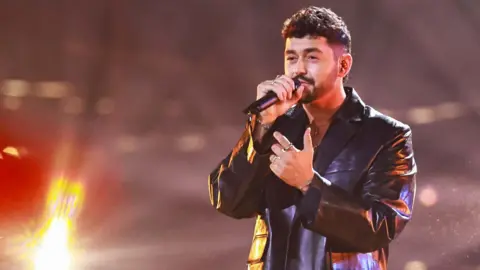
"I was aware," Israel's entry Noam Bettan told the BBC. "I heard there was booing and everything, and there was a moment of, like, a wow effect, you know? A little bit of shock."
Israel's presence at Eurovision has been contentious since the start of the war in Gaza in 2023.
The public broadcasters of five countries - Spain, the Netherlands, Ireland, Iceland and Slovenia - are boycotting this year's event, making it the smallest since 2003.
Irish broadcaster RTÉ said Ireland's involvement was "unconscionable given the appalling loss of lives in Gaza", and Dutch broadcaster Avrotros said the Netherlands' participation was "incompatible with the public values that are essential to us".
Israeli broadcaster Kan has described their absences as a "cultural boycott" which "harms freedom of creation and freedom of expression".
Bettan, 28, said he was hopeful the five broadcasters could return for future contests.
"It's bad for them," he said. "They're losing the opportunity to be in this amazing experience. So I am full of hope that next year they can sing and spread their light."
 EPA
EPAThe five broadcasters' criticisms have been echoed by human rights group Amnesty International, which said the European Broadcasting Union (EBU) had "betrayed humanity" by allowing Israel to compete.
The Gaza war was triggered by the Hamas-led attack on southern Israel on 7 October 2023, when about 1,200 people were killed and 251 others were taken hostage.
Israel responded by launching a military campaign in Gaza, during which more than 72,740 people have been killed, according to the territory's Hamas-run health ministry, whose figures are considered reliable by the UN.
Israel has strongly denied the allegation from Amnesty International and other human rights groups that its forces have committed genocide against Palestinians in Gaza.
 Reuters
'Can't prepare for booing'
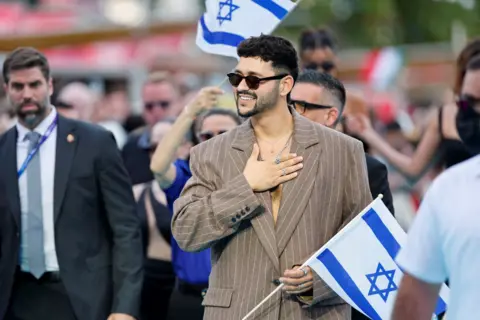
After Bettan's initial shock at the chants during Tuesday's semi-final, he said he "looked for the flags of the people who love me and want me to do my best, and that really carried me".
It is not the first time Israel's performance has been disrupted in recent years.
Singer Eden Golan faced a similar chorus of cheers and boos as she sang in Sweden two years ago. Last year in Switzerland, two protesters unsuccessfully tried to storm the stage and throw paint during a song by Yuval Raphael.
Like his predecessors, Bettan practised being booed during his preparations for Eurovision, though he admitted it did not compare to the real thing.
"You can't bring 13,000 people to a rehearsal room and get them to boo. I had a few people in my crew trying to make it hard for me, to practise for this moment - but you can't really prepare for this," he said.
 EPA
EPAAustria's broadcaster ORF, which is hosting Eurovision, has stated it will not ban Palestinian flags or censor any audience booing at this year's event. The removal of audience members on Tuesday related to more disruptive behaviour.
Despite the protests, Bettan gave a confident performance, and said the song's lyrics gave him strength on stage.
"There's a moment at the end of the song when I sing in Hebrew and it means, 'There's always someone listening'," he said.
"And in that moment, I felt that I was singing my heart out to my people."
He said while this "sounds like a big cliche", he found that moment emotional and was "very proud to be here and very proud to represent my country".
Small voting controversy
Bettan has been at the centre of a minor controversy, after he asked fans on social media to use all 10 of their votes to support Israel at Saturday's grand final.
That prompted a rebuke from organisers, who said Bettan's post "wasn't in the spirit" of the competition, and demanded that it be deleted.
They also issued a formal warning to Israel's broadcaster, Kan, which organises the country's Eurovision entry.
It followed an Israeli government-backed campaign to boost votes for Yuval Raphael last year, which some countries said tipped the scales in Israel's favour.
Raphael came top of the public vote in 2025, finishing second overall after the jury votes were taken into account. The EBU said at the time it had found no evidence of irregularities.
Bettan told the BBC he had not been aware of guidelines that discourage contestants from campaigning for multiple votes, and had "erased" the post.
Asked whether Israel could be disqualified for further breaches, Eurovision director Martin Green told BBC News: "We're a long way from any of that.
"If there is a problem, we start a conversation and we try and resolve it amicably, without reaching for sanctions.
"We hope, in a way, that you teach the world that you can solve [conflict] by being collegiate right now."
After qualifying from Tuesday's semi-final, Bettan will perform again during Saturday's grand finale - with his song expected to finish in or around the top five.
There are further protests planned outside the event, and the furore over Israel's presence will continue, but he said he was determined to make the most of the opportunity.
"There's a lot of hate outside. I'm not looking at it - I look at the bright side," he said.
"I don't even feel that I'm in a competition. There's such talented artists here, and I'm here to unite. I'm here to spread my light, my colour in this world."
More on this storyIsrael qualifies but Boy George is out of Eurovision
Eurovision boss: 'We're watching the voting very carefully'
Where and when is the 2026 Eurovision Song Contest taking place?
Anti-work anthems, Boy George and controversial lyrics: A guide to all 35 Eurovision songs
IsraelEurovision Song ContestMusicСхожі новини
Fake TikTok fans and pop music's 'unethical' marketing