Fake TikTok fans and pop music's 'unethical' marketing
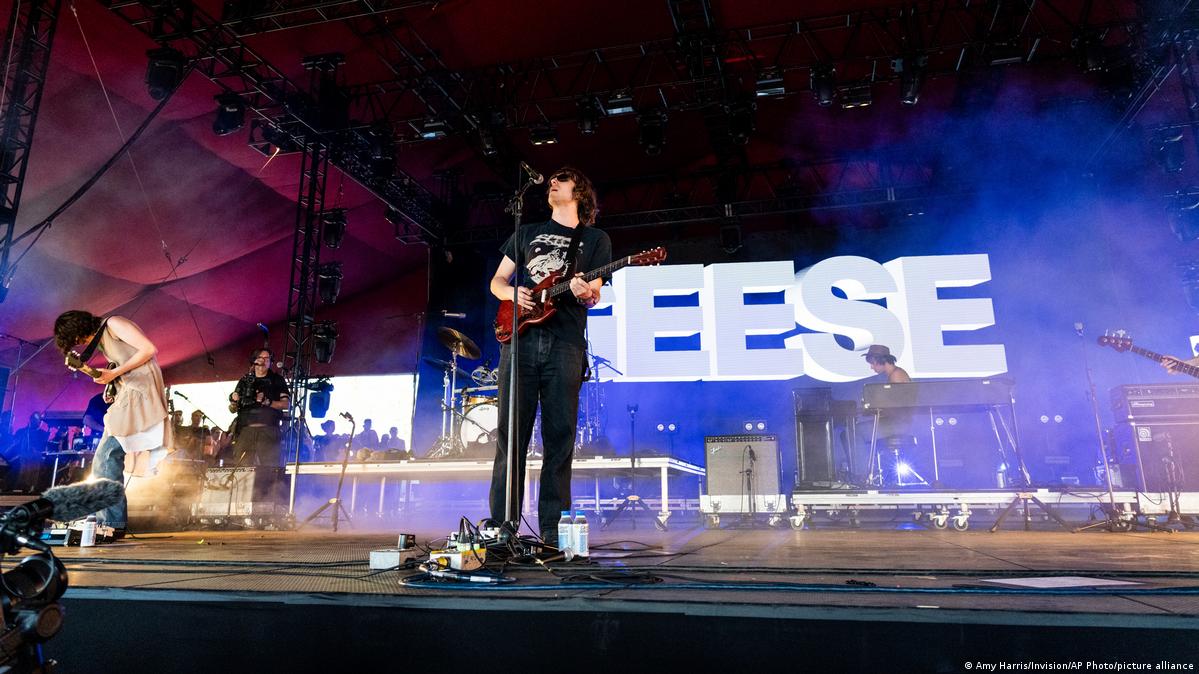
There's a special name for music that's not produced by the big labels and that can't be easily squeezed into a genre: "indie," short for independent. Indie bands have an image of being authentic and non-commercial. Fans presume their favorite bands achieved their success through their great music and hard work alone. That's why many were shocked to find out that the hype surrounding indie bands like Geese, as well as singer-songwriters like Sombr, Jane Remover and Mk.gee turned out to have been fabricated, at least in part, by social media manipulation.
A kick-start for bands
The uproar began with an interview in Billboard magazine with Andrew Spelman and Jesse Coren — heads of American marketing company Chaotic Good Projects, which represents Geese and Sombr.
In it, the two spoke openly about how they help artists' hits go viral. "A big part of what we're doing is posting enough volume across enough accounts with enough impressions to try to simulate the idea that the song is trending or moving," Spelman explains.
After that happens, the artists' own posts also see higher engagement.
The company uses an automated promotion system, which runs countless social media accounts across thousands of iPhones to make a song a hit. The duo sees this "trend simulation" as a sort of kick-start for their clients, whose songs probably wouldn't have grown famous otherwise.
If an artist then does actually get some attention and manages to score an appearance on a show like Saturday Night Live, for instance, the next phase of boosting the artist is initiated. "The second SNL drops at midnight you should post a hundred times saying that was the best performance of the year," Spelman continues. That then creates a positive impression in other, real users' perception. He goes on to emphasize, "I think controlling the narrative is really, really important."
'I'm calling it cheating'
But this doesn't stop with social media — streaming figures are also being manipulated on Spotify. On the podcast "The Manager's Playbook," US A&R and music manager Chris Anokute — who has worked with big-name stars like Rihanna, Katy Perry and Selena Gomez — provided a candid explanation. Music labels allegedly hire promotion companies to ensure a song gets tens of thousands of extra hits.
"Everybody in the record business (...) has seen their company cheat," says Anokute. "I can tell you I cheated. (...) They call it marketing, but (...) I'm calling it cheating. You're manipulating streams, you're manipulating charts, you're manipulating data, you're paying for play. (...) That's cheating."
70 years of manipulated charts
While the means of manipulation may be new, the principle itself is as old as the music business itself, as Anokute explains. Managers and record companies have always found ways to promote their artists in morally questionable, sometimes even illegal ways.
- The late 1950s: The "payola scandal" erupted in the US. To increase sales figures, radio DJs and heads of broadcasting received cash or gifts for giving certain songs higher rotation. That, in turn, artificially boosted the music's popularity. Since the radio broadcasters didn't declare the payments as advertising, audiences were deceived. The term "payola" is a portmanteau of the words "pay" and the gramophone model "Victrola." The practice was outlawed in the US in 1960 and declared a form of unfair competition.
- In the 1970s, record companies like Casablanca Records exerted enormous influence over the position of their albums and singles in the charts. Larry Harris, the label's vice president at the time, bribed the editor of Billboard magazine, who was responsible for the US charts, to push Casablanca's artists to the top. Since major department store chains would only stock records that were on the Billboard charts back then, the move had a great influence on record sales at the time. In his memoir, Harris explained that it was only through his efforts that four albums by rock band Kiss made it onto the Billboard charts simultaneously in 1977.
- In the 1990s, record companies sometimes manipulated sales figures by bribing store employees to scan CD barcodes multiple times outside of opening hours. Labels would also send out "street teams" to buy stacks of CDs.
- While it may not have been technically cheating, one surefire way to manipulate the European charts was to make an appearance on the extremely popular German TV show "Wetten, dass …?" Anyone who sang their new hit on the show could be almost certain to be in the top 10 on the German charts — the biggest market in continental Europe — by the following week . That was motivation enough for nearly all major American artists hop across the pond to appear — from Michael Jackson to Cher, Madonna, the Backstreet Boys, Justin Timberlake, REM and many more.
- In 2005, music industry giants Sony BMG and Warner Music Group paid $10 million and $5 million (€8.6 million and €4.3 million), respectively, to settle court cases over payola bribes to New York DJs.
- In a 2019, an anonymous hacker by the name "Kai" admitted to helping German rap stars conquer the charts in a YouTube documentary by "Y-Kollektiv" — a network of journalists for German public broadcasters. His method allegedly involved hacking the Spotify accounts of between 150,000 and 250,000 German users. He would log them in and have them "listen to the song non-stop." The longer they listened, the higher the number of hits, the better the chart ranking — and the more money for him. The label mentioned in the documentary, Groove Attack, has vehemently denied the allegations.
Chaotic Good Projects has now deleted all content about its work from its website. It seems it wasn't exactly good for business to talk about its methods so publicly.
This article was originally written in German.
Advertisement