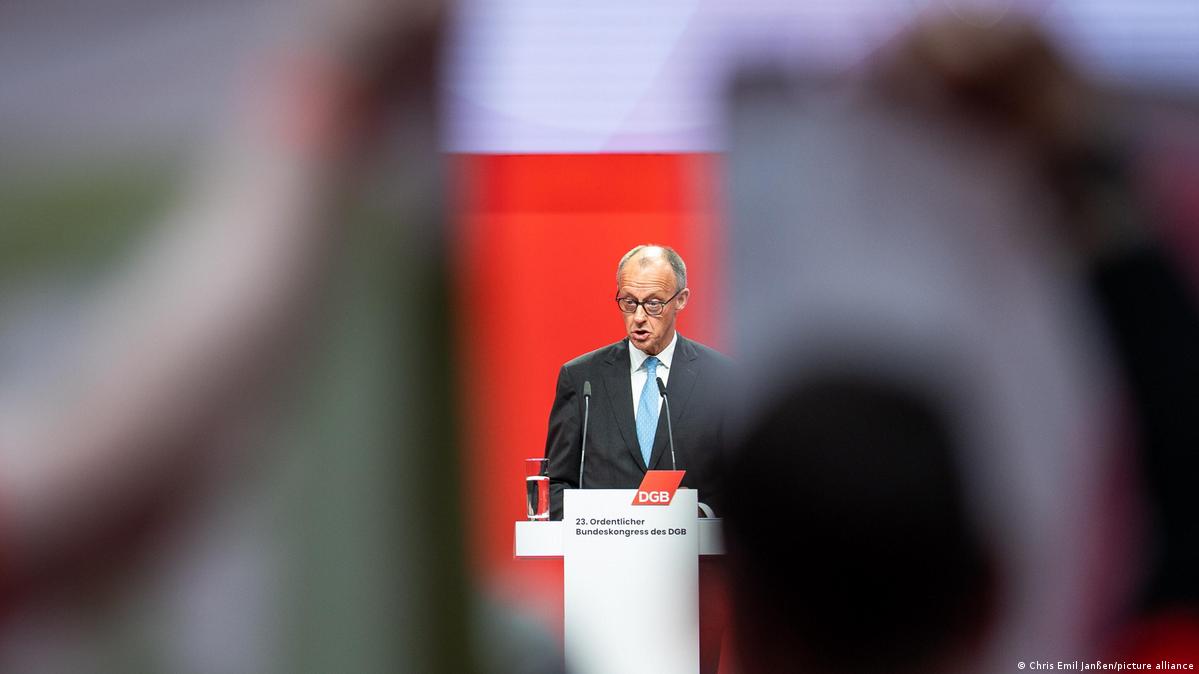
Germany news: Merz booed as he advocates economic reform
What you need to know
- Chancellor Friedrich Merz says Germany must do more to overcome years of economic stagnation
- Speaking to trade unionists amid boos, he cited global upheaval and deep structural problems
- The chancellor warned that Germany is losing more than 100,000 industrial jobs each year
- Germany’s inflation rate rose to 2.9% in April, as energy prices surged 10.1% year on year
Here are the latest developments from and about Germany on Tuesday, May 12, 2026.
Skip next section Lufthansa moves to take majority stake in ITA05/12/2026May 12, 2026Lufthansa moves to take majority stake in ITA
German airline Lufthansa is moving to take a majority stake in ITA Airways as early as this summer.
CEO Carsten Spohr told shareholders in Frankfurt the group would exercise its option after what he called the fastest operational airline integration in its history.
Lufthansa's stake will rise to 90%, up from the 41% it has held since January 2025. A deal with the Italian state sets out further steps toward a full takeover.
The second tranche will cost a fixed €325 million ($381 million), with completion subject to regulatory approval and expected in the first quarter of 2027. Lufthansa said it could acquire the remaining 10% from 2028.
As part of competition remedies, Lufthansa and ITA have already had to give up takeoff and landing slots in Milan and Rome.
Shareholders gathered in person in Frankfurt for the first time since 2019, with supervisory board elections also on the agenda. Candidates include Bayer CFO Wolfgang Nickl and former Eon chief Johannes Teyssen, who is set to become the new supervisory board chair, succeeding Karl-Ludwig Kley, pending a decision by the newly formed board.
Frankfurt Airport's Terminal 3 faces crucial stress test
To view this video please enable JavaScript, and consider upgrading to a web browser that supports HTML5 video
https://p.dw.com/p/5DddtSkip next section Many in Germany neglect retirement planning05/12/2026May 12, 2026Many in Germany neglect retirement planning
A large share of workers in Germany are still not actively planning for retirement.
A survey cited by Funke Media Group of newspapers says only about four in ten respondents were seriously engaging with the issue, according to the Association of German Banks.
That marks a slight increase from the previous year, though interest remains below pandemic levels. In 2020, 56% said they had seriously addressed retirement planning, before the figure fell back in subsequent years to just over one in three in 2024.
Financial circumstances play a key role, with people in weaker economic situations far less likely to focus on retirement planning. The banking association said this means those who would benefit most from structured planning are the least likely to do so.
Berlin under pressure to fix pensions, health care and taxes
To view this video please enable JavaScript, and consider upgrading to a web browser that supports HTML5 video
https://p.dw.com/p/5DdBDSkip next section Germany inflation rises to 2.9% in April05/12/2026May 12, 2026Germany inflation rises to 2.9% in April
Germany's inflation rate has climbed to 2.9% in April, driven by rising energy costs.
The Federal Statistical Office, Destatis, says prices increased from 2.7% in March and 1.9% in February, with consumer prices up 0.6% month on month.
Energy prices surged 10.1% year on year, with fuel costs jumping 26.2% and heating oil soaring 55.1%.
"Overall inflation increased for the second consecutive month as a result of another rise in energy prices that was due to the Iran war. Consumers are particularly feeling the persistent price pressure regarding motor fuels," said Destatis President Ruth Brand.
Food prices rose 1.2%, below the overall rate, with increases for sweets, fish and meat, while butter and cooking oils were significantly cheaper. Egg prices climbed 14.6%.
Core inflation, excluding food and energy, stood at 2.3%. Goods prices rose 2.9% overall, while services increased 2.8%, with notable gains in social services and transport.
https://p.dw.com/p/5DcvpSkip next section Merz faces union boos over reform push05/12/2026May 12, 2026Merz faces union boos over reform push
Michaela Kuefner BerlinThe chancellor took his reform message directly into the lion's den — the conference of the German Trade Union Confederation (DGB), writes DW’s Chief Political Editor Michaela Küffner.
And things unfolded exactly as expected: ranging from frosty to heated.
"Everyone will have to give something, and in return, we will gain a great deal"—this was a message no one here wanted to hear, let alone "share the burden" as the Chancellor had urged.
There were whistles, along with a few boos and shouts of "Tax the rich!"
Merz remained composed, explaining — amidst the occasional murmuring — why Germany's prosperity urgently requires greater economic growth in the near future — growth which, in his view, necessarily entails a degree of sacrifice.
Merz refused to be provoked. He vowed to continue seeking compromise — even in the face of resistance — in order to tackle healthcare, pension, and tax reforms designed to remain effective "for a decade."
DGB Chairwoman Yasmin Fahimi took the opportunity to remind the audience that the DGB had established its own pension commission after being denied access to the Federal Government's commission. It was a sore point.
The very evening before, at the unions' conference hotel, Social Democrat (SPD) Vice-Chairman Lars Klingbeil had already received a stern reminder that "the SPD emerged from the labor movement, not the other way around."
The pressure on the SPD — the chancellor's coalition partner — to offer a counterproposal to Merz’s reform plans is intense.
Whether this deeply ingrained and carefully nurtured class animosity remains mere political theater — or even derails this government's reform agenda entirely — will be judged not by the noise it generates, but ultimately by the concrete results it yields. Proposals regarding pension reform are expected before the summer recess.
https://p.dw.com/p/5Dd7fSkip next section Merz urges Germany to pull itself together05/12/2026May 12, 2026Merz urges Germany to pull itself together
Chancellor Friedrich Merz has told trade unionists that Germany must do more to overcome years of economic stagnation.
He told the German Trade Union Confederation in Berlin that pressure to act had not been this intense for decades, citing global upheaval and ingrained structural problems.
The chancellor said the pressure now had "likely not been as great for politics, society, and businesses for decades as it is at present." The world was realigning itself explosively and at breakneck speed, he said, adding: "Germany must therefore pull itself together."
Merz said Germany’s economy has been stagnating for at least seven years while other countries continue to grow. Growth, he said, is essential for jobs, tax revenues, a functioning welfare state, and stable pensions.
The chancellor warned that Germany is losing more than 100,000 industrial jobs each year and said the country cannot continue on its current path.
He pointed to rising energy, production and living costs linked to the Iran war, along with heavy bureaucracy weighing on businesses. But Merz said the challenges were also homegrown, adding that Germany had failed to modernize in areas such as demographics and digitalization.
Merz's first year marked by coalition tensions, AfD gains
To view this video please enable JavaScript, and consider upgrading to a web browser that supports HTML5 video
https://p.dw.com/p/5DctoSkip next section Welcome to our coverage05/12/2026May 12, 2026Welcome to our coverage
Richard Connor | Rana Taha EditorGuten Tag from the DW newsroom in Bonn.
You join us as Germany Chancellor Friedrich Merz says the country needs to get its act together after years of economic drift.
Merz told trade union leaders in Berlin that the pressure to act had not been this intense for decades, pointing to global shocks and long-standing structural issues at home.
Meanwhile, inflation in Europe's largest economy has risen once again.
Stick with us for these and other stories that Germany is talking about.
https://p.dw.com/p/5DctbShow more postsСхожі новини