Everest: Record 274 climbers summit from Nepal in single day
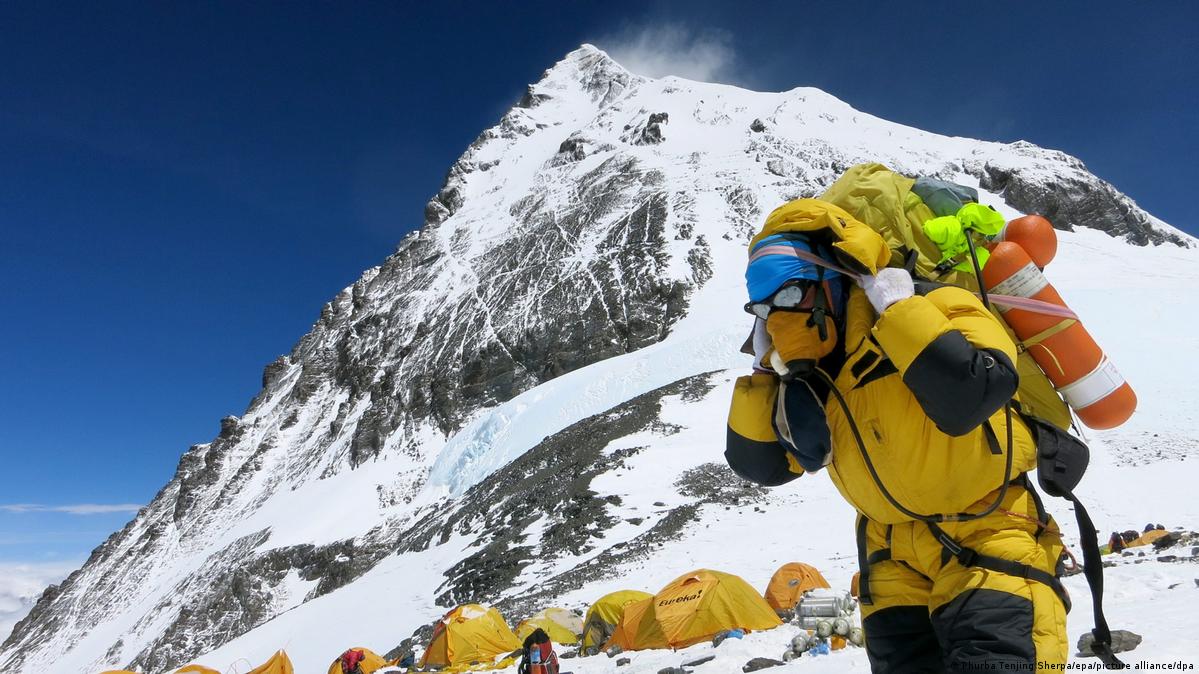
Over 270 climbers reached the summit of Mount Everest from Nepal on Wednesday, setting a new record for the number of people to climb to the top of the world's tallest mountain from the Nepali side in a single day.
Local officials said that 274 people scaled the 8,849-meter (29,032-foot) peak on the border between Nepal and China's Tibet region, smashing the previous record of 223, which was set on May 22, 2019.
The record for the highest number of summits in one day from both the Nepali and Chinese sides combined was set the day after, May 23, 2019, when a total of 354 climbers made it.
Chinese authorities have not issued any permits to climb Everest from the Tibetan side this year, so all ascents must currently begin in Nepal. Photos and videos showed hundreds of climbers queuing near the summit on Wednesday.
"It was a historic day," said Nepali Department of Tourism official Himal Gautam, adding that congestion was expected given the high number of climbers.
"At one point on Wednesday, there was a queue right from 'balcony' to the summit," he said, referring to the final section of the climb. "But the department has been doing everything for good management through better coordination."
Tibet: Rescued hiker recalls being stranded on Mount Everest
To view this video please enable JavaScript, and consider upgrading to a web browser that supports HTML5 video
Everest: Nepal issues record number of climbing permits
Nepal issued a record 494 climbing permits this season for 389 men and 105 women from 55 nations. With each permit costing $15,000 (about €12,950), the Everest climbing season has more than $7.4 million in revenue for one of the poorest countries in the world.
Mountaineering experts often criticize Nepal for allowing large numbers of climbers on the mountain, which sometimes leads to congestion and long queues in the so-called "death zone" below the summit, where the level of natural oxygen is below what is required for human survival.
Nepal has acknowledged the risks and hopes tighter controls and higher permit fees will discourage inexperienced climbers, but three deaths have already been reported so far this season, the start of which was delayed by a large ice block known as a "serac" blocking the notorious Khumbu Icefall.
Despite the danger and the expense, thousands of people have climbed Mount Everest since it was first scaled on May 29, 1953, by New Zealander Edmund Hillary and his local Sherpa guide Tenzing Norgay.
Earlier this week, veteran mountain guide Kami Rita Sherpa scaled the peak for the 32nd time, breaking his own record. His closest competitor, Pasang Dawa Sherpa, reached the peak for the 30th time this week.
Meanwhile, their colleague Lakpa Sherpa scaled Everest for the 11th time, topping her own record for the highest number of climbs by a woman.
Why are so many people dying on Everest?
To view this video please enable JavaScript, and consider upgrading to a web browser that supports HTML5 video
Everest: 'If teams carry enough oxygen it is not a big problem'
But for the foreign permit holders, scaling Everest is usually a once-in-a-lifetime achievement.
"We wait for climbers to return and give us photographs and other evidence to prove their ascents and then provide them with climbing certificates," Department of Tourism official Gautam told the Reuters news agency. "Only then can we confirm the numbers.”
Expedition organizer Lukas Furtenbach of the Austria-based Furtenbach Adventures said large numbers of people on Everest were not a problem as long as expeditions are sufficiently stocked and managed.
"If teams carry enough oxygen it is not a big problem," claimed Furtenbach, who has 40 paying climbers currently waiting at different camps for their chance to move up.
"We have mountains in the Alps like the Zugspitze where we have 4,000 people on top per day. So 274 is actually not a big number, considering this mountain is 10 times bigger," he added.
The Zugspitze isGermany's highest mountain and at 2,962 meters high is a third of the height of Everest, not to mention far below the zone where additional oxygen tanks are needed to summit the peak.
Why it’s colder on a mountain, though it's closer to the Sun
To view this video please enable JavaScript, and consider upgrading to a web browser that supports HTML5 video
Edited by: Sean Sinico
AdvertisementСхожі новини

Політики радше куплять телеграм-канал, ніж вкладатимуться в медіа, — Віта Думанська
DW Exclusive: Germany’s far-right AfD vows to 'make history'

«Львівелектротранс» платитиме стипендію майбутнім водіям під час навчання