DW Exclusive: Germany’s far-right AfD vows to 'make history'
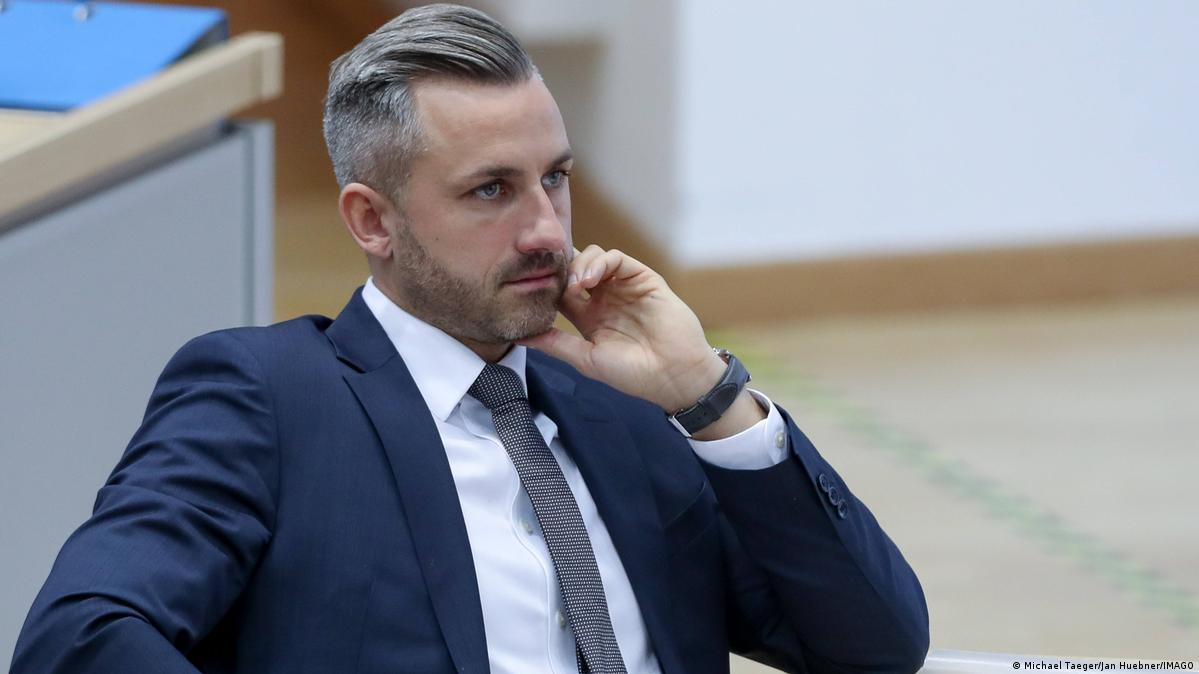
Ulrich Siegmund, the far-right Alternative for Germany party's lead candidate in upcoming regional elections in Saxony-Anhalt, has told DW he wants to create a "domino effect" with a "historic" victory.
According to the polls, the AfD is on course to win elections in the state in September, and could even govern alone.
"There's a real sense of optimism here in Saxony-Anhalt. It's a wonderful feeling. We want nothing more and nothing less than to make history. We're making the first AfD-led government in all of Germany a reality here in Saxony-Anhalt," 35-year-old Siegmund told DW in an interview at the state parliament in Magdeburg.
How much of a neo-Nazi party is the German AfD?
To view this video please enable JavaScript, and consider upgrading to a web browser that supports HTML5 video
'Extremist' label
Siegmund's branch of the AfD is one of the more controversial in Germany.
The Office for the Protection of the Constitution, the state's domestic intelligence service, labels the AfD's regional chapter as "right-wing extremist". They argue that the party pushes a concept of citizenship based on race, which contradicts the German constitution, the Basic Law.
Siegmund dismisses the intelligence agency's classification as politically motivated.
Yet political opponents and police chiefs warn that an AfD government would present risks to national security, including the sharing of classified information.
The AfD, Siegmund insists, is "committed to the rule of law."
But many political scientists are skeptical: "I assume that an AfD in government would further establish and professionalize its radicalism," Matthias Quent, from the Institute for Democratic Culture at Magdeburg-Stendal University, told DW. "Especially in Saxony-Anhalt, which has one of the most far-right state branches. There are no forces there that would want a different course."
No 'ideological vetting'?
Behind-the-scenes preparations are underway to start scouting potential candidates to fill key roles in a new administration
Siegmund said recruitment would follow the civil service rules and said he would not carry out "ideological vetting" of candidates with connections to the white supremacist Identitarian Movement.
"For me, the focus is on the individual, and we take a close look at them. If they meet the criteria for the position in question, I will not subject them to ideological vetting, but will instead respect them, their qualifications, and the applicable legal framework," he said.
AfD mayoral win offers glimpse of party's local strategy
To view this video please enable JavaScript, and consider upgrading to a web browser that supports HTML5 video
If the far-right AfD were to take power in Saxony-Anhalt following the September elections, Siegmund estimates that up to 200 positions would need to be filled across ministries and state agencies.
Asked whether he would adhere to the AfD's own rules — which bar party members from joining certain organizations, including extremist groups — Siegmund drew a distinction between party membership and state appointments.
He said, "You're talking about a political party. We're talking about a state government. There are no political guidelines when appointing, for example, a department head — there is a legal framework, and of course, we always adhere to that. What you mean is political cooperation or party membership."
Sociologist Matthias Quent, however, expects that, if the AfD comes into government, it would try to install its extremist supporters into the civil service.
Security services overhaul
Siegmund, a former salesman, whose TikTok account is among the most popular political accounts in the country, also outlined his intention to address law enforcement agencies.
"Actually, we want to steer the apparatus back onto the path to success, depoliticize it, and make it neutral again — and, above all, serve the interests of the country."
Georg Maier, the Interior Minister in neighboring Thuringia, has called for the implications of an AfD takeover of power to be on the agenda at the next meeting of state interior ministers in June.
Maier told DW: "We're seeing that the AfD's strategy is to undermine our liberal democracy from within and destroy it piece by piece."
'Remigration plans'
The AfD has promised to get tough on rejected asylum seekers or migrants whose visas have expired. In contrast to current legislation, the AfD wants all people awaiting deportation to be detained.
"Under our government, individuals required to leave the country must, of course, be placed in detention pending deportation," Siegmund said.
He wants to set up a deportation task force to enforce those new rules. According to Saxony-Anhalt's Interior Ministry's figures, there are just under 5000 people in the state who are required to leave the country.
Could 'remigration' blow up the AfD's plan for power?
To view this video please enable JavaScript, and consider upgrading to a web browser that supports HTML5 video
Education overhaul
Siegmund wants root and branch changes to the education system, from the reintroduction of home schooling to separate classes for refugee children. In Germany, education is a matter for the federal states.
"We are going to de-ideologize the curricula. That means everything that has been ideologically introduced here in recent years will be removed."
The AfD has campaigned heavily on removing diversity education, LGBTQ+ awareness and anti-racism seminars from public education.
Russia reset
Although foreign policy is the responsibility of the federal government, Siegmund has called for an end to sanctions on Russia. If elected, he's pledged to bring back Russian language courses and wants Russian students to return to the state as part of school exchange programs. The small state of Saxony-Anhalt was part of East Germany, the GDR, which had close ties to the Soviet Union.
"Why should we now simply steer culture in a different direction just because that's the zeitgeist? We don't think that's a good idea. We want culture to remain separate from this trend," Siegmund argued.
Why is the far-right AfD so powerful in eastern Germany?
To view this video please enable JavaScript, and consider upgrading to a web browser that supports HTML5 video
Saxony-Anhalt AfD rocked by scandals
At the start of the year, Siegmund came under pressure over allegations of nepotism. Numerous AfD lawmakers in the state parliament were revealed to have secured well-paid jobs for the family members of their colleagues.
Siegmund himself also made the headlines for attending a networking event for far-right figures in 2023. Media reports on this meeting subsequently sparked the largest civil society protests in the history of the Federal Republic.
At that so-called "Potsdam Meeting," Austrian ethnonationalist Martin Sellner presented his master plan for "remigration."This plan involves the deportation of asylum seekers, foreigners with the right to remain, and "non-assimilated citizens."
Domino effect?
Despite the scandals, the AfD's support in opinion polls has continued to grow. If the regional surveys in Saxony-Anhalt are correct, September's election could end more than two decades of conservative rule and mark a breakthrough for the AfD, which was founded as an anti-Euro party in 2013, and embraced the issue of anti-immigration in 2015.
Despite the pressure to deliver results, Siegmund believes an AfD victory would be a springboard for others in the AfD.
"It would send the signal that a political shift is finally taking place, that we are once again pursuing policies tailored to our own state. And that would, of course, have a domino effect," Siegmund said.
The election in Saxony-Anhalt is scheduled for September 6; just under 1.8 million people are eligible to vote in the state, which has seen its population shrink and age faster than other regions.
Edited by Rina Goldenberg
AdvertisementСхожі новини
Політики радше куплять телеграм-канал, ніж вкладатимуться в медіа, — Віта Думанська
Everest: Record 274 climbers summit from Nepal in single day

«Львівелектротранс» платитиме стипендію майбутнім водіям під час навчання