Dan Storyev: It's Not Too Late to Cure the Madness of Putin’s Victory Day
 By Dan Storyev
May 9, 2026
By Dan Storyev
May 9, 2026

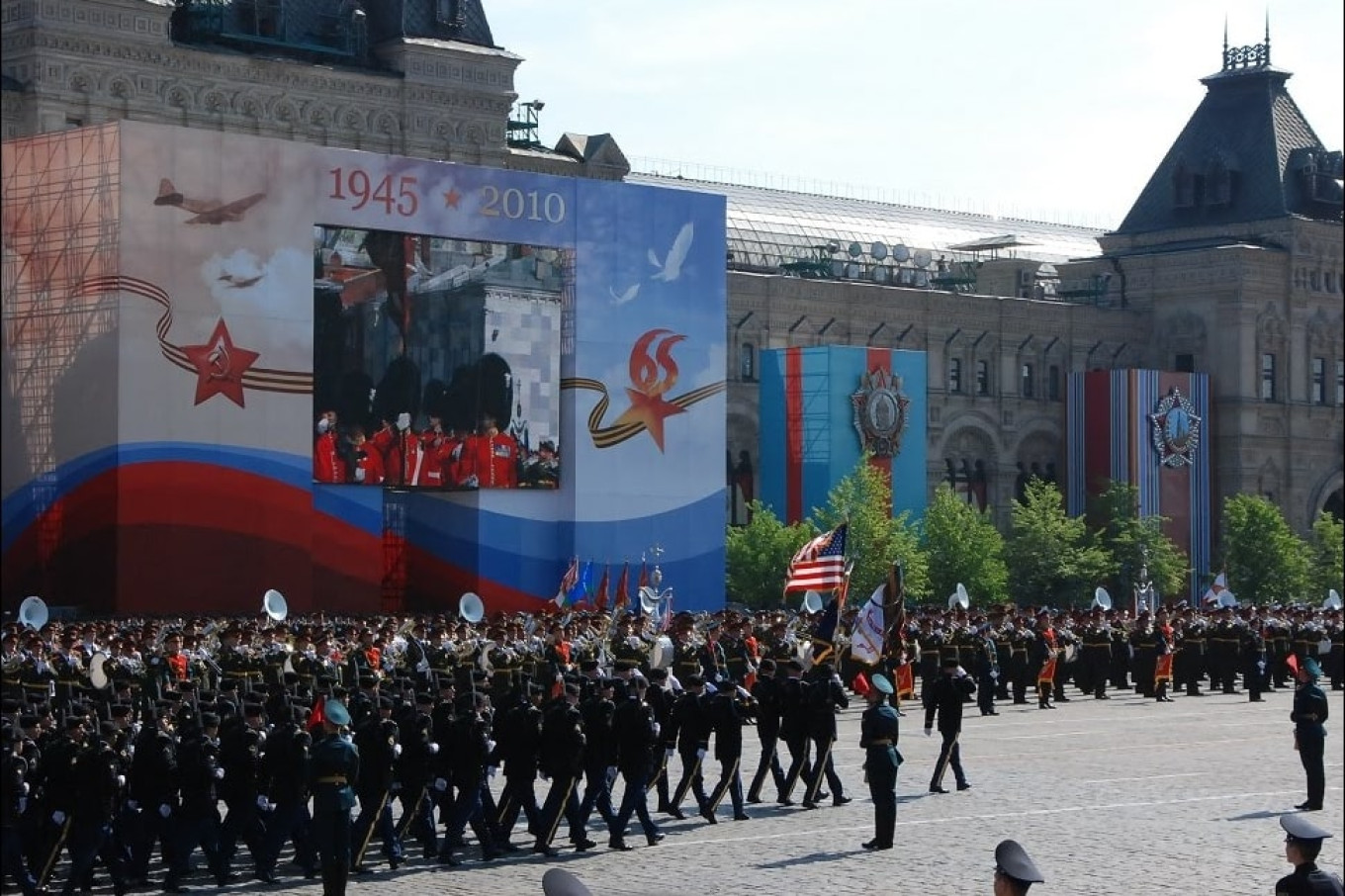
American soldiers march through Red Square. The U.S. never had much of a parade tradition, so it’s more of a stroll. British troops fare much better, bearskin hats over their eyes and brass buttons flaring in the sun. The announcer's ecstatic voice booms over the square as it introduces a special guest: green and white-clad Turkmen Pygy Bayramdurdiyev riding a pale horse, “a direct descendant of the steed Marshal Zhukov rode at the 1945 Victory Parade!”
This is no fever dream. This is Russia’s Victory Parade on May 9, 2010.
As a kid, I looked forward to May 9 whenever I was in Russia. School would be out and all TV channels were filled with the aforementioned parade bonanza and feel-good shoot-‘em-ups where dashing Soviet soldiers quipped their way through World War II. Moscow turned into a kind of a festival of missile-shaped balloons, fireworks and street musicians playing martial music. Families would flaneur in Gorky Park: dad wearing a Zhukov tee, mom sporting tank-shaped slippers, children dressed in miniature uniforms emblazoned with red stars.

As a teenage boy, I equally enjoyed the airshow, parades and fireworks of July 4 in Washington. I just wished it had more tanks. It was also missing another, more paradoxical, ritual. What makes a great celebration — May 9 is not a memorial day but a celebration, a kind of a militaristic Purim — is that the fun and frippery must be based around something meaningful: life, death, rebirth.
In Russia of the aughts, the bones of Victory Day were still visible under the layers of jingoistic fat. Those were the dessicated old men and women, some wearing click-clacking rows of medals on their chests, burning with hammers, sickles and red stars. I remember how we, children, handed carnations to the vets, which they would accept with trembling hands, smiling the blinding smiles of steel dentures. Those of us with veterans in the family would take them out and listen to their stories if they wanted to talk.
This paradox of light-hearted militarism, brass orchestras and playgrounds being interjected by shambling figures of veterans was exactly what made May 9 meaningful. It felt like a celebration of life because interacting with the veteran elders was like having a brief encounter with death. Their stories of endless pain, toil and loss weaved into the military bonanza and counteracted it, making the Ninth “a celebration with tears,” to quote one Soviet song. The tanks, the orchestras and even slogans like “onwards, to Berlin!” seemed not like a declaration of war on the West, but as a fun carnival, earned by the sacrifice of millions of our grandparents.
But as the veterans started dying out, the mood changed. The annual Victory Day tradition began in Brezhnev’s era, partially as a search for some kind of a national identity that could bind together the hundreds of millions of Soviet people of myriad nationalities. A war that was still a living memory that elevated ordinary Soviets into the ranks of legendary heroes fighting the infernal evil of Nazism; a war that killed millions; a war to which nearly every citizen of the U.S.S.R. had an intimate connection — why, it was the perfect material for a national myth.
Putin’s Kremlin was enthused to carry on the tradition. After all, the question of forging a single cohesive identity out of a multiethnic and multilingual post-imperial state remains as pressing in Russia as it was in the U.S.S.R. Moreso, in fact, as Russia can’t even fall back on a single mobilizing ideology. Victory Day and the New Year are perhaps the only major celebrations that can be said to be unifying for all of Russia.
The Kremlin’s contemporary strategy is that of a parasite. It takes over national trends and funnels them to its own needs, faltering along the way but nevertheless succeeding. Just look at the Russian IT industry, which produced some of the boldest coders and freshest online projects in the early days of the World Wide Web. Over the years, the Russian tech sector was ransacked by the security services, leading to the exodus of talented specialists — but also to some of these specialists choosing to willingly build the digital Gulag of the surveillance state.
Something very similar happened to the Ninth. As the veterans died, the celebrations took on an ever more threatening mood, matched by the rhetoric on TV. “Never again” became “We can do it again” — by which the talking heads meant the Red Army’s liberation-conquest of Europe. They never elaborated on why anyone should do it again in the first place, seeing how the first time resulted in millions of dead.
There were grassroots attempts to save the spirit of Victory Day. Chief among them was the Immortal Regiment, an initiative by a group of journalists from the Siberian town of Tomsk that started in 2011. Its goal was simple: to honor Soviet war dead by walking the streets with their portraits. A kind of ancestor worship, which given the rapidly declining number of living veterans seemed like the next best thing.
"It was an honest and very human patriotism," the movement’s co-founder Sergei Lapenkov recalled to Meduza in 2015. "It was as if everyone was there with their family." Lapenkov wanted to keep the movement grassroots: “We did not want Regiment concertos or Regiment-branded mineral water.”
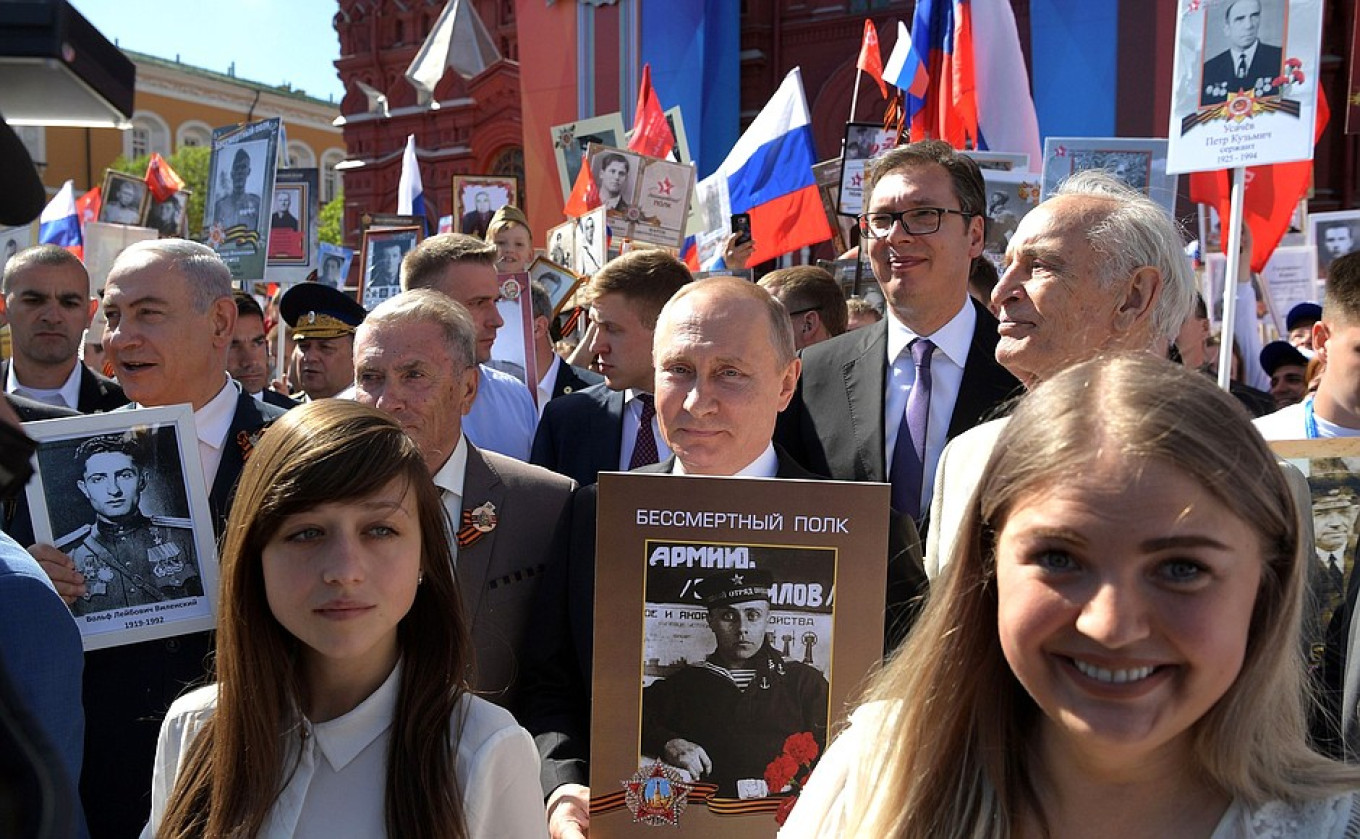
The Kremlin, however, was quick to co-opt the emerged tradition. By 2015 the Regiment was beaten by officials and absorbed into the Kremlin’s narrative in what Tomsk journalists called “a soft capture.” The initiative went global in the ensuing years, bolstered by Russian embassies all over the world. World leaders like Serbia’s Vučić and Israel’s Netanyahu took part in the Regiment’s marches.
By 2026, the Ninth has been so thoroughly taken over by the Kremlin that it is hard to find anything genuine in its symbols. The St. George’s Ribbon was initially a Russia Today astroturf. The Immortal Regiment now organizes underwater group swims with the portraits of Soviet soldiers. And of course, the war in Ukraine ensured that any Victory Day memorabilia is now figuratively stained with blood. St. George’s Ribbons are routinely worn by Russian soldiers, and the comparison between them and the Red Army of the 1940s are made by both sides.
But does that now mean that May 9 is forever tainted by Putin’s rot? Should anyone who is flying a Soviet flag or watching a Soviet war movie this week be denounced as a pro-Russian fascist?
I don’t think so. Because when all is said and done, this day is still about a memory of a real, tangible and traumatic event. A memory that millions of people are partial to.
What is needed is a transformation of how people honor this memory. Russians in Russia or abroad won’t beat Putinist hostile takeover by forgetting Victory Day altogether — that is why European initiatives to ban it are unlikely to work but to provoke a reaction out of spite.
We do have a chance, though, if we change how we remember World War II, if we put it in context of the Ukraine war today and in context of Putin’s imperial ambitions elsewhere.
It can still be a bizarre carnival — but a carnival whose main message is “never again,” just as our grandparents would have wanted.
The views expressed in opinion pieces do not necessarily reflect the position of The Moscow Times.Dan Storyev
 Dan Storyev is a Russian and American writer and researcher. Interested in violence and ideology, Dan got his education through covering global upheavals on the ground and completing an MPhil at the University of Oxford. He is the co-author of How to Survive Authoritarianism: A Russian’s Phrasebook for Everyday Life in America (out: Sept. 29, 2026).
@storyevtime
Dan Storyev is a Russian and American writer and researcher. Interested in violence and ideology, Dan got his education through covering global upheavals on the ground and completing an MPhil at the University of Oxford. He is the co-author of How to Survive Authoritarianism: A Russian’s Phrasebook for Everyday Life in America (out: Sept. 29, 2026).
@storyevtime
Dan Storyev
Dan Storyev is a Russian and American writer and researcher. Interested in violence and ideology, Dan got his education through covering global upheavals on the ground and completing an MPhil at the University of Oxford. He is the co-author of How to Survive Authoritarianism: A Russian’s Phrasebook for Everyday Life in America (out: Sept. 29, 2026). @storyevtime Read more about: Victory Day , Soviet Union , WWIISign up for our free weekly newsletter
Our weekly newsletter contains a hand-picked selection of news, features, analysis and more from The Moscow Times. You will receive it in your mailbox every Friday. Never miss the latest news from Russia. Preview Subscribe Subscribers agree to the Privacy Policy We sent a confirmation to your email. Please confirm your subscription.A Message from The Moscow Times:
Dear readers,
We are facing unprecedented challenges. Russia's Prosecutor General's Office has designated The Moscow Times as an "undesirable" organization, criminalizing our work and putting our staff at risk of prosecution. This follows our earlier unjust labeling as a "foreign agent."
These actions are direct attempts to silence independent journalism in Russia. The authorities claim our work "discredits the decisions of the Russian leadership." We see things differently: we strive to provide accurate, unbiased reporting on Russia.
We, the journalists of The Moscow Times, refuse to be silenced. But to continue our work, we need your help.
Your support, no matter how small, makes a world of difference. If you can, please support us monthly starting from just $2. It's quick to set up, and every contribution makes a significant impact.
By supporting The Moscow Times, you're defending open, independent journalism in the face of repression. Thank you for standing with us.
Once Monthly Annual Continue Not ready to support today?
 Remind me later. ×
Remind me next month
Схожі новини

Від керування інформацією до архітектора довіри: як змінилась роль керівника IT — колонка
У Москві завершився так званий парад перемоги, він тривав 45 хвилин
США вдарили санкціями по супутникових компаніях Китаю через допомогу Ірану