‘You can’t control everything’: the rise in plastic surgeons asked to create ‘AI face’
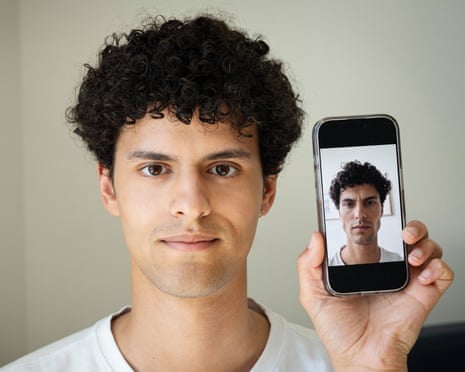
Growing numbers of people are seeking improbable cosmetic surgery based on chatbots’ recommendations
Plastic surgeons are increasingly concerned about the rise of “AI face”, as more and more clients arrive in their offices with unrealistic AI-generated visions of what they want to look like.
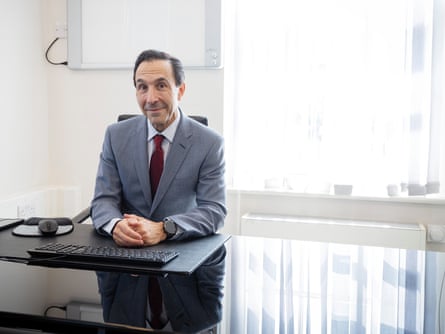
Dr Nora Nugent, a cosmetic surgeon from Tunbridge Wells, has seen this first hand. Clients have started coming to her office with photos of themselves beautified by AI and a false expectation that those results are achievable with surgery. She is also the president of the British Association of Aesthetic Plastic Surgeons, and says many colleagues are having similar experiences.
“I can only predict an increase, given the rate AI has been incorporated into every aspect of life,” she said.
People using AI chatbots to generate their ideal faces are increasingly arriving at surgeons’ offices with briefs demanding flawless skin, sharply sculpted cheekbones, refined noses and near-perfect symmetry – standards that are too time consuming, prohibitively expensive and, in many cases, physically unattainable.
While AI can control every single pixel, “surgery certainly doesn’t work on that microscopic detailed level”, according Dr Alex Karidis, a surgeon based in west London.
For many clients, however, those expectations are shaped long before they ever meet a surgeon. Karidis and Nugent describe how psychologically effective AI-generated images can be in defining – and reinforcing – clients’ aesthetic ideals.
Nugent said: “Once you see an image, it’s wired into you.”Karidis agreed, describing AI images as being “seared” into patients’ minds, and said colleagues had recently been inundated with them.
Surgeons are also keen to emphasise that cosmetic surgery outcomes are far from guaranteed.
“The patient has to understand that there is human variation in how they heal, how they age and what can be done” said Nugent. “I say to patients beforehand: it’s not limitless what I can do in surgery. Neither of us control everything.”
To better understand the phenomenon, I asked an AI agent to recommend cosmetic procedures and generate images for Karidis to review. As I requested increasingly dramatic alterations to my appearance, the agent eventually began warning me about the feasibility of the operations I was proposing.
But Karidis says that when clients do their deep-dive research into cosmetic procedures, they often fixate on the images and ignore “all the noise” around them.
“That’s the bottom line for everybody. The moment you show them something like that, that’s it,” he said.
Surgeons have also noticed consistencies in the aesthetics of “AI face”, particularly hyper-symmetry – something AI can generate effortlessly but which is often impossible to recreate in real life.
If one of your eyes is a few millimetres higher than the other, AI can alter that in seconds, according to Dr Julian de Silva, a Harley Street cosmetic surgeon. But rearranging pixels is not the same as rearranging anatomy.
“It’s impossible to change [eye level] because that’s actually set in bone, and your brain sits behind the orbits. You cannot safely change the position of the orbits,” he said.
De Silva added that when AI edits a client’s photo, it frequently defaults to widely accepted beauty ideals: for women, a V-shaped jawline, a sweeping “ogee curve” along the cheekbones and a heart-shaped face; for men, broader jawlines, lower eyebrows and fuller upper eyelids.
But De Silva is also concerned about another growing trend: clinicians sharing surgery results on social media that appear astonishingly effective, but which he suspects may themselves be AI-generated.
“I remember looking at one of these last week and I looked at it over and over,” he said, recalling a video in which a patient appeared to have been made to look 30 years younger. “And then the third time I watched it, I could see … the hands had six fingers.”
My trip to the surgeon
Having generated some beautified versions of myself, I asked Karidis to share his thoughts on AI’s recommendations.
I told the chatbot I was considering cosmetic surgery and asked for “some enhancements” to my photo. I also asked it to explain the virtual surgeries it had performed. It gave me a rhinoplasty and septoplasty, “refining the nasal tip and straightening the bridge”. It also applied “a subtle blepharoplasty [eyelid lift] and brow refinement”.
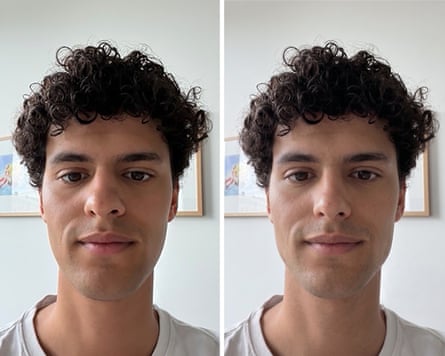
Karidis said the rhinoplasty was relatively modest and the blepharoplasty barely noticeable, but estimated the work would still cost about £25,000.
I then asked my virtual assistant to give me “hunter eyes and a more masculine face”. It recommended chin implants, buccal fat removal, infraorbital augmentation, another blepharoplasty, facial stubble grafts and a handful of other procedures.
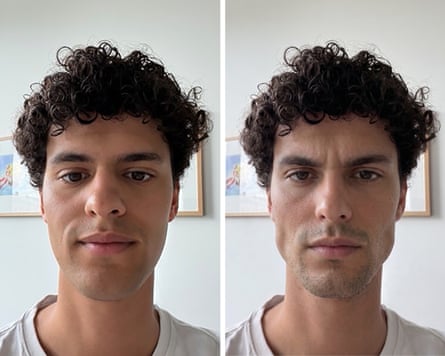
“This is where things start to get a bit silly,” Karidis said. “It looks like its given you someone else’s eyes.” He says the chin implant is unnecessary, and that I would “pay the price” for the buccal fat removal later on in life as my face naturally became more gaunt with age.
“If one were to theoretically do everything it suggests, it would easily be £100,000-plus and still probably wouldn’t look anything like this, not to mention you’d be exposed to potential significant side-effects and recovery.”
“Make me look like more of a chad,” I then instructed the chatbot. It responded with further recommendations, including a neck lift, brow lift, two types of custom implant and full ablative laser resurfacing to create “perfectly even, fresh skin”.
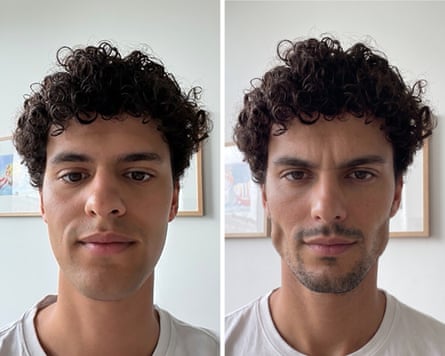
“This is where things start to look scary,” Karidis said. “What’s with the whopping great big dents along your jawline angle? It looks like chunks of tissue have been removed.
“As to neck lift and brow lift, that’s frankly untrue. I don’t see any evidence of any lifting in these areas. Tissues like the eyebrows seem to have been lowered rather than lifted. Your original complexion looks much better than this.”
Explore more on these topicsShareReuse this contentСхожі новини
Delhi govt trials new air-cleaning technologies to tackle pollution

DO NOT INVITE: Why Donald Trump offboarded Tulsi Gabbard
Flotilla activists arriving in Spain violently beaten by airport police
