Xi Jinping prepares to welcome Vladimir Putin to China, four days after hosting Donald Trump
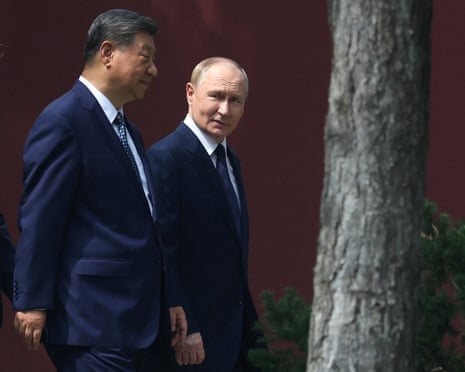
China’s deep relationship with Russia remains a continuing cause for concern in the west, particularly since Moscow launched its invasion of Ukraine
Xi Jinping and Vladimir Putin exchanged “congratulatory letters” on Sunday ahead of the Russian president’s visit to Beijing this week, four days since Donald Trump left China after a high-stakes summit.
Xi, China’s leader, said bilateral cooperation between Russia and China had “continuously deepened and solidified”, with this year marking the 30th anniversary of the two countries’ strategic partnership, according to Chinese state media.
Putin’s visit to Beijing is scheduled on Tuesday and Wednesday.
An article published in state media tabloid the Global Times on Monday said the visits of the US and Russian presidents showed Beijing was “fast emerging as the focal point of global diplomacy”.
“The tightly sequenced visits have sparked widespread attention, with analysts noting that it is extremely rare in the post-cold war era for a country to host the leaders of the US and Russia back-to-back within a week,” the Global Times said.
China’s deepened relationship with Russia has been a cause for concern in the west, particularly since Moscow launched a full-scale invasion of Ukraine in 2022. China’s economic and diplomatic support for Russia since then has helped to sustain the conflict, according to western diplomats and analysts.
The two men have met on more than 40 occasions, far outstripping Xi’s encounters with western leaders.
China and Russia’s bilateral trade has soared to record levels since 2022, with China purchasing more than one-quarter of Russia’s exports. China’s large purchases of Russian crude oil have supplied Moscow with hundreds of billions of dollars of revenue for the war in Ukraine.
Beijing has bought more than $367bn of Russian fossil fuels since the start of the full-scale invasion, according to data collected by the Centre for Research on Energy and Clean Air.
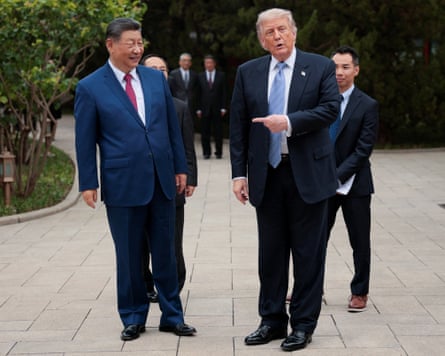
The purchases have supported China’s energy security, which has become especially important since the crisis in the Middle East stopped the shipping of oil through the strait of Hormuz.
Neither the war in Ukraine, nor the Sino-Russian relationship, appeared to feature heavily in Trump’s talks with Xi last week. The Chinese statement about the main bilateral meeting made a brief reference to “the Ukraine crisis” while the US statement did not mention it at all.
Instead, the US-China talks appeared to focus on trade, Taiwan, and the war in the Middle East, with Trump saying China agreed with him on the importance of reopening the strait of Hormuz.
Xi also pressed Trump on Taiwan, warning him of the potential for conflict if the issue was not handled properly. Trump left Beijing saying that he had not decided whether to approve a multi-billion dollar deal of US weapons to Taiwan. Halting the sale would be a major win for Beijing, which seeks to take control of the self-governing island, something the majority of Taiwanese oppose.
Joseph Webster, a senior fellow at the Atlantic Council, said in a newsletter that “Taiwan may be the subtext of the Xi-Putin meeting”. Webster said Beijing may be looking to sign more fossil fuel deals with Moscow to ensure its supplies of energy in the event of a future conflict. Expanding Russian oil pipeline capacity to China “would significantly enhance Beijing’s oil security in a Taiwan contingency”, Webster wrote.
Russia has been pushing China to move forward with the “Power of Siberia 2” gas pipeline that would add 50bn cubic metres of capacity to the existing network between the two countries.
Additional research by Yu-chen Li
Explore more on these topicsShareReuse this content