Why your recycled clothes could end up in this South American desert

 AFP via Getty Images
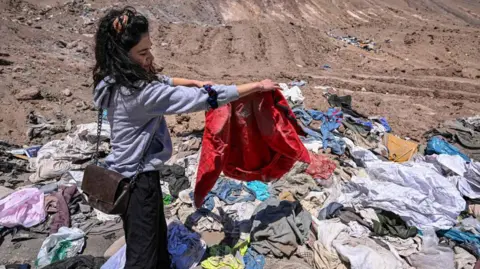
If you have ever taken old clothes to a recycling bank, be it in the UK or North America, there is a real chance that the garments ended up illegally dumped in a desert in northern Chile.
The South American country is one of the world's biggest importers of used clothing, but items that fail to be resold have for years been simply discarded in big piles out in the barren, bone-dry countryside. In response to a law change, one Chilean company is now moving to tackle the problem.
Chile imports 123,000 tonnes of used clothes every year, according to government estimates. The big driver of this is the free-trade port of Iquique in the north of the country.
Businesses in the city and surrounding towns can import, store and sell goods without having to pay customs duties or VAT.
Known as Zofri, which stands for Zona Franca del Iquique (Iquique Free Trade Zone), it was created in 1975 to boost economic and social development in northern Chile.
Used clothes became one of the biggest imports. They continue to arrive from the US, Canada, Europe and Asia, baled up in shipping containers. The clothing is either sold locally, or exported to other countries in Latin America.
BBC World Service: Fixing Chile's fashion graveyard
Felipe González, the general manager of Zofri, says the 50 or so clothing import firms help the local economy. "It's a sector that gives the most work to local women in the region," he says. "Around 10% work with textiles.
"The women help to put the clothes in different categories according to their quality. It's not highly-skilled labour, which makes it accessible for people without lots of qualifications."
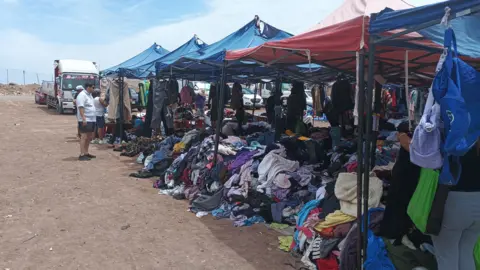
The worst quality clothes end up at La Quebradilla, a huge open air market near the town of Alto Hospicio, around half an hour uphill from Iquique, and still within Zofri.
There are rows upon rows of tents with piles of clothes laid out on plastic sheets.
Stall-holders sell everything from T-shirts, to jeans and dresses. The prices are cheap, starting from 500 Chilean pesos (54 cents; 42 pence). Tourists and locals flock here, especially at the weekend to find a bargain.
Although the clothes create jobs for the local economy, the big issue is what happens to the stock that doesn't sell. It cannot go to the local council's landfill, because that can only be used for household waste, not commercial imports.
So what the traders should be doing is either exporting the clothing, or paying tax to sell it in Chile beyond the free-trade zone, or sending it to an authorised waste company.
As all those options cost money, what unscrupulous traders actually do is either illegally burn the clothes, or illegally dump them out in the surrounding Atacama Desert. Some 39,000 tonnes are illegally dumped every year, according to the biggest estimates.
It's a headache for Alto Hospicio's local authority. Miguel Painenahuel, who works in the town's planning department, says it is difficult to monitor and stop the dumping.
"Alto Hospicio is surrounded by the desert and hills which are easy to access with a lorry or truck to ditch the clothes. The town council has patrols with cars and cameras so that it can keep tabs on what's going on and fine the culprits."
But he admits: "There are so many trucks dumping clothes it's really hard to keep on top of it! We don't have the resources."
Elsewhere, a solution has emerged to turn the waste clothing into a business opportunity.
Back in Iquique, Luis Martínez is the executive director of the Centro Tecnológico de Economía Circular (CircularTec).
It is a private Chilean organisation focused on promoting reuse of resources rather than them being thrown away. Martínez recently led a project looking at how best to refashion and reuse unsold old clothing.
"We don't want the Atacama Desert to be famous as a tourist attraction where visitors can see mountains of clothes," he says.
Martínez highlights a factory being built to find new uses for unwanted clothing. "It's run by a private company and according to our projections it will be able to deal with a big part of the unwanted stock," he says.
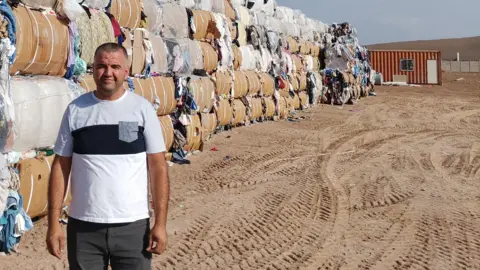
Out in the hot, windy desert around 20 minutes' drive from Alto Hospicio the facility in question is being constructed by businessman Bekir Conkur.
Originally from Turkey, but working in Chile for more than 15 years, he is one of the largest importers of textiles in the region. His company brings in around 50 containers of clothes every month.
He says he wants there to be a solution the problem of dumped clothing, "and I think this factory is going to help that".
He describes what the site will be capable of when it's up and running in a few months' time. "The factory we are building won't need water or chemicals.
"We are going to use machines that will turn the clothes into fibres, and then into felt, which will be used in things like mattresses, furniture, the inside of cars and for insulation.
"We think we will have the capacity to process 20 tonnes a day."
He admits one of the reasons he is doing it is to comply with a law change that's in progress.
Last July, textiles were added to existing Chilean legislation called the Extended Producer Responsibility (Rep) Law. This makes companies that sell physical products responsible for what happens to them at the end of their life.
For clothing firms, it means fashion brands, retailers, and importers will eventually have to finance and organize the collection, reuse, recycling, or proper disposal of textiles, instead of that cost falling on local councils or the Ministry of the Environment.
The government is currently working to draft the specific details for the clothing sector.
For Bekir it's a great business opportunity. He has invested $7m (£5.2m) in the new factory and hopes he can recoup it by taking on unwanted textile stock from the length of Chile, and, in the future, from other countries around the world.
Read more global business stories