Why Russia's Northern Sea Route is a risky bet for global trade
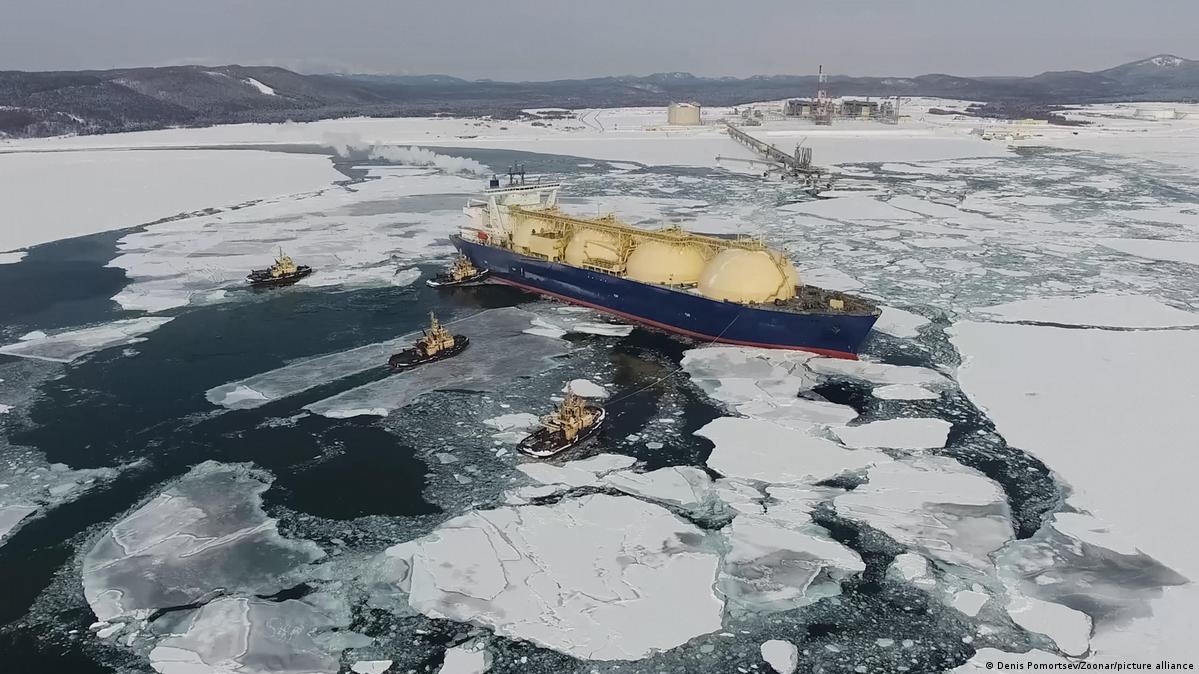
The Iran war and resulting blockade of the Strait of Hormuz have focused minds on international shipping. Russian officials are promoting the Northern Sea Route (NSR), an Arctic sea lane running along their country's northern coast. President Vladimir Putin said in April the route's importance as "the most safe, reliable and efficient path is becoming ever more obvious."
It is the shortest maritime route between Asia and Europe. But it's frozen for much of the year, and comes with significant political considerations. DW asked an environmental foundation which has studied the route — how realistic is this vision of the NSR as a new major shipping passage?
Northern shipping route less popular because of Russia's war in Ukraine
Shipping goods along the Northern Sea Route can reduce travel distance by up to 40%, compared to going via the Suez Canal, which is the most common route between Asia and Europe. But for a host of reasons, the NSR is not used that often.
Moscow had planned to move 80 million tons of cargo through it by 2024, but those ambitions were stymied by the 2022 Russian invasion of Ukraine and the Western sanctions that followed. NSR infrastructure operator Rosatom recorded less than half of the goal, around 38 million tons of cargo, actually passing through that year. That's less than 1% of global maritime trade — compared with up to 15% that usually passes through the Suez Canal.
Even so, Russia is continuing significant investment, budgeting 1.8 trillion Russian rubles (around €20.5 billion/$24 billion) for NSR development until 2035.
The NSR remains primarily a route for Russian crude oil and liquid natural gas (LNG), which formed more than 80% of cargo passing along in 2024. Those figures come from the Bellona Environmental Foundation's 2025 report, an international environmental NGO with headquarters in Oslo, Norway. Ksenia Vakhrusheva, Bellona's Arctic project adviser and co-author of its NSR report, told DW the Kremlin had wanted the route to become more popular.
"Economics of the use of this route is not matching the image that Russia wants to create around it," she said.
The route emerged due to climate change melting Arctic ice and reshaping the region. But it's still only fully accessible for a few months a year, from mid-summer to mid-autumn. And even then, floating ice can pose a danger to ships. The rest of the year the NSR is covered in ice, making passage only possible with an icebreaker leading the way.
Ice still a problem on NSR despite climate change
According to Bellona's report, the lack of emergency rescue infrastructure capable of quickly responding to incidents makes an already risky journey even more dangerous.
And despite the climate crisis, Vakhrusheva said it's unlikely the NSR will become much easier to navigate within the next decade, meaning that the all-year shipping won't become a reality anytime soon.
"If every ship will need an icebreaker to go through the whole route, then it will be extremely expensive," she said, adding that Russia only allows its own icebreakers to operate there.
Any ship sailing through the NSR must obtain a special permit, too.
There's also the question of Russia's dependability, said Vakhrusheva. Moscow's continuing war against Ukraine reduces the draw of using the NSR.
If the government continues to disregard international law, "then, of course, it's very dangerous for any country to be dependent on anything controlled by Russia," she said.
Environmental risks higher in Arctic waters
Even though the NSR is more direct than other routes between Asia and Europe, it's not much greener.
"That's also quite a common thought, that if it's shorter, then ships use less fuel and [...] emit less greenhouse gases," said Vakhrusheva. "It's not the complete picture."
She said the ice-class vessels needed for such waters burn more fuel per nautical mile than normal ships, since they are heavier.
And any fuel spill poses a greater threat in the Arctic than elsewhere, because oil products decompose much more slowly in the cold. Additionally, black carbon emitted by ships' engines accelerates climate change when it lands in the Arctic because the soot turns ice and snow dark, reducing its reflectivity — meaning it absorbs more sunlight and traps heat.
The International Maritime Organization, the UN body that regulates international shipping, banned the use and carriage of heavy fuel oil in Arctic waters from 2024. The risks it posed in the event of a spill and its contribution to black carbon production were considered too high. But Russia did not sign up to the ban, and it remains unclear whether it will do so before its waiver expires in 2029.
Why are the poles warming faster than other places?
To view this video please enable JavaScript, and consider upgrading to a web browser that supports HTML5 video
European reluctance to cooperate with Russia to use the NSR could be strengthened by such environmental concerns.
"If European countries say that they don't want cargo going through the Arctic routes, because of the very vulnerability of this region from an environmental and climate point of view, then there is no development for it," said Vakhrusheva.
Asia tests Arctic shipping, but holds off on big investments
China's shipping giant Cosco ran test cargo trips between China and Europe via the Arctic from 2013, but stopped in 2022 after Russia's invasion of Ukraine. Yet, activity has not disappeared entirely: Smaller-scale shipments from Chinese to Russian ports resumed in 2023. Two years after that, the container ship Istanbul Bridge also completed a test transit from China to European ports, seen as part of China’s "Polar Silk Road" strategy.
Earlier this year, South Korea also announced plans to send a container ship through the NSR to Rotterdam as a test in September 2026.
Even so, Vakhrusheva thinks the route is still unlikely to take over any significant proportion of international trade.
"Major logistics and shipping companies are not keen on investing money right now in this route," she said, adding that she sees current engagement as "more political than economic."
China's hesitation is rooted in the question of control. Russia effectively administers the NSR, so any Chinese investment in it would depend on Russian infrastructure.
"I don't see that China is so keen to just throw money in Russian infrastructure because, of course, China wants to have some control of it," said Vakhrusheva.
China's Arctic ambition eyes raw materials, military bases
To view this video please enable JavaScript, and consider upgrading to a web browser that supports HTML5 video
It's not China's only area of interest — and there are safer and more predictable alternatives available.
"China is trying to [...] be part of every potential infrastructural development in the world," said Vakhrusheva. "But I don't think that the Northern Sea Route is a primary interest for now."
Yet in the longer term, the climate crisis could change this. A 2024 study in the scientific journal Communications Earth & Environment suggested that the NSR could be navigable year-round by 2100. However, Vakhrusheva said if that's the case humanity will likely have other, far greater concerns.
"With this effect of climate change, what will the rest of the world look like?" she asked. "Will we need this route then? Who will use it?"
Edited by: Hannah Cleaver
Advertisement