Why reluctant 'guru' says Dutch will win World Cup
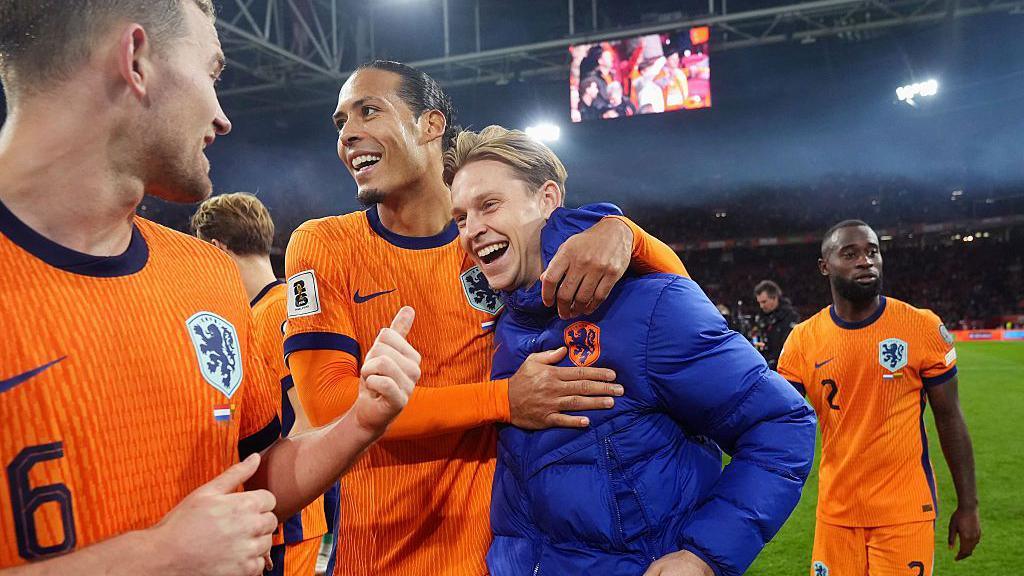 Image source, Getty Images
The Netherlands is arguably the strongest footballing nation never to have won a World Cup
- Published3 hours ago
When Paul the Octopus predicted all of Germany's results correctly at the 2010 World Cup, he was hailed by the world as an oracle.
But German economist Joachim Klement has trumped Paul with a complex forecast model which has kept a 100% record of predicting the World Cup winner since 2014.
The Netherlands would become the fourth of four predicted winners to fulfil Klement's statistical prophecy if they lift the trophy in July.
As well as the winners, his model maps out the breadth of the 48-team tournament - from a surprise win for Japan against Brazil in the second round to Scotland being knocked out by South Korea at the same stage.
England are due to make it to the semi-finals, with Portugal poised to knock them out two decades after they did in 2006 - though the model stops short of foretelling 'penalties, again'.
For Klement, a self-professed "pessimist" who has lived in the UK for 10 years, the research was never about protecting anyone from heartbreak, or winning big on a bet.
Rather, he hoped to reveal the absurdity of trying to predict outcomes.
"This started as an exercise in showing the world a hubris of economists who think they can forecast stuff that they actually have no clue about," Klement said.
"And now it's become an exercise in how, if you're lucky often enough, people will think you're a guru."
After his first prediction came true when his native Germany won the 2014 World Cup, Klement imagined running the numbers again in 2018 would expose it as a fluke.
But he predicted correctly with France in 2018 - then again with Argentina in 2022.
"Because I was right three times in a row, people now think that this model is unbeatable and that I obviously will have to be right as well next time," he said.
It is true that World Cup success is partly determined by known "systemic" factors, such as national population, wealth, climate and Fifa world rankings.
But Klement urges readers of his quadrennial forecast - growing in popularity with each successful prediction - to take its contents with a pinch of salt, since such factors only tell part of the story.
"The other 50% is luck," he adds.
"Every match - especially when you have these high-quality teams playing against each other that are very similar in skills and quality - it really depends on the form of the day, a ref call, a piece of luck in the sense of hitting the post versus the ball going in.
"Things like that are completely unpredictable."
Each time the tournament approaches, Klement's model offers a welcome diversion from his day-to-day work: "In particular in 2026, when there are so many crises, wars and things going on, it is something that makes me feel good and hopefully the readers feel good and gives them a little bit of a distraction from all the kind of bad stuff that is going on in the world."
But with each accurate prediction, the weight of expectation mounts on Klement, who works as a strategist at investment bank Panmure Liberum.
In the office, Klement faces enquiries from fellow economists around, for instance, how Dutch Tottenham midfielder Xavi Simons' ACL injury will impact the model?
So in spite of his many disclaimers around the integrity of the forecast, Klement is braced for the tournament kick-off in June.
"I've got several colleagues who bet some money on the Netherlands in response to me publishing that note," he said.
"And if the Netherlands get eliminated from the World Cup, I think the next day I have to work from home."
Related topics
World Cup fixtures and group standings
How to watch the World Cup on the BBC
- Published10 December 2025
Everything you need to know about the World Cup
- Published1 April
Схожі новини

Загибель студентів у гуртожитку Старобільська: як РФ використала удар і приховала наслідки — рослідування

Трагедія у Бучі: 11-річний хлопчик стрибнув із крану на будівництві

Таропрогноз на 27 травня 2026 року: кому день принесе прорив, а кому — важливе випробування