Why Modi wants Indians to buy less gold and take fewer foreign holidays

 NurPhoto via Getty Images
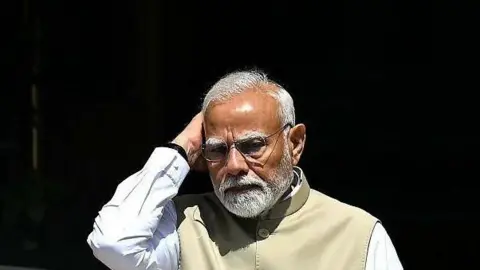
As the war in Iran drags into its third month with no clear end in sight, Prime Minister Narendra Modi is asking Indians to tighten their belts in ways not seen since the pandemic.
Work from home if possible, he urged. Avoid unnecessary foreign travel. Buy less gold. Consume less fuel.
The appeal, delivered at a public event in Hyderabad on Sunday, carried echoes of the Covid years, when the prime minister relied on symbolic mass participation to rally the country around a national cause.
This time, the collective mission is economic survival: save dollars. Unsurprisingly, the message sent a wave of panic across India's financial markets.
"My view is we should prepare for paranoia before the event," Uday Kotak, a veteran Indian banker, told a gathering of industry leaders this week, adding, "We must prepare for the worst."
"We have not seen the impact in the last two months of the Middle East war in terms of energy price transmission… It's coming and its coming big and consumers have not felt the pressure at all," Kotak said.
India's vulnerability is straightforward.
The country imports roughly 90% of its crude oil and half its gas needs. With the Strait of Hormuz - the narrow Gulf chokepoint through which much of the world's oil flows - shut for more than two months amid the war, India's import bill has ballooned by billions of dollars.
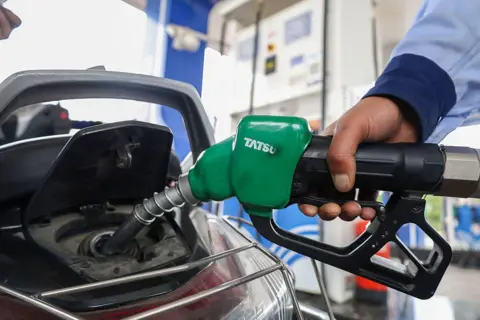
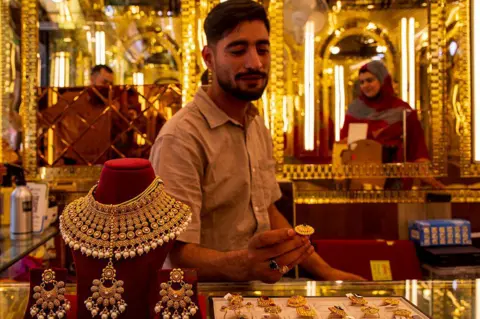
Air fares have surged as airlines pass on fuel costs. Overseas holidays are becoming more expensive. Gold imports, a chronic drain on foreign exchange, have become a fresh target, with the government sharply raising import duties on gold and silver to 15%.
"What was initially seen as a temporary shock could now turn into a prolonged crisis. If that happens, India could be among the worst-affected economies," says Rajeswari Sengupta, an associate professor of economics at Mumbai-based Indira Gandhi Institute of Development Research.
 Getty Images
Behind Modi's unusually direct appeal lies a deeper anxiety in Delhi: not that India is running out of dollars, as it did during the balance-of-payments crisis of 1991, but that demand for dollars is beginning to outstrip supply at an uncomfortable pace.
Back then, India had barely enough reserves to cover three weeks of imports.
Today, it has around $690bn (£510bn) in reserves - among the world's biggest and enough to finance India's goods imports for 11 months.
There is no imminent risk of default. But the pressures are real nonetheless.
Oil, gas, fertiliser and gold imports are pushing up demand for dollars just as foreign investment inflows weaken, exports slow down and geopolitical uncertainty rattles markets. India's forex reserves have fallen by $38bn since the Iran war began - one of the sharpest declines in the region.
Petroleum minister Hardeep Singh Puri sought to calm frayed nerves, insisting there was no fuel shortage. But oil at $100 a barrel is testing the government's finances.
"Modi's comments signal that the pressure on the government fiscal finances is reaching a tipping point, that there is less appetite for further rupee depreciation and that the burden of adjustment may be incrementally shared with consumers," according to Aurodeep Nandi and Sonal Verma of Nomura, a Japanese broking house.
According to Nomura, India's fiscal deficit - the gap between government spending and earnings - is projected to widen to 4.6% of gross domestic product (GDP) by March 2027, above the budget target of 4.3%. The balance of payments gap - which tracks the flow of money into and out of the country - has crossed $70bn.
 LightRocket via Getty Images
Keeping India's external balances under control while preventing further rupee weakness will be the "key macroeconomic challenge" this year, India's chief economic adviser, V Anantha Nageswaran, said recently. But economists argue the rupee's troubles predate the war and cannot be solved through austerity alone.
Foreign investors have pulled about $22bn from Indian equities in recent months, driven by concerns over slowing global trade, US tariff threats and India's ability to compete in emerging industries such as AI, batteries and electric vehicles.
"Since India hasn't done much in AI or renewable energy or semi conductors, there are not many industries generating the kind of excitement or long-term returns investors now see elsewhere in Asia," says Sengupta.
"Even if the economy grows at 6-6.5%, the broader investment story looks less convincing."
Net foreign direct investment has stagnated, helping make the rupee one of Asia's weakest-performing currencies this year, down about 6-7% so far.
"In my 30 years of investing, I have never seen such [investor] indifference toward India," global investor and author Ruchir Sharma said at a talk organised by the Indian Express newspaper recently.
Many economists say this leaves India with little choice but to accept some economic pain: external shocks such as higher oil prices inevitably push up costs, weaken currencies and dampen consumer demand.
If petrol becomes expensive, people drive less. If LPG prices rise, households economise. A weaker rupee makes imports costlier and exports more competitive, helping narrow the current account deficit over time.
 NurPhoto via Getty Images
But many economists say India has always treated currency depreciation not merely as an economic adjustment, but as a matter of national prestige.
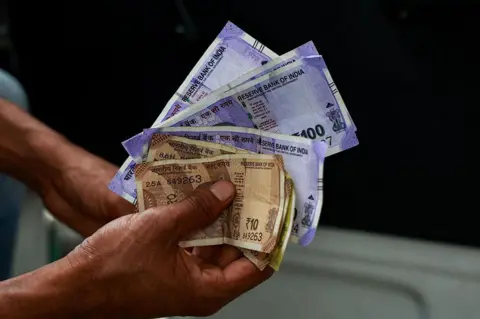
Policymakers are deeply uneasy about the "political optics" of a sharply weakening rupee. A slide towards 100 rupees to the dollar would become a potent symbol of economic weakness.
In 2013, Modi himself attacked the then Congress-led federal government over the rupee's slide against the dollar, saying it was "neither concerned about the economy nor the falling rupee" and worried only about "saving its chair".
Now instead of allowing prices alone to curb demand, Modi has turned to moral persuasion - asking Indians to voluntarily consume less in the national interest.
The message, economists say, is clear: if supply cannot be increased, demand must be restrained.
The question is whether patriotic austerity can substitute for the harsher arithmetic of markets.
"Consumers cannot and should not be completely insulated from global supply shocks, because that will cause even more pain later," Rahul Ahluwalia, founder director of the Foundation for Economic Development, told the BBC.
He added that shielding consumers now could worsen shortages later, slow the energy transition and put further pressure on government finances. State-run oil companies are already running out of capacity to absorb mounting losses.
 LightRocket via Getty Images)
The real debate is not whether prices should rise, but who should bear the pain.
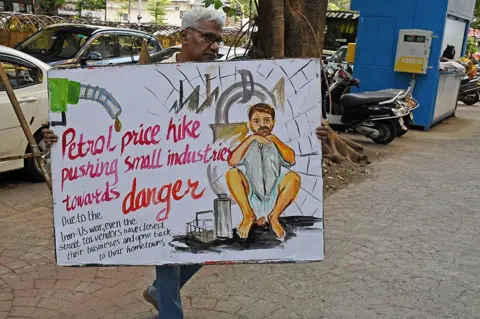
The government had absorbed the price shock for two months and held back pump price hikes amid a string of state elections. But on Friday, India raised petrol and diesel prices for the first time in four years, with Delhi retailers increasing rates by three rupees ($0.03) a litre - more than 3% - to offset losses from higher global crude prices.
Economists like Sengupta argue that shielding everyone through artificially cheap fuel is unsustainable.
Instead, they argue for targeted relief - wartime-style subsidies for poorer households, especially for cooking gas - while allowing prices to rise for everyone else.
India's inflation is already on its way up. HSBC called the latest inflation number "calm before the climb", with prices set to go up on account of the "twin energy and Niño [a weather phenomenon which releases more heat into the atmosphere] shocks" - which will force the central bank to hike the cost of borrowing.
For years, India's economic managers have tried to soften every shock. But oil markets are unforgiving. Eventually, the bill arrives - and the longer prices are held back, the harder the adjustment becomes.