Why AI And Why Now?
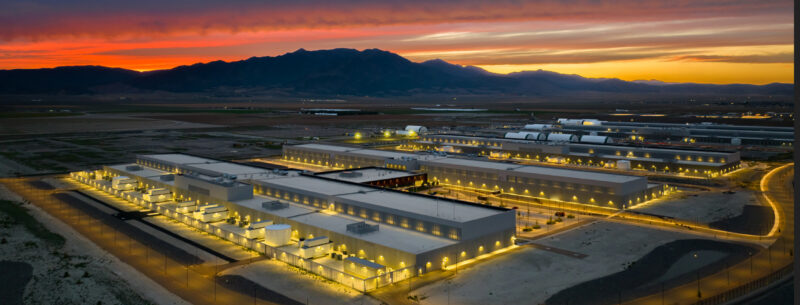 Meta data center. Eagle Mountain, Utah
May 24, 202627 minutes
Steve Hanley
0 Comments
Support CleanTechnica's work through a Substack subscription or on Stripe.
Meta data center. Eagle Mountain, Utah
May 24, 202627 minutes
Steve Hanley
0 Comments
Support CleanTechnica's work through a Substack subscription or on Stripe.
Millions of words have been written about artificial intelligence — popularly known as AI — and billions more will be written over the next few years. Advocates point to its benefits — allowing doctors to make better diagnoses of health issues, for instance, or allowing scientists to create new technologies in the lab that lead to better, cheaper batteries. Those benefits are real and are not to be dismissed lightly.
Yet there is a growing chorus of detractors who are concerned that AI may have long-term effects that are not so beneficial. Paul Krugman this week had a discussion with Heather Cox Richardson in which he discussed how AI mania resembles previous economic bubbles — from tulip mania in Amsterdam in 1636, to Bernie Madoff, to the dot-com crash, to the California gold rush, and to the global financial meltdown that began in 2007.
Just the sheer number of those events suggests there is something about the human psyche that inevitably leads to such boom/bust scenarios. Krugman cites economist Robert Shiller, who said “a bubble is a natural Ponzi scheme. It’s something where you get in and you make money because other people get in, and people keep on coming in because everybody before them made money. But in the end, it’s a game where the money isn’t really there. It all depends on fresh crops of suckers coming in. And at some point you run out of suckers.”
Opposition To AI Is Growing
AI means data centers and those data centers are becoming a flash point in US politics. Just this week, Utah approved a massive data center that Grist says will consume 9 GW of power, which is double what the entire state uses today. It will cover 40,000 acres, an area twice the size of Manhattan, and raise the state’s carbon emissions by 64 percent. “While its water needs remain unknown, the sprawling data center would neighbor the northernmost tip of the shrinking Great Salt Lake, which will likely hit a record low elevation this year following an unprecedented dry winter,” Grist reported.
But that’s not the bad news. Robert Davies, a physics professor at Utah State University, believes the giant computer center will create a massive heat island capable of devastating the area’s ecology. He estimated the finished project would cover about as many square miles as Washington, D.C., making it the largest data center on the planet, and that it could produce enough heat to spike nighttime temperatures by as much as 28 degrees Fahrenheit [emphasis added] in the high desert valley where it will be located. “What I’ve found is, it’s so much worse than I even thought it would be,” Davies said.
He said the additional thermal load in the valley will be the “equivalent of about 23 atom bombs’ worth of energy dumped into this local environment every single day” and that trapped heat could devastate the local ecology. “What happens if you deposit that much energy continuously into a topography like this? Right at the north end of the Great Salt Lake, a watershed that is in collapse? A high-desert environment? A valley?” All good questions, and the answers are troubling, to say the least.
New Jersey City Bans Data Centers
The Millville Board of Commissioners in southern New Jersey this week voted to ban data centers in the city. It passed an ordinance that said “data centers are incompatible with the City’s land use planning objectives, infrastructure capacity, and community character. The Commissioners therefore determine that the construction and operation of data centers within the City would be detrimental to the public health, safety, and welfare.”
According to Business Insider, the decision will halt the proposed 1.4 gigawatt Millville Energy & Data Center Campus, which would have spanned more than 60 acres. The Climate Revolution Action Network, an environmental nonprofit based in New Jersey, told Business Insider in a statement that it spent months organizing residents to oppose the Millville data center. “This is a winning coalition and something we need to see more of across the country,” Kayleigh Henry, one of its leaders, said. “These corporations may have more money than us, but they’re no match for people speaking out and making their voices heard.”
This month, a coalition of anti-data center groups asked New Jersey Governor Mikie Sherrill to impose a moratorium on approving and constructing new data centers that use at least 20 megawatts of power “until regulations or legislation are implemented to protect ratepayers and consumers, maintain electric grid reliability, and minimize environmental impacts.”
Memphis Knuckles Under To Musk
The Memphis Flyer reports that Elon Musk’s xAI data center in Memphis, Tennessee, purchased more than 25 million gallons of water from Memphis Light, Gas, and Water in March to cool its Colossus 1 data center. Readers will note that Colossus I is just one of several data centers xAI is using in the area, although the others are just across the state line in Mississippi.
Protect Our Aquifer said the company has increased its water usage, which now totals 812,502 gallons pumped from the Memphis Sand Aquifer every day. The group expects demand will be higher in the summer months. “If companies are making multi-billion dollar commitments tied to xAI’s facility, then Memphis residents deserve transparency and public accountability,” POA said. In the news this week it was revealed that Anthropic has agreed to pay xAI $1.5 billion a month from now until 2029 for use of its computers.
MLGW CEO Doug McGowen told Memphis City Council members recently that Musk’s parent company was “committed” to building a wastewater treatment facility for its Memphis supercomputer, however, since then the company said it was “prioritizing … more immediate projects at the site” and would continue to use Memphis Sand Aquifer water instead. McGowen told council members that the project cost went from $80 million to around $200 million. One thing that sticks in the craw of local residents is that xAI pays 19 cents for every 100 gallons of water it uses, which is almost half of the 32 cents per 100 gallons regular customers pay.
The concerns over water are in addition to those local residents have about the emissions from the 50 portable methane-fired generators being used to power the xAI data centers. The states of Tennessee and Mississippi have told local residents to go pound sand when it comes to complaining about such pollution. Environmental justice in the South is similar to racial justice in the area, which is to say close to nonexistent. Those emissions are concentrated in neighborhoods that are low income and predominately populated by people of color who have recently been disenfranchised — again — by the US Supreme Court.
AI & The Surveillance State
If you are starting to wonder why we need all these data centers and all this artificial intelligence in an era when actual intelligence appears to be in short supply, Germany’s DW this week has an extensive exposé that details how AI networks in China enable social control. Of all the concerns about artificial intelligence, this is the one that should concern people the most.
A computer expert who uses the pseudonym NetAskari told DW the Chinese no longer rely solely on police cameras on street corners. Their AI-enabled system accurately records the specific train carriage and seat number a target — typically a foreign journalist — occupies when arriving from Beijing or Shanghai. It synchronizes photos taken by facial recognition ticket gates at local ski resorts directly into its tracking mechanism. On the site NetAskari was able to access, the system identified the acquaintances he recently skied with, who were precisely flagged and mapped out with detailed trajectories.
“The idea is simply to process as much data as possible from as many sensors as possible in real time,” he said. The system logs daily behaviors like gasoline consumption, regular shopping locations, and whether an individual frequently visits areas where civil unrest is prevalent. “This massive data fusion effort attempts to stitch together a person’s physical whereabouts, consumption habits, and digital footprints into a flawless ‘holistic personnel archive,'” he said.
In the past, foreign reporters traveling to sensitive regions such as Xinjiang often relied on experience to shake off plainclothes police trailing them, but now algorithmic upgrades to the policing system render this traditional cat-and-mouse game obsolete. “They don’t need to send two or three cars to follow you anymore,” NetAskari said.
Because the system has access to your mobile payments, ticket purchases, and social networks, authorities can perfectly anticipate your itinerary, ensuring you only see what they want you to see upon arrival. If the data network detects you interacting with certain individuals, police can simply call and intimidate your sources behind the scenes. In this perfectly closed surveillance loop, the concept of an “under-the-radar investigation” is being systematically eradicated.
This is bad news for the authors of spy novels who delight in describing the lengths their protagonists go to in order to elude surveillance. Now the surveillance is in front and knows exactly where persons of interest are going and when they are likely to arrive. NetAskari said in the Chinese system, people are reduced to numbers, patterns, and vector operations. They become “a ‘data mass’ that can be controlled, shaped and coerced as needed.”
The Perfect Social Control System
Do you think Stephen Miller is not salivating over the prospect of creating a similar system in the US? Think again, and when it happens, it will be powered by those massive AI data centers being built all across America as we speak — data centers that members of the public are paying for in higher utility bills and degraded environmental protections.
In the US today, Brave New World and 1984 are merging, thanks to AI. If you weren’t worried before, perhaps you should be now. During the tawdry xAI vs OpenAI trial this month, it was abundantly clear that neither Elon Musk nor Sam Altman cares a flying fig about you, and neither do their tech bro friends. If AI is a bubble, its denouement cannot come soon enough.
Sign up for CleanTechnica's Weekly Substack for Zach and Scott's in-depth analyses and high level summaries, sign up for our daily newsletter, and follow us on Google News! Advertisement Have a tip for CleanTechnica? Want to advertise? Want to suggest a guest for our CleanTech Talk podcast? Contact us here. Sign up for our daily newsletter for 15 new cleantech stories a day. Or sign up for our weekly one on top stories of the week if daily is too frequent. CleanTechnica uses affiliate links. See our policy here.CleanTechnica's Comment Policy
Share this story!
Схожі новини

Britain’s anxious young adults struggle with modern workplace demands, warns UK govt advisor

The AI agent called, your smartphone is changing