Where are US forces stationed in Europe?
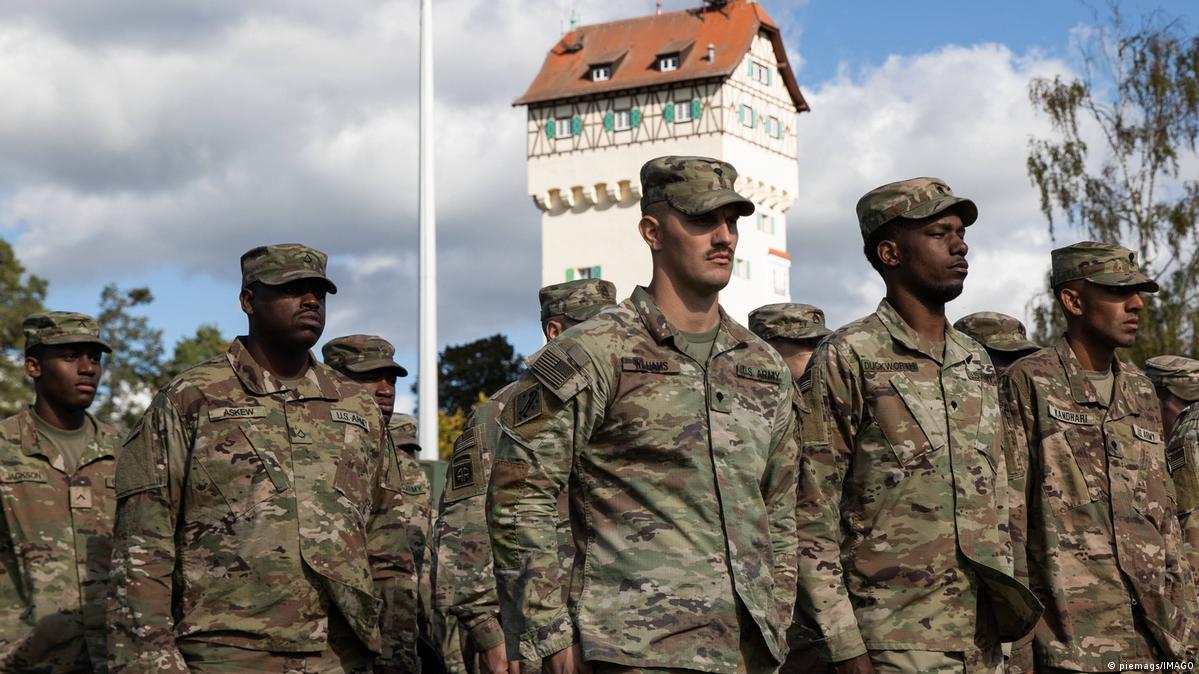
American military personnel are a common sight across Europe, stationed in Germany but also far-flung regions like the Azores, Romania, northern Norway, Sicily and many other locations.
But since he returned to the White House in 2025, US President Donald Trump has threatened to cut troop numbers at those bases, most notably in Germany. A similar announcement to halt a scheduled deployment to Poland was walked back on Thursday, when Trump said he would send an additional 5,000 soldiers there due to his good personal relationship with Poland's right-wing nationalist president, Karol Nawrocki.
Why are so many US troops stationed in Europe?
After the end of World War II in 1945, the allied bloc which had defeated Nazi Germany disintegrated into two camps: one led by the US and other Western states, and another headed by the Soviet Union. The former founded the North Atlantic Treaty Organization (NATO) in 1949 amid the nascent Cold War.
The US, NATO's biggest military power, saw permanently stationing troops in Europe as an important deterrent against the Soviet-led Warsaw Pact defense treaty. In line with security doctrines issued by US Presidents Harry S. Truman and Dwight D. Eisenhower, American bases were established throughout the continent.
At the peak in the late 1950s, some 475,000 US military personnel were stationed in Europe. This presence was established on the basis of NATO rules and various bilateral agreements struck with the respective host countries. From 1991, after the collapse of the Soviet Union, US troop numbers were gradually reduced to the tens of thousands.
This gradual drawdown was slightly reversed after 2014, following Russia's annexation of the Ukrainian peninsula of Crimea, which sparked a renewed desire for European military deterrence.
US troop cuts 'not a surprise': German vice defense chief
To view this video please enable JavaScript, and consider upgrading to a web browser that supports HTML5 video
Where is the largest US troop presence?
Most US troops are stationed in Germany. Over 36,400 active-duty military personnel were still based there late last year, according to the US Department of Defense . Both EUCOM, the US command center for European military operations, and AFRICOM, which coordinates missions on the African continent, are based in Stuttgart, southwestern Germany.
The US Air Force Headquarters for Europe and Africa (USAFE-AFAFRICA) is based in Ramstein, in Germany's western state of Rhineland-Palatinate. This airbase serves as a key hub for missions extending as far as the Middle East. Nearby Landstuhl, meanwhile, hosts the largest American military hospital outside the US.
It's believed the US keeps roughly 100 nuclear weapons at Germany's Büchel airbase. These weapons can be delivered by European pilots in a case of emergency, in accordance with NATO's doctrine of nuclear sharing, but only with permission from Washington.
Italy has the second-largest US troop presence in Europe with some 12,700 US soldiers, going by figures from late 2025. The United Kingdom comes in third place with around 10,200. It hosts a variety of crucial NATO airbases, from where the US can launch fighter jets, strategic bombers and aerial refueling aircraft.
A small numbers of fighter jets are also stationed in Italy, along with an airborne brigade that can be deployed as a rapid reaction force throughout Europe or Africa. Naples, meanwhile, hosts the headquarters of US naval operations in Europe and Africa (NAVEUR-NAVAF).
These US troop numbers do not include units that were specifically stationed on eastern NATO bases following the annexation of Crimea.
Why are US forces still in Europe?
The US employs its European bases for global operations. German and British bases, for instance, were used to launch airstrikes on Iran earlier this year. Several NATO allies have, however, restricted recent operations being launched from their territory, among them Italy, which barred bombers and transport planes from landing at the US logistics base Sigonella in Sicily.
Spain likewise prohibited the use of its bases, but also closed its airspace to US aircraft. Trump subsequently threatened to withdraw troops from both countries.
Europe's strategic importance to the US stems from its geographical location. If US units are to be deployed to a region such as the Middle East, sending them from Europe will be quicker than the American continent. Direct flights, too, have limited ranges.
The same applies to communication signals, which is why the US operates a drone signal relay station in Ramstein, Germany. This explains why German courts have examined whether Germany should intervene to stop US drone attacks that violate international law.
The rotating units on NATO's eastern flank play a very specific role in the alliance's deterrence against Russia, with the US leading the Poland-based multinational battle group. In 2016, NATO decided to set up four such battle groups to win time in the event of a Russian attack. These are not permanent troop deployments; personnel rotates every six months.
Initially, these battle groups were relatively small to underscore their defensive character. Then, as part of NATO's Operation Atlantic Resolve, additional US air, land and naval forces were deployed to Germany and Poland as reinforcements.
Which troop deployment issues are currently unresolved?
In mid-May, the Pentagon canceled a deployment of around 4,000 soldiers to Poland in the context of an Operation Atlantic Resolve troop rotation. The decision came at the very last minute, after vehicles had already been shipped out, and soldiers had already prepared for departure.
While US news outlets reported that Pentagon budget constraints were the reason for the sudden decision, other analysts have linked the move to Trump's repeated threats to cut US troop numbers in Europe.
But this week, Trump performed yet another U-turn and announced the deployment of 5,000 additional soldiers to Poland. Trump did not specify whether the troop rotation would go ahead after all, whether some forces would be withdrawn from Germany or if other units will be mobilized.
In early May, Trump announced he would withdraw 5,000 US soldiers from Germany after clashing with German Chancellor Friedrich Merz over the ongoing conflict in Iran. But despite the strong words, observers doubt the US will really reduce its troop presence in Germany. That said, Washington has made clear that a prior agreement reached between both countries' previous leaders — Joe Biden and Olaf Scholz — to station US medium-range missiles in Germany by 2026 to deter Russia would not be honored.
This article was originally written in German.
AdvertisementСхожі новини
Shueisha turns 100 with an eye on the future of manga
Nippon Life books its first impairment loss in current bond rout
Former Japan trading house head warns of naphtha supply crunch