What Trump and MAGA just did in Virginia and Tennessee shows Democrats have little chance in midterms
On Friday, Democrats received a massive body blow when Virginia’s Supreme Court nullified the state’s ballot initiative that voters passed last month to allow for the creation of four new Democratic-leaning districts ahead of the midterm elections.
Immediately, President Donald Trump celebrated the decision.
“Huge win for the Republican Party, and America, in Virginia,” Trump posted on Truth Social. “The Virginia Supreme Court has just struck down the Democrats’ horrible gerrymander.”
Trump’s statements carry too much hypocrisy to bear. The normally staid and proper Democrats in Virginia took this route because Trump had demanded that Texas, Missouri and North Carolina redistrict.
Trump did so to avoid the normal midterm trend where the president’s party usually loses control of the House of Representattives in a midterm election. And after a handful of Republicans in Indiana defied his demands, Trump’s political apparatus steamrolled five of them in the primary on Tuesday.
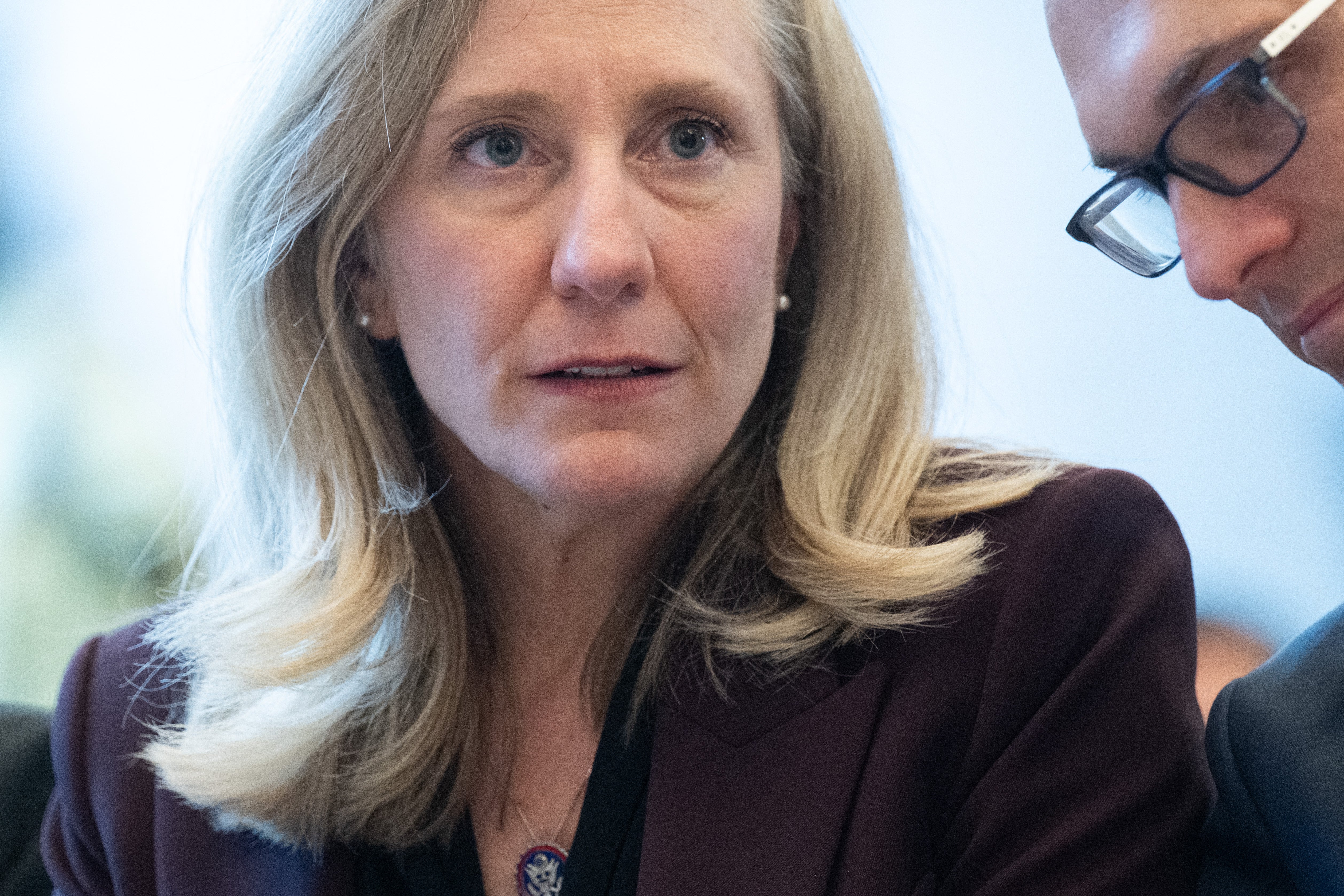
By contrast, Virginia’s Democratic Gov. Abigail Spanberger gave a tepid response.
 open image in gallery
“I am disappointed by the Supreme Court of Virginia’s ruling, but my focus as governor will be on ensuring that all voters have the information necessary to make their voices heard this November in the midterm elections because in those elections we — the voters — will have the final say,” she posted.
As if this were not enough, last week, the U.S. Supreme Court said that Louisiana — a state with two Democratic districts with large Black populations — had to redraw its congressional map, virtually nullifying the Voting Rights Act.
Republican-dominated states responded almost immediately. Florida Gov. Ron DeSantis signed legislation to create four new Republican-leaning House seats. The Tennessee legislature sliced the 9th district, a 60-percent Black district that includes Memphis, to create a seat with nine Republican seats and zero Democratic-leaning House seats.
Louisiana looks to not be too far behind on this as well. South Carolina’s legislature looks primed to wipe out the 6th district, home to Rep. Jim Clyburn, the kingmaker in the state’s presidential primary.
And this does not count the redrawing of congressional districts in Missouri and North Carolina before the Supreme Court decision, or Alabama, which is under a court order to not redraw its map until 2030.
By contrast, so far, only California has been able to respond when voters there redrew its map to add five Democratic-leaning districts.
 open image in gallery
Zachary Donnini, the head of data science at VoteHub, put it bleakly for Democrats.
“Decent chance we are looking at 9 pro-GOP redraws and 1 pro-Dem redraw between 2024 and 2026,” he said on X. “Gain of ~9 GOP seats from redraws in a neutral environment.”
That means that Democrats need to go from flipping only three seats to win back the House of Representatives to twelve seats.
In New York, the other major vote bank, Democrats would need to amend the state’s constitution to redraw the map, but that would require two consecutive legislative sessions and then subject the change to voters. That means it likely would be up for a vote as early as 2028.
The same goes for Colorado, where Democrats hope to put a redistricting ballot up for a vote this November so they can respond in kind. New Jersey, another blue state, also has a nonpartisan redistricting commission, hindering Democrats ability to respond to Republican states.
It reveals a fundamental failure of Democrats. For the past 15 years, they turned their states into laboratories for democracy, seeing if redistricting commissions would work.
They hoped they could use their success to show that nonpartisan redistricting could work and convince their Republican interlocutors.
That didn’t happen. Instead, it turned into unilateral disarmanent on behalf of the Democrats.
Republicans responded either with partisan redistricting, and when the Voting Rights Act prohibited them from acting, they filed lawsuits to chip away at the seminal 1965 law.
 open image in gallery
So far, none of the Republican states that gerrymandered or redrew their maps asked their voters for permission. They did not care about the will of the voters. Their state constitutions have no safeguards.
This is not to say all hope is lost. Take Texas. Republicans redrew their map last year partially on the assumption that the Hispanic reversion to Trump and the GOP would be permanent. That’s proven not to be true.
Texas Republicans redrew the districts of incumbent Democratic Reps. Henry Cuellar and Vicente Gonzales, who represent majority-Hispanic districts. Given Hispanic reverting back to Democrats after flirting with Trump, this might be easier.
The same could prove true with South Florida, where the state’s normally conservative Cuban Americans have been caught in the Trump immigration dragnet. And the economy, inflation and the war in Iran have all bruised Trump’s approval rating, making a Republican hold of the House even more difficult.
But it does reveal that Democrats made a fundamental miscalculation. By creating guardrails and rules, Republicans did not see a reason to compromise and meet them halfway. It made them targets for weakening. Now, Democrats have put themselves in a bind. They only have themselves to blame.
Join our commenting forum
Join thought-provoking conversations, follow other Independent readers and see their replies
Comments