What is hantavirus and how does it spread? Key questions after outbreak
The cruise ship hit by an outbreak of hantavirus could dock in the Canary Islands by the weekend.
Three people confirmed to have the virus and five suspected cases have been linked to the ship. One passenger that authorities say had the virus has died, while two other deaths are under investigation.
The Andes strain of the virus has been confirmed in two passengers who were taken to South Africa, according to the country's health minister.
The ship, MV Hondius, was travelling from Argentina across the Atlantic to Cape Verde.
What is the Andes strain of hantavirus?
Hantaviruses, which are named after a river in South Korea, describe a family of viruses rather than one single disease.
There are more than 20 different viral species, according to the World Health Organisation (WHO) - almost all of them linked to infection by rodents, typically rats and mice, through dried urine and droppings.
But one strain, known as Andes virus, is thought to spread by human-to-human transmission, although very rarely. It has now been identifed in passengers on the cruise ship.
The Andes virus is mostly found in Argentina and Chile.
In late 2018, there was an Argentinian outbreak that was traced back to people who had attended a party – a single person with the virus is thought to have unwittingly spread the virus to 34 confirmed cases, with 11 deaths.
How does this change what happens next?
The WHO has been working on the assumption that the virus could be spreading through very close contact from person to person on the ship and through contact with rodents.
Now the Andes virus is confirmed, it becomes even more important for passengers and crew on board the ship to observe the sort of social distancing we grew used to in the Covid pandemic.
Passengers are currently confined to their cabins to limit exposure, so that will help.
Experts say that measures such as isolating infected patients, regular handwashing, tracing and monitoring close contacts and applying infection control measures will all be critical to stopping the spread of the disease.
It is still not clear how the outbreak started. A Dutch couple who have died had travelled in South America before boarding the ship at the beginning of April. It is possible one or both of them came into contact with the virus during their travels.
The cruise had been visiting remote wildlife areas, so there is always the possibility a passenger came into contact with the virus during the cruise.
Further genetic testing of the virus may be able to narrow down how it got on board in the first place.
Experts say the risk of infection for the global population is very low. At present, there is no evidence of spread beyond the ship.
Cruise passengers tell of life on board stranded ship after hantavirus outbreak
Hantavirus strain that spreads between humans found in cruise ship passengers
How does hantavirus spread?
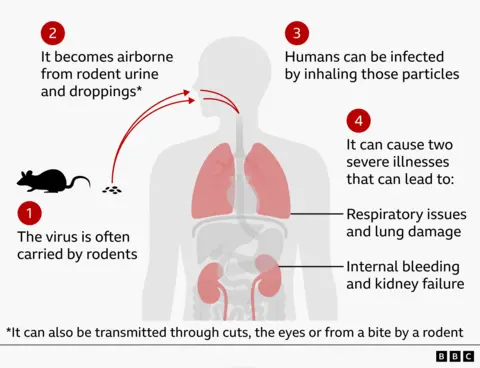
It's normally spread when people come into close contact with droppings, urine and saliva from rodents.
This usually happens by breathing in the virus, for example when rodent urine and droppings that contain hantavirus are stirred up into the air.
The virus can also be caught from a bite from a rodent, such as a rat.

Only one strain is known to spread from person to person, although very rarely - the Andes strain.
Where there is person-to-person transmission, it is through very close, prolonged contact with someone with symptoms.
 Elton Monteiro / EPA
What are the symptoms and how deadly is hantavirus?
The virus can cause two severe illnesses. The first, Hantavirus Pulmonary Syndrome (HPS), often starts with fatigue, fever, and muscle aches, followed by headaches, dizziness, chills, and abdominal issues.
But it is possible that respiratory symptoms then develop – severe breathing difficulties – and at that point patients need urgent medical attention.
This is one of the main illnesses caused by the Andes strain, with a mortality rate of 20-40%.
The incubation period for the disease is also a complicating factor – it can take anywhere between one and eight weeks for symptoms to appear.
The second illness, Haemorrhagic Fever with Renal syndrome (HFRS), which starts looking like the flu, can go on to affect the kidneys and lead to low blood pressure, internal bleeding, and acute kidney failure.
Is there a vaccine or treatment for hantavirus?
There is no specific treatment for hantavirus infections - but early medical support can improve survival.
The type of care recommended can include oxygen therapy, mechanical ventilation and even dialysis.
Patients who are very ill with severe symptoms may need to be admitted to hospitals and treated in intensive care units.
New treatments are being trialled.
There are currently no widely available vaccines to protect against the virus. However, some are being used in China and South Korea against strains that are common there.
How many cases of hantavirus are reported globally?
There are an estimated 150,000 cases of HFRS worldwide each year, primarily in Europe and Asia, according to a report from the National Institutes of Health. More than half of the reported cases typically occur in China.
The latest data from the US shows that there were 890 cases of hantavirus in the country from 1993-2023.
Have there been recent hantavirus cases?
In February 2025, Betsy Arakawa, the wife of Oscar-winning actor Gene Hackman, died from a respiratory illness linked to hantavirus.
Medical investigators believe Arakawa contracted HPS - the most common strain in the US - which led to her death.
Nests and some dead rodents were found in outbuildings of her house where she was found.
Are you on the ship or do you know someone who is? If you feel able to do so, please get in touch by using this link or the form below.

Rodent nests found near house where Gene Hackman's wife died of hantavirus
Cruise norovirus outbreak saw 519 cases at peak
HealthCruise shipsCape VerdeOutbreaksDiseaseVirusesСхожі новини

Суд забуксував у хаосі. Як нова адвокатка Вʼячеслава Зінченка впливає на перебіг справи
Спека до +29°С чи грози: якою буде погода в Україні
Чи наближається в Росії переворот? Чвари російських еліт стають чимраз запеклішими