What flings mysteriously powerful particles called 'cosmic rays' at Earth?
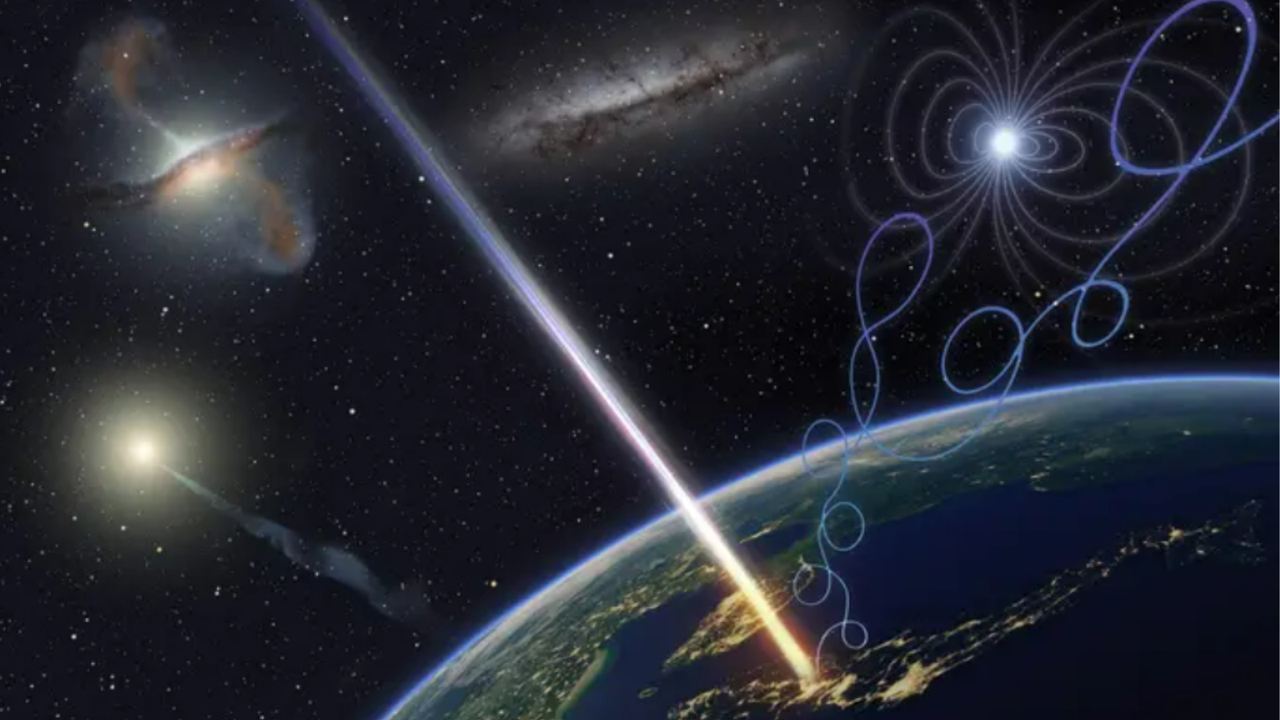
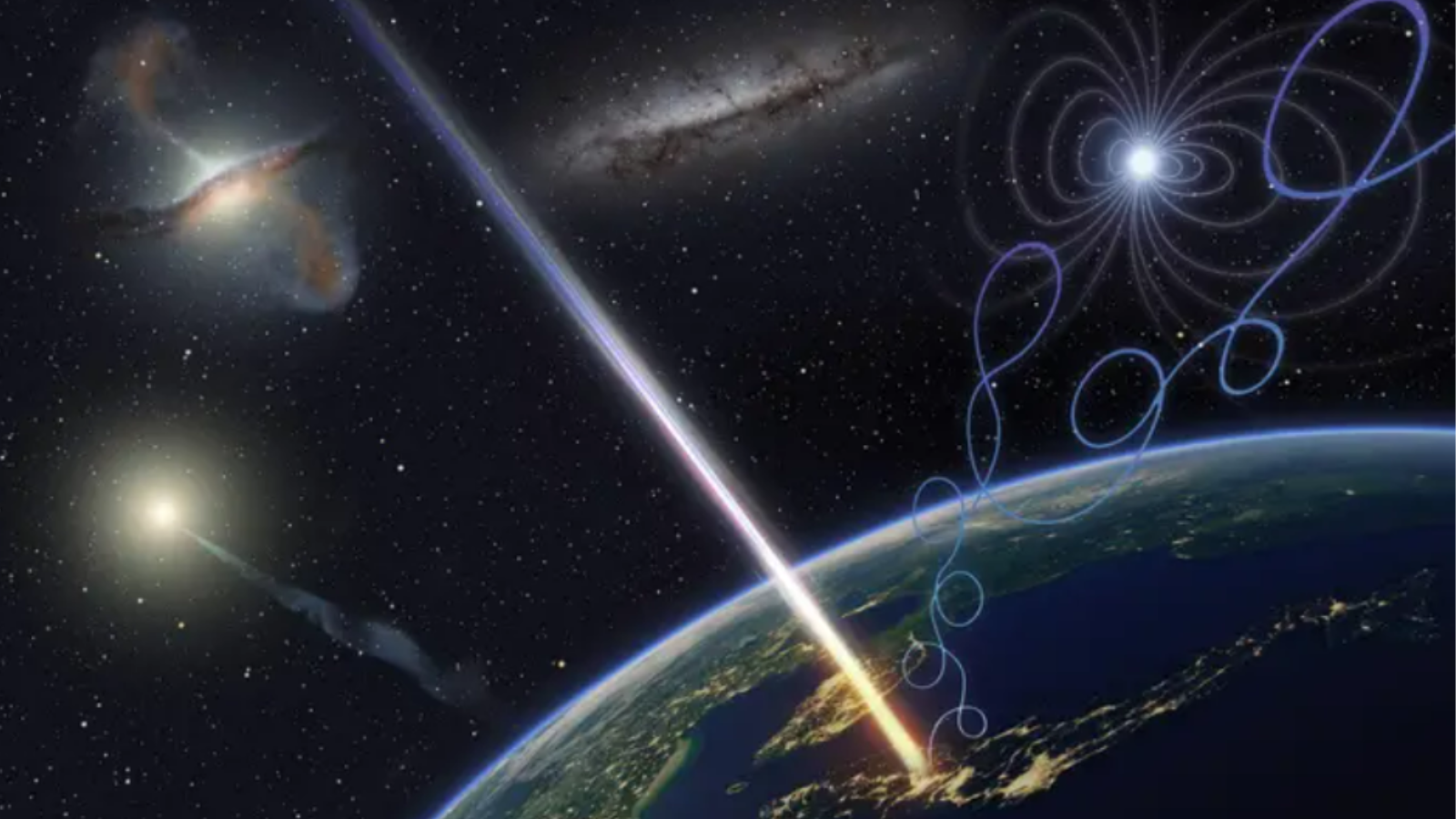
On Earth, the Large Hadron Collider can smash atoms together and accelerate particles to near light speeds — but in space, there are high-energy cosmic rays with over 10 million times more power than even those zippy particles. And now, new research suggests such cosmic rays may hide a secret that is the key to unlocking a 60-year-old space puzzle.
One of these cosmic rays for instance, dubbed the Amaterasu particle (after the Japanese sun goddess) slammed into Earth in 2021 with an energy 40 million times greater than particles slammed together at the Large Hadron Collider (LHC). Amaterasu is considered the second most powerful cosmic ray ever detected — after the aptly named "Oh-My-God particle" detected back in 1991. However, the origins of these particles, and the sources that accelerated them to such high energies, are shrouded in mystery.
"The origins and acceleration mechanisms of ultrahigh-energy cosmic rays have been among the biggest mysteries in the field for more than 60 years, since the first example was reported," team leader Kohta Murase, of Penn State's Eberly College of Science, said in a statement. "Ultrahigh-energy cosmic rays can only be accelerated by some of the most powerful sources in the universe. When we detect individual cosmic-ray particles such as the Amaterasu particle here on Earth, we can often use their energies, arrival directions, and expected magnetic deflections to infer their possible cosmic sources."
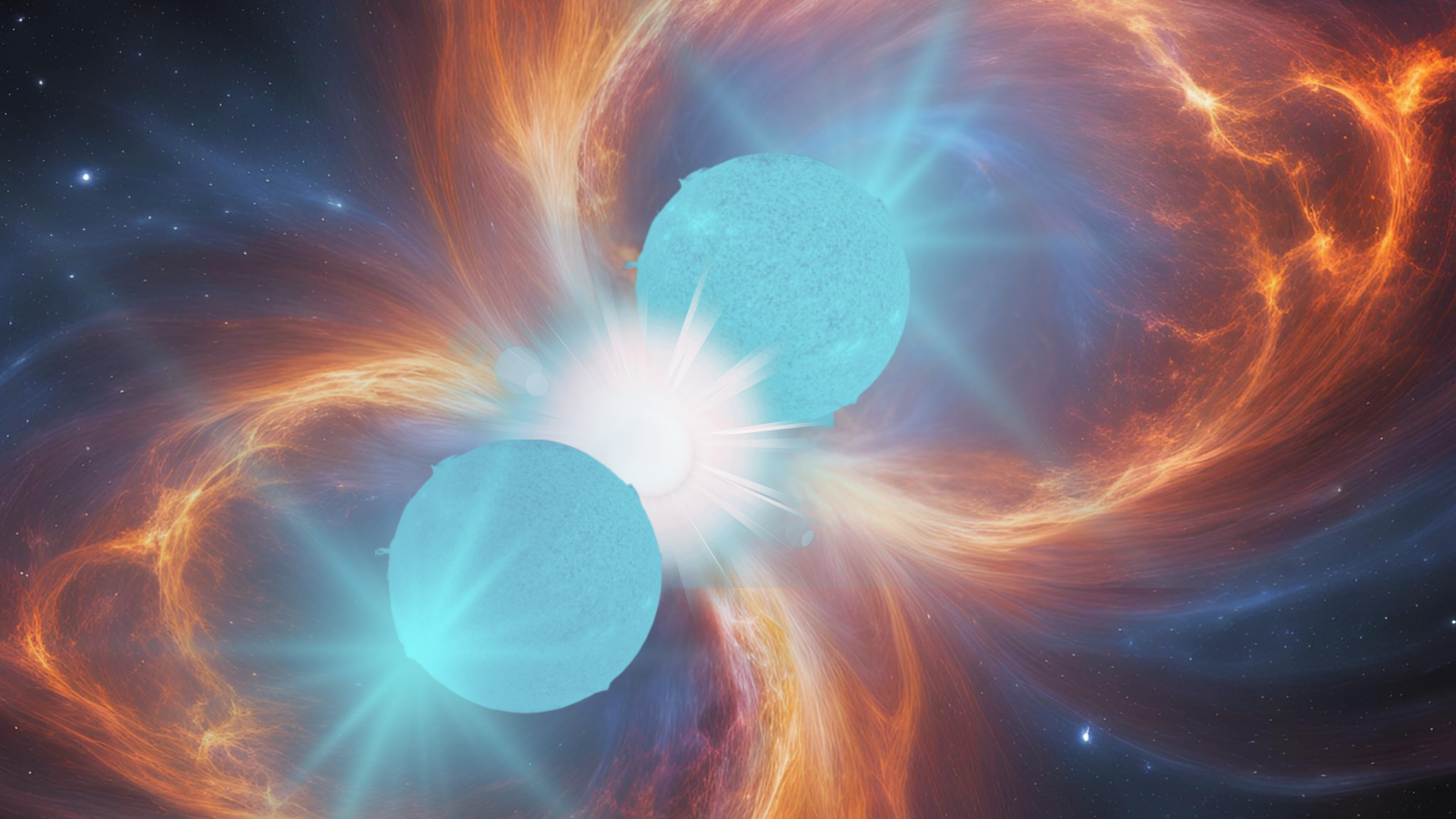
Many sources have been proposed as the origins of high-energy cosmic rays, including the collapse of a massive star to form a neutron star or a black hole or the collision of two neutron stars themselves. For context, the matter that composes neutron stars is so dense that if a mere teaspoon of it were brought to Earth, it would weigh about 10 million tons, which is the same as 85,000 adult blue whales (try getting them on one teaspoon).
So, compressing a body with the mass of the sun to a width of around 12 miles (20 kilometers) is already incredibly violent — consider two of those compressed bodies meeting.
"These highest-energy cosmic rays are thought to come from extreme astrophysical sources, like two neutron stars colliding or a massive star collapsing," Murase said. "For many cosmic-ray events taken together, their energy distribution, arrival-direction pattern, and statistically inferred composition provide important clues about where these particles come from and how they are accelerated."
If Murase and fellow researchers are correct that cosmic rays may be the nuclei of elements heavier than iron, then this neutron star collision story may have some real footing at last.
To understand these high-energy particles and their origins, Murase and colleagues performed simulations tracking how cosmic rays of different masses would lose energy as they passed through vast cosmic distances to reach Earth. What this revealed was that atomic nuclei heavier than the atomic nucleus of iron lost energy much more slowly than lighter particles.
"Our research showed that at energies comparable to that of the Amaterasu particle, ultraheavy nuclei lose energy more slowly than protons or intermediate-mass nuclei, making them better able to survive cosmic distances and reach Earth at extreme energies," Murase said. "We are not saying that all ultrahigh-energy cosmic rays are ultraheavy nuclei. But if some of the highest-energy events are ultraheavy nuclei, that would impact how we search for their sources."
The team was also able to place constraints on how many heavy nuclei cosmic rays account for the overall population of high-energy cosmic rays.
"The most promising sites for producing and accelerating such ultraheavy nuclei are massive star deaths involving explosive collapse into black holes or strongly magnetized neutron stars, as well as binary neutron-star mergers known to be powerful gravitational-wave emitters," Murase said. "These violent cosmic phenomena can also power gamma-ray bursts that are among the most energetic explosions in the universe.
"A contribution from these sources could also help explain a possible difference seen between the northern and southern skies in the ultrahigh-energy cosmic-ray spectrum. If ultraheavy nuclei contribute significantly at the highest energies, future data should indicate a composition heavier than iron."
These results were published on Thursday (May 7) in the journal Physical Review Letters.
View MoreYou must confirm your public display name before commenting
Please logout and then login again, you will then be prompted to enter your display name.
Logout
Robert Lea is a science journalist in the U.K. whose articles have been published in Physics World, New Scientist, Astronomy Magazine, All About Space, Newsweek and ZME Science. He also writes about science communication for Elsevier and the European Journal of Physics. Rob holds a bachelor of science degree in physics and astronomy from the U.K.’s Open University. Follow him on Twitter @sciencef1rst.
Схожі новини
Dried to survive: desiccated tardigrades tolerate high heat
Pristine Antarctic ice records the Solar System’s travels