‘We’re going backwards’: Five civil rights activists slam the supreme court’s gutting of Voting Rights Act

Organizers, including Selma foot soliders, say ruling is latest chapter in long battle over Black disenfranchisement in US
The supreme court’s recent decision to gut the Voting Rights Act is an affront to everyone who marched, bled and died to make that law possible, civil rights activists said.
“When we look at the supreme court’s action against the Voting Rights Act, it’s really a kneecap – a way to discriminate, to silence voters who fought so hard for this right,” said Sheyann Webb-Christburg, who, at eight years old, marched with civil rights leaders in Selma, Alabama, in 1965.
The Louisiana v Callais ruling eviscerated the provision of the law that prevented racial discrimination in voting practices and gave minority voters the opportunity to elect candidates of their choice. Just eight days after the decision, the Republican-led Tennessee legislature passed new redistricting maps, eliminating the state’s one Democratic, Black-majority congressional district. Other southern states, like Mississippi, are expected to follow suit.
But the struggle for voter enfranchisement is as old as the US itself. When the country was founded, voting was limited to white male landowners. After the American civil war, Black American men were granted the right to vote under the 15th amendment – and they did so in droves, electing Black senators and representatives to serve in Congress. White southern Democrats responded with violence, fraud, poll taxes and literacy tests that gutted Black political power and erased Black congressional representation for generations.
But Black Americans continued organizing and fighting for voting rights through strategic litigation, mass organizing and protests. The fight was not an easy one. Pillars of the civil rights movement, such as Medgar Evers, Martin Luther King Jr and Vernon Dahmer, were assassinated for their efforts. Others, like Fannie Lou Hamer, Amelia Boynton and John Lewis, were assaulted. Throughout the south, voting rights activists, prominent or not, were murdered, kidnapped and otherwise beaten; their homes were firebombed and their families harassed.
A turning point came in 1965, when hundreds of activists were brutalized by state troopers on the Edmund Pettus Bridge in Selma, as they marched to demand equal voting rights. Remembered as “Bloody Sunday,” that assault on peaceful protesters was broadcast nationally, galvanizing public pressure that led to the passage of the Voting Rights Act (VRA) just five months later. The VRA outlawed literacy tests and poll taxes, fundamentally transforming Black political participation across the country.
In the wake of the recent supreme court decision gutting the VRA, the Guardian spoke with those who participated in the civil rights movement about the fight for voting rights and what the setback means for Black voters.
‘It’s an assault on the struggle of the civil rights movement’
Sheyann Webb-Christburg
70, a civil rights activist known as the “smallest freedom fighter”, who was eight years old when she crossed the Edmund Pettus Bridge on Bloody Sunday.
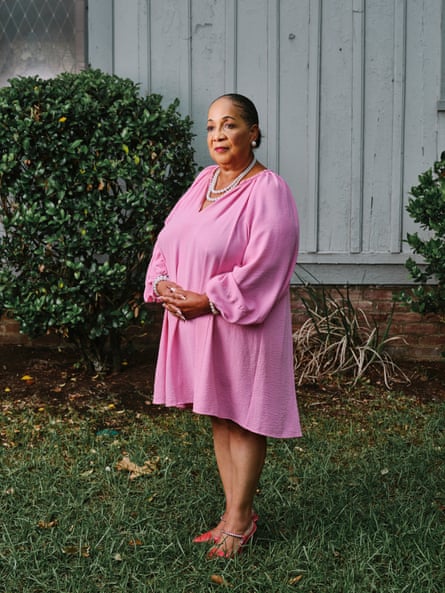
Sheyann Webb-Christburg, known as the “smallest freedom fighter” of the 1960s civil rights movement, remains an active voice for civil rights today. Photograph: Matt Odom/The Guardian I remember the first time I truly understood what freedom meant. I was just a little girl – eight years old – living right next door to Brown Chapel church in Selma, Alabama. One day, I saw all these men getting out of cars and making their way toward the church, and I didn’t know who any of them were. Then someone introduced us to Dr [Martin Luther] King [Jr]. He immediately started talking to us, asking us normal questions that adults ask children. When they were about to go in the back for a prayer meeting, the man who introduced us said we’d have to stay behind – but Dr King suddenly said no. He took us by our hands and said, “Let them stand,” and he brought us into that room, pulled up chairs and sat right in front of us, continuing to have conversations with us. That was special. I was just filled with excitement.
But my parents told me to stay away from that church. I didn’t quite understand it then, but later I would come to understand they were afraid – afraid of the Ku Klux Klan, afraid of losing their jobs. But as a child, I had already come to understand that I was fighting for them. And so I was disobedient. I would slip out of my backdoor constantly to go to meetings, to march alongside freedom fighters, and there were times when I even skipped school. That seed was planted right there in Selma.
On 7 March 1965 – Bloody Sunday – I remember vividly participating as the youngest little eight-year-old on that march. I wasn’t gonna let nobody turn me around. Once we had reached the Edmund Pettus Bridge, and I looked down, I saw hundreds of policemen with teargas masks, state troopers on horses, the dogs, the billy clubs. I remember the leaders of that march – the late congressman John Lewis and Hosea Williams. They were asked to turn the marches around. However, they refused. And after they refused, racism unleashed its brutality upon the marchers. Teargas had begun to burst in the air. People were being beaten down to the ground, as if they weren’t human beings. I remember the horses and the dogs trampling over people, pushing their way into the crowd. My God. I remember that teargas burning my eyes.
As I was trying to make my way back home to the George Washington Carver projects, I’ll never forget the late Hosea Williams picking me up. My little legs were still galloping in his arms, and I turned to him, devastated, and I said in my own childish words: “Put me down, because you are not running fast enough.”
The Bloody Sunday march was an effort for African Americans to gain their right to vote. Much blood, sweat and tears were shed in an effort for people to gain that right. And today, when we look at the supreme court’s action against the Voting Rights Act, it’s really a kneecap – a way to discriminate, to silence voters who fought so hard for this right. To put a special effort of voter suppression, at this time, in 2026 – that saddens me. I think this is not only illegal and unconstitutional, but I think it’s an assault on the struggle of the civil rights movement.
We cannot turn around. We’ve come too far. This supreme court decision should be a wake-up call for us to become more cognizant – more woke – on the reality of what is happening. We need to stay out here. We need to place much more emphasis on training and voter education, not just at election time, but throughout. We have not come this far to go back.
From the very beginning, I understood in a very significant way the importance of becoming registered voters. I saw many times where Black folks, if they knew we were coming to talk to them about registering, they would slam their doors. They were afraid. So many of them were afraid. And that only made me more determined. Because I knew that even though I wasn’t old enough to vote myself, I could still be out there encouraging others. That’s what gave me a much clearer understanding, as a child, of how important it was for our people to exercise that right.
‘Racism is still the root of the structure’
Constance Slaughter-Harvey
79, the first Black female graduate of the University of Mississippi Law School, the only female founder of the National Black Law Students Association and the first Black female judge in Mississippi.
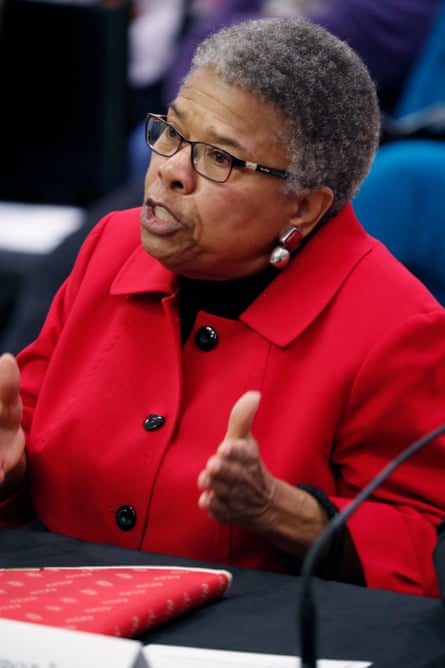
Among many other achievements, Constance Slaughter-Harvey was the first Black female judge in Mississippi. Photograph: Rogelio V Solis/AP At six years old, I knew that there were certain things that African Americans couldn’t do. And that made me more determined to do them – and I felt that way about the ballot.
I met Medgar Evers [the NAACP’s first field secretary in Mississippi] in 1963, and he, along with my father, encouraged me to be actively involved in securing the right to vote for everybody. Medgar was good-looking. He spoke the right language. He was not afraid. He was very articulate. He had a swagger. And then he was murdered in front of his children, so that added more fuel to the fire in my heart.
The mindset for this country tells us, as African Americans, that we must fight to keep whatever semblance of freedom that we have. The only way you can do that is to vote. Medgar said, once you register, you threaten the system with your vote. I’ve adopted that. The white power structure, they know that if you vote, it’s over – and that’s what happened. We managed to bring about change.
We always thought that we could outgrow racism and that racists would die out. But racism is still the root of the structure. I tell people: “We do well surviving, but we have to prevail.” Survival is not sufficient. Our children must reach their full potential, because we’ve invested too much in this society not to demand that.
I’ll be 80 this year. I’m not about to get out and march any more, but at the same time, I’m not ever going to be content with being second class. I may not be able to beat you physically fighting, but I know one thing: if we get into a fight, you won’t come out looking like you looked before you went in. And you may knock me on the ground, but now your hair will be messed up. Your clothes may be torn up, because it’s not going to be an easy fight. That’s what these young people have to believe.
‘We’re going backwards’
Benny Tucker
86, a Selma foot soldier and Martin Luther King Jr’s bodyguard.
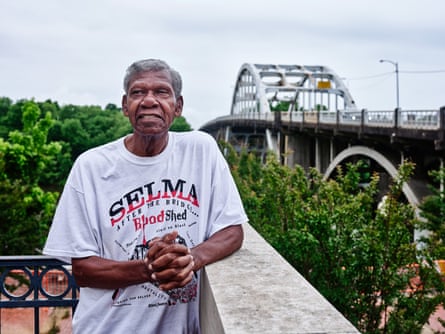
The Rev Benny Tucker, who served as a bodyguard to Dr Martin Luther King Jr, became one of Selma’s most unsung figures in the fight for justice. Photograph: Matt Odom/The Guardian I went through a lot of things that never made me comfortable in the city of Selma. We couldn’t eat in the restaurant unless we went through the back door. There were white and Black water fountains. The drug stores and movies were all segregated. If you would try to go in to eat at a restaurant, they’d close the door and tell us we had to get it from the side. It was a horrible time growing up. So we decided that we would start protesting.
By then, a leader at the university, who was 33, started talking with us and we got comfortable with being non-violent. Because we knew someone was going to get killed and we knew some of us would get killed. That was a chance we had to take.
On Bloody Sunday, we were fighting for the right to vote. There were about 100 people who risked their lives trying to vote here in Dallas county in the city of Selma. If you tried to go in there to vote, they’d make you take a test: how many jelly beans in the jar? How many marble bars? How many rocks? How many pieces of rice in the bowl? Then they would tell you you didn’t pass or that you were disqualified.
Before we got to the Edmund Pettus Bridge that day, the movement had already started. After [activist] Jimmie Lee Jackson was killed by a state trooper [for organizing a peaceful voting rights march], we decided to leave Marion, [Mississippi], where he was killed, and carry his body to Montgomery and put it on the state capitol.
We had no idea that the state troopers would stop us. Jim Clark, at that time, was the sheriff. He wore a big button on his shoulder that said “never” to integration and Black voter registration. He had formed a posse of a bunch of uneducated men, including the Ku Klux Klan, who were carrying sticks and billy clubs and riding horses. As they got over the bridge, they blocked us off and told us to turn around and go back. We said we were going to Montgomery, and we didn’t leave. They started shooting teargas. They were taking their horses and running us over and beating us with billy clubs. I was hit upside the head. With all that teargas, we were blind. I was able to run and make it back to Brown Chapel church.
[This was broadcast on TV], but they didn’t care. Those white people didn’t care about that. They were after Governor Wallace’s instructions: segregation, now and forever.
I didn’t think we needed a Voting Rights Act. I always felt that way in my heart. I was MLK’s body guard here in Selma, and I told him that and he told me, “Tucker, yes, we do.” My mind was telling me this day was coming. All I said was, “Dr King, we don’t need a Voting Rights Act because someone is going to come along and change it. What we need is a president strong enough to enforce the law.”
So here we are at the turning point now. Now, we have to keep marching and let our voices be heard. We’re going backwards. There’s no leadership. All of the famous people I walked with are now gone. I’m about the oldest one of them left, at 86 years old. We look to the supreme court to be the law of the land, but there are no laws of the land. The supreme court is turning its back on all American citizens. But we have to have faith. We need to get on that bus and go to Washington, march again. What’s happening now has happened before, and they made it through.
‘Don’t be discouraged, even though this is a discouraging time’
Flonzie Brown-Wright
83, the first Black woman elected official in Mississippi post-Reconstruction, who helped register thousands of voters in the state.
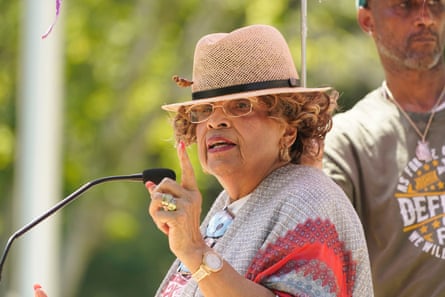
Flonzie Brown-Wright, a longtime Mississippi civil rights activist. Photograph: Rogelio V Solis/AP When a Black person went to register to vote, they were given, including myself, a 21-item questionnaire. When you got to item number 17, you had to go to the registrar’s desk, reach in a cigar box, pull out a folded section of the Mississippi constitution and interpret that section to his satisfaction. He may or may not have known if your answer was correct or not. But what he had was power: the power to either allow you to register or deny you. If he denied you, the law said you could not come back within 30 days to try again. We didn’t have a word for that at that time, but that was clear voter suppression.
When I was born, my daddy didn’t have the right to vote. My mother didn’t have the right to vote. My grandfather couldn’t read because he couldn’t go to school. Our people, our grandparents and foreparents and ancestors, took us as far as they could go. They knew they would never see the day that they could vote freely, that they could register, that they could become elected officials. But they had high hopes for us that they laid a footprint, a pathway for us to be able to do those things. We have to do the same thing. I’ve been in this struggle for 63 years. Every day, if there’s an opportunity to share encouragement, to share validation, I’m going to do that.
I wanted to help, but I did not see myself as a leader. I did not see myself as one in the forefront, but my community did. When Mrs Annie Devine [who was active in the Mississippi civil rights movement] asked me to run for office, it was quite a surprise to me. I knew that there was a lot of work that needed to be done.
This is not to put a feather in my cap, but my election [to election commissioner in Canton, Mississippi] changed the narrative of Blacks being elected. Representative Robert Clark had been elected to a statewide position in 1967, being the first African American male to occupy an office. My election the next year allowed me to be the first African American female to be elected in the state in the biracial town of Canton. The next year, Charles Evers, Medgar Evers’ brother, became the mayor of Fayette, Mississippi. People began to see how important the vote was. We were having voting registration campaigns and going to the courthouse and having days where we didn’t shop with the white merchants. And so we had a whole scenario of collaborative efforts just to try to get the right to vote. The Voting Rights Act was passed in 1965, and years after that, there were still concerted efforts to keep registering. Today in Mississippi, we have more Black elected officials than any other state in the country. We changed the narrative.
Our ancestors fought with nothing. They had no education, no internet, no cell phones. They had no means, but they still fought. Harriet [Tubman] led the underground railroad. Sojourner Truth was the first Black woman to sue her plantation owner and win a lawsuit. Her baby son, Peter, was still a slave on his plantation. When she filed that lawsuit to bring Peter home, she won it, but she wouldn’t have won had she not tried.
Now, here we are today: business people, lawyers, doctors, different people in all kinds of professions. So I tell young people, don’t be discouraged, even though this is a discouraging time. At the end of the day, it’s the vote that counts. It is registered voters who decide what level of education people are going to be given. It’s registered voters who decide where red lights are going to be placed to keep kids safely crossing the street. If you don’t have a voice in that, then you have to take the crumbs that’s left over. The journey of 1,000 miles begins with one step – your one vote. And it does matter.
‘We’ve got to put our shoulders to the plow and work harder and smarter’
Doris Crenshaw
83, started organizing for voting rights at age 12, with Rosa Parks.
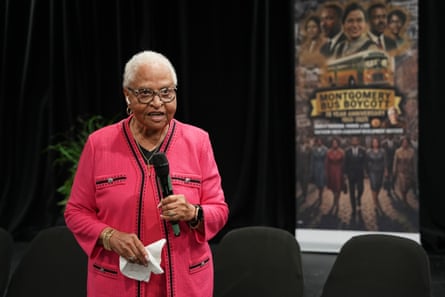
Doris Crenshaw organized with Rosa Park as a youth. Photograph: Olivia Bowdoin/AP I was born in Montgomery, Alabama, and when I was 12 years old, Mrs Rosa Parks asked my grandmother if I could become a part of the NAACP’s youth council. I travelled the state with Mrs Parks, who was collecting information about different ways Black people were being attacked in Alabama. We went house to house, asking people to go down to register to vote. We talked to them about voter suppression and about education, and we attended workshops on the type of obstacles people faced, like stupid jelly bean questions to discourage them from registering. Mrs Parks herself was registered after three attempts; on her fourth, they let her through – but her husband was never registered. Ever.
By 1965, I was a college student in Atlanta. I came back to Montgomery to participate in the last leg of the [Selma] march. We celebrated the Voting Rights Act when it was passed that year. It put another fire in us, and we were encouraging people everywhere to register and to vote. That same year, I became a deputy registrar in Atlanta. I’ve been registering people to vote and working on voter turnout for more than 70 years.
But I’ll tell you the truth. When they gutted section 2 of the Voting Rights Act, I was expecting it. They’ve been working on getting rid of it almost since the bill was passed. It feels like we’ve got to put our shoulders to the plow and work harder and smarter. We’ve got to register people to vote like we never registered to vote before. We’ve got to put a fire in the hearts of people who are registered but do not vote. We’ve got to encourage white people and Black people and people of all colors to turn out.
The young people today want to be engaged. We have to go back into the churches and all organizations and schools. We just have to provide a platform and a space for them. We just got to stay lifted up.
- US news
- Building power
- Civil rights movement
- US supreme court
- US voting rights
- Race
- Black US culture
- features
Схожі новини
У Чорнобильській зоні триває ліквідація масштабної лісової пожежі
Germany’s business ties to Russia delayed aid to Ukraine, historian says

На Херсонщині загинула жінка, поранено чоловіка через удар ворожого БпЛА