Watch NASA's Curiosity rover 'struggle' to remove a rock that got stuck on its robotic arm for nearly a week
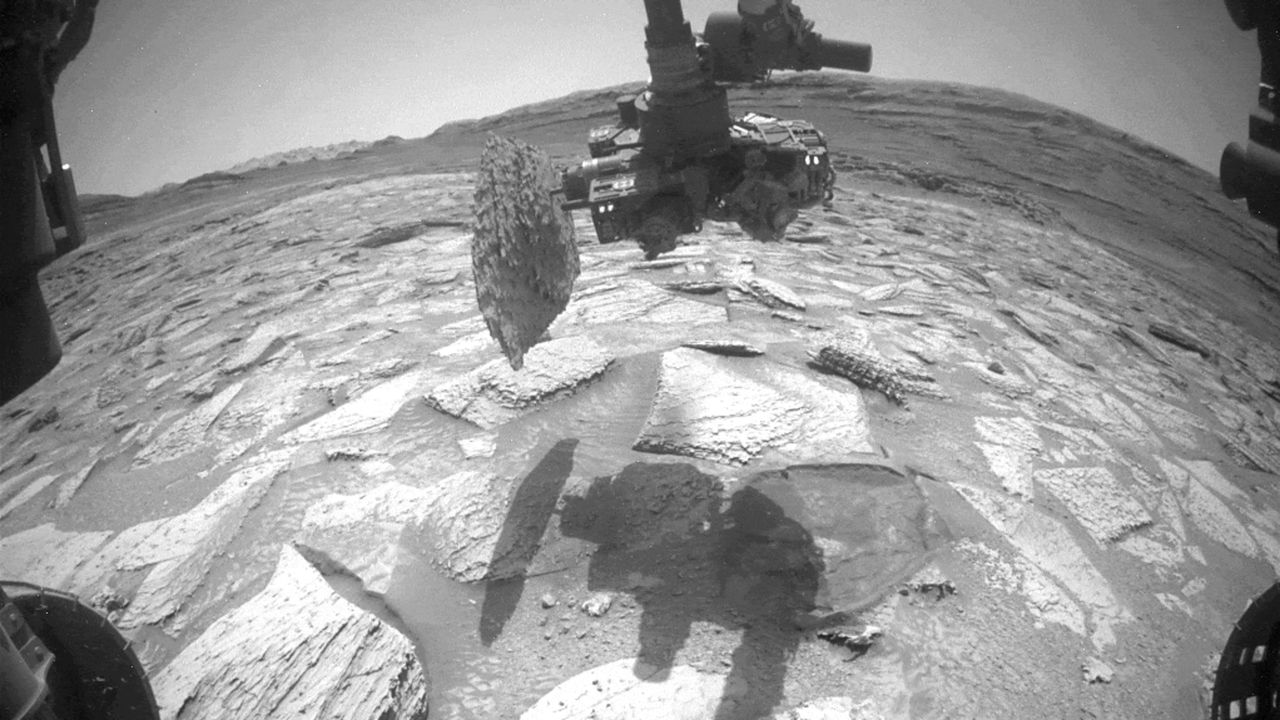
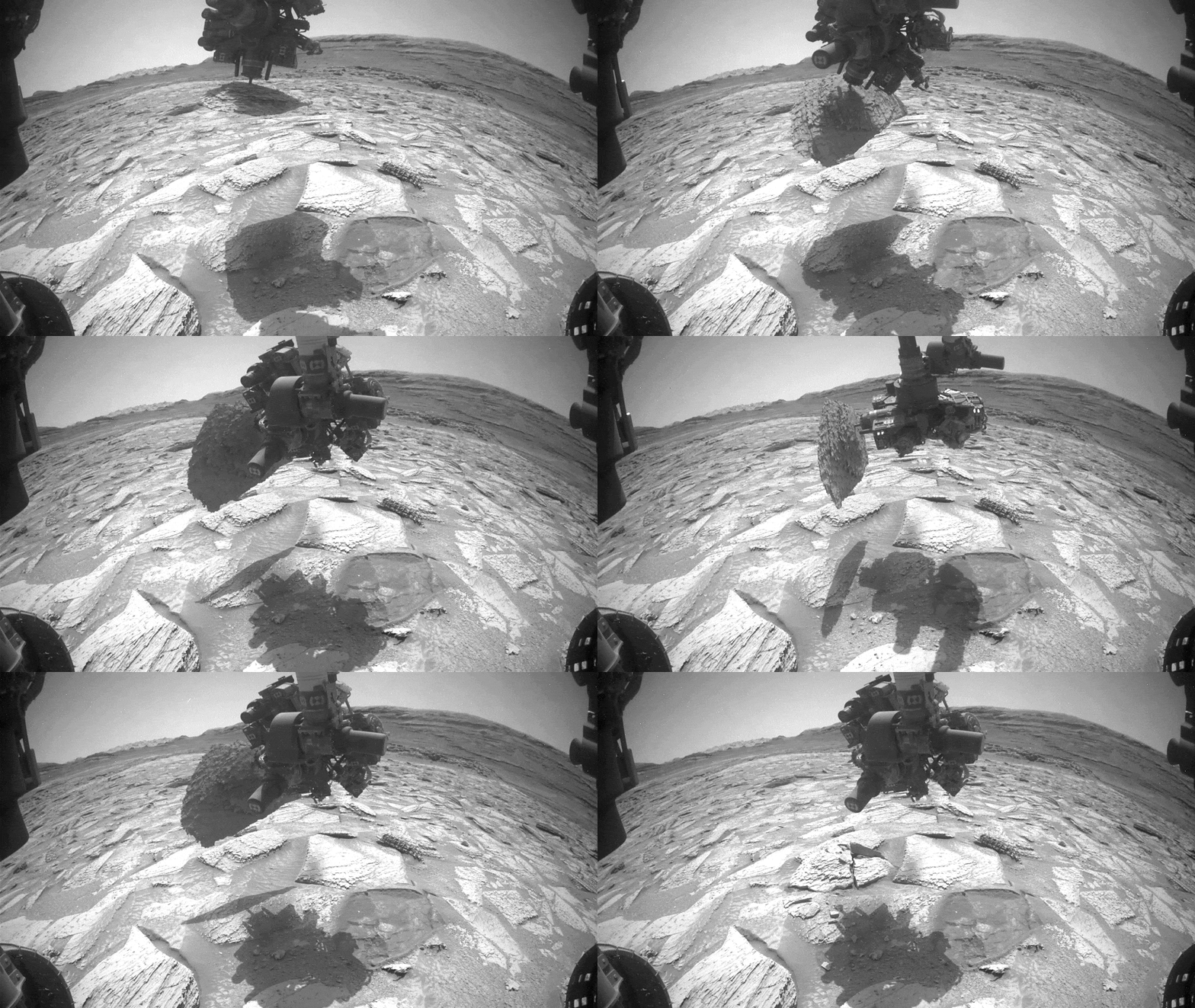
The scientists operating NASA's Curiosity rover are breathing a sigh of relief after successfully removing a troublesome rock that got stuck on the end of the Mars rover's robotic arm for nearly a week. Video footage shows the robot "struggling" to shake off its pesky passenger by tilting, rotating and vibrating its metallic limb.
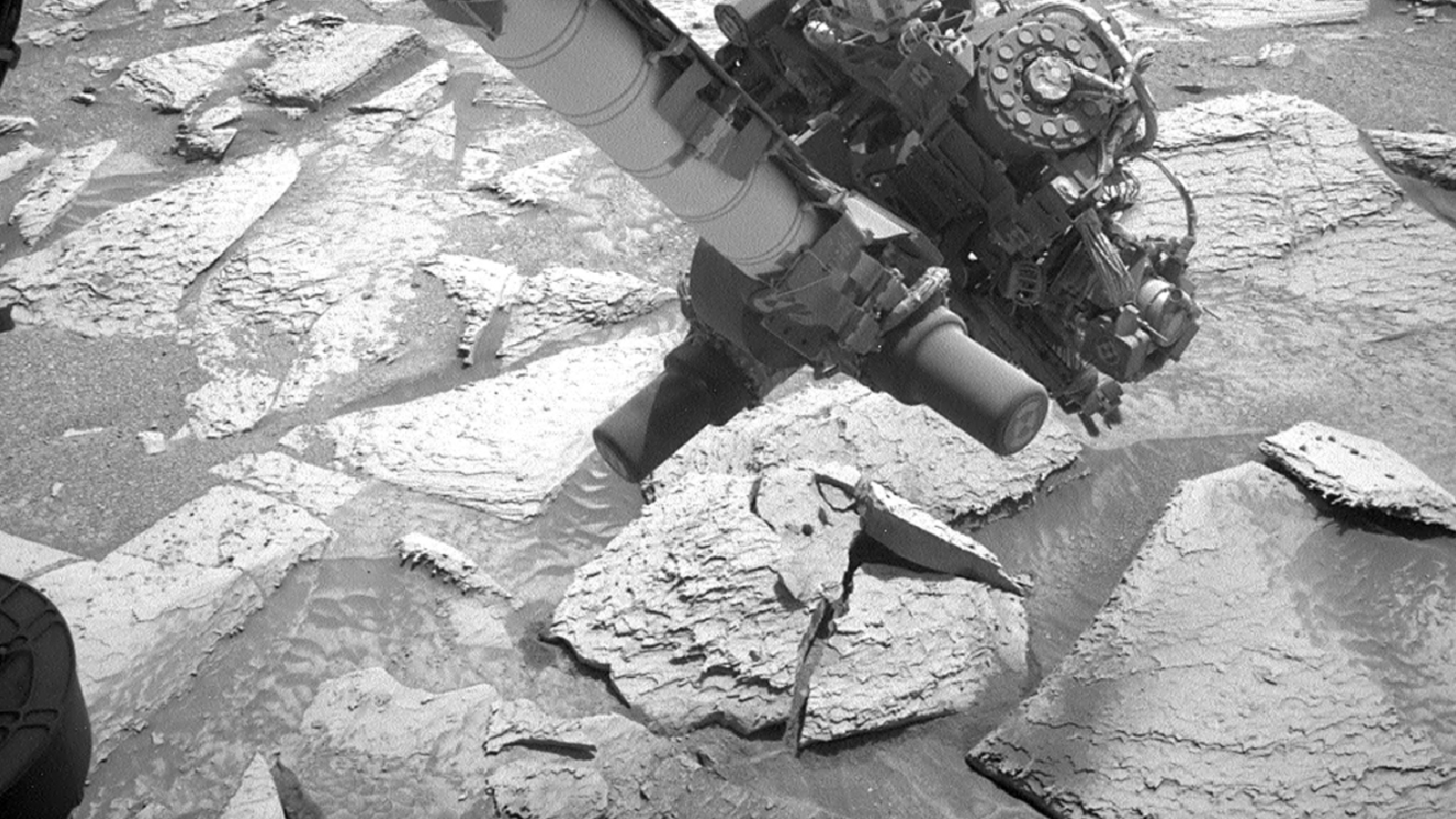
The first-of-its-kind fiasco began when Curiosity came across a fairly innocuous-looking rock, dubbed Atacama (after the Chilean desert on Earth), while exploring the slopes of Mount Sharp, which stands at the heart of Gale crater, near the Red Planet's equator. The rock was around 1.5 feet (46 centimeters) in diameter, 6 inches (15 cm) thick and approximately 28.6 pounds (13 kilograms), making it an ideal candidate for further analysis.
"When the rover retracted its arm, the entire rock lifted out of the ground, suspended by the fixed sleeve that surrounds the rotating drill bit," NASA representatives wrote in a statement. "Drilling has fractured or separated the upper layers of rocks in the past, but a rock has never remained attached to the drill sleeve."
This posed an entirely new problem to the scientists controlling Curiosity, who "went to work to develop a plan to extract the drill bit from the rock," Bill Farrand, a senior research scientist at the Space Science Institute in Boulder, Colorado, who worked on NASA's Mars Exploration Rover mission, wrote in a NASA blog post. But this ended up being something of a "struggle," he wrote.
Mars rock gets stuck on Curiosity rover's drill - Takes 5 days to shake off - YouTube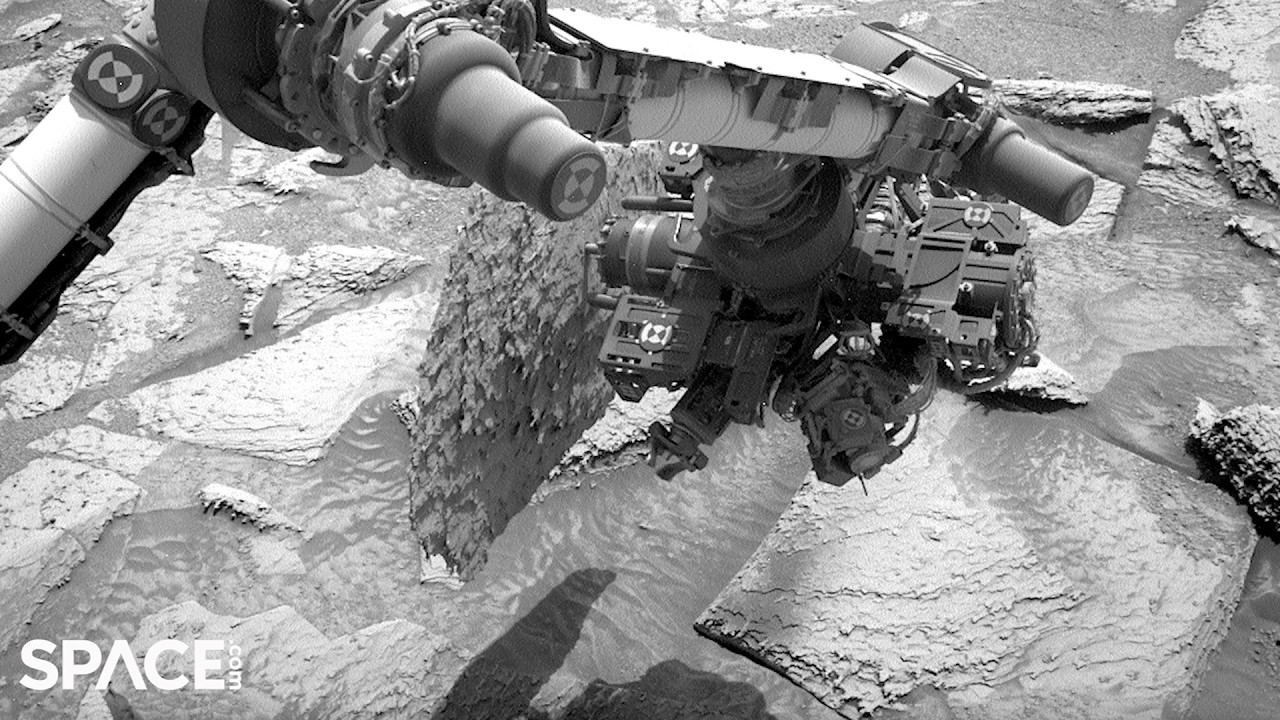 Watch On
The Curiosity team initially tried to remove Atacama by "vibrating the drill to shake off the rock," but they were unsuccessful. On April 29, they tried to vibrate the drill while reorienting the arm. However, this only managed to shake tiny, sand-like fragments off the rock.
Finally, on May 1, the rock dislodged after the team attempted "tilting the drill more," as well as rotating, vibrating and spinning the drill bit. They had planned to do this multiple times. However, the rock separated at the first attempt and fell back to the Martian surface, Farrand wrote.
Sign up for the Live Science daily newsletter nowImages show that Atacama fractured into at least two pieces upon impacting the ground.
Atacama broke into multiple pieces after it fell from Curiosity's drill and landed on the ground.
Unfortunately, the sample, or drill tailings, were "lost from Atacama as part of the effort to dislodge the drill bit from the rock," Farrand wrote. The Curiosity team is, therefore, "seeking a more firmly rooted drill target in order to collect drill tailings for analysis," he added.
A busy few months
Curiosity has been through a lot since it first landed on Mars in 2012, but the past few months have been particularly eventful for the wandering robot.
RELATED STORIES
- NASA's Curiosity rover snaps extremely detailed 'postcard' of Martian landscape after waking up from a 'brain-boosting nap'
- New NASA images reveal giant hole in Curiosity rover's wheel after 12 years of 'abuse' on Mars
- NASA's Curiosity rover accidentally reveals ultra-rare sulfur crystals after crushing a rock on Mars
In late April, researchers revealed that the rover had collected seven organic molecules at once — the largest single haul on Mars to date — to go along with a "giant string" of hydrocarbons discovered in February. (Both of these findings offer clues about the potential for ancient alien life on the Red Planet.)
A few weeks earlier, in early April, Curiosity also snapped photos of dozens of what look like "dragon scales" scattered across the ground. And in March, the robot found ruby-like crystals hidden within rocks similar to Atacama.
Prior to these findings, the rover had spent more than six months closely studying a series of ridge-like features, dubbed boxwork, which look like giant rocky spiderwebs zigzagging across the Red Planet's surface, and, most recently, discovered that they are covered in tiny, egg-like structures.
Mars quiz: Is your knowledge of the Red Planet out of this world?
TOPICS
Harry is a U.K.-based senior staff writer at Live Science. He studied marine biology at the University of Exeter before training to become a journalist. He covers a wide range of topics including space exploration, planetary science, space weather, climate change, animal behavior and paleontology. His recent work on the solar maximum won "best space submission" at the 2024 Aerospace Media Awards and was shortlisted in the "top scoop" category at the NCTJ Awards for Excellence in 2023. He also writes Live Science's weekly Earth from space series.
View MoreYou must confirm your public display name before commenting
Please logout and then login again, you will then be prompted to enter your display name.
LogoutСхожі новини

Nature’s giant vacuum cleaner: Scientists reveal how the Sun is secretly cleaning Earth’s space junk
My English skills are hurting my chances in academic publishing — how can I improve?
Early-career researchers do more ‘disruptive’ science than veterans