Visa adds Polygon, Base support as stablecoin settlement run rate hits $7B


 Written by Sam Bourgi, Staff Editor. Reviewed by Robert Lakin, Staff Editor. Written by Sam Bourgi, Staff Editor. Reviewed by Robert Lakin, Staff Editor. Visa adds Polygon, Base support as stablecoin settlement run rate hits $7BLatest NewsPublishedApr 29, 2026
Visa broadens its crypto pilot to nine blockchains as stablecoin volumes grow, highlighting early traction for onchain settlement in global payments.

Global payments giant Visa has expanded its stablecoin settlement pilot to include Polygon and four other blockchain networks, signaling continued experimentation with crypto-based payment infrastructure.
The pilot, launched by Visa in 2023, allows partners to settle transactions using stablecoins rather than traditional banking rails. Newly supported networks include Polygon, Base, the Canton Network, Arc and Tempo. They join existing supported chains such as Ethereum, Solana, Stellar and Avalanche.
The expansion comes as the program has reached an annualized settlement run rate of roughly $7 billion, growing about 50% quarter over quarter, according to Visa. Despite that growth, volume remains small compared to the company’s core payments business.
According to Visa, the initiative is designed to evaluate whether stablecoins can offer faster settlement, round-the-clock availability and efficiencies in cross-border payments.

Source: Cointelegraph on X
Visa has been increasing its focus on stablecoin-based settlement. In March, the company expanded its partnership with Bridge, a subsidiary of Stripe, to support a global card program that enables stablecoin-linked payments.
Related: Visa deepens blockchain push with Tempo validator node launch
Stablecoin payments race heats up
The growing focus on stablecoin settlement comes as competitors such as Mastercard step up activity in the sector, including enabling stablecoin-linked card spending in the United States through integrations with wallets like MetaMask.
On Wednesday, payments software provider Modern Treasury said it integrated with Polygon to help businesses move stablecoin payments faster, adding to the growing push into blockchain-based settlement. The San Francisco-based fintech acquired stablecoin and fiat payment platform Beam in October.
In the United States, momentum has also been shaped by the passage of the GENIUS Act, which establishes clearer regulatory standards for payment stablecoins.
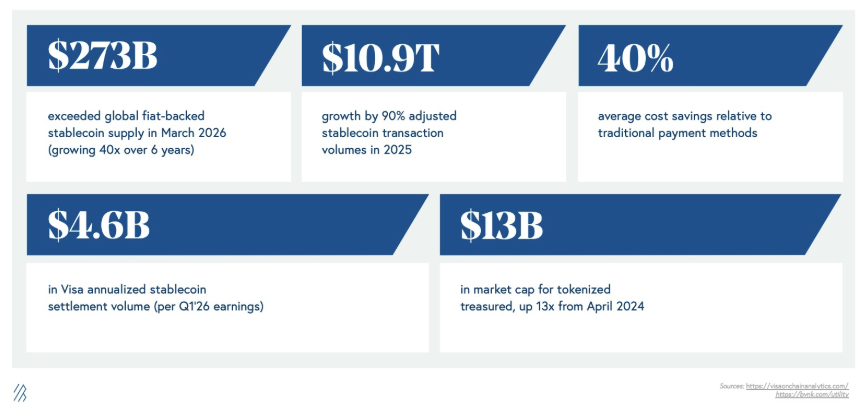
Key stablecoin statistics and average cost savings relative to traditional payments. Source: Bessemer Venture Partners
As regulatory clarity improves, both crypto-native companies and fintechs are increasingly competing to build and control the infrastructure underpinning stablecoin payments, particularly the settlement layer that moves funds between institutions. However, broader policy questions, including whether stablecoins can offer yield, are still being debated in a proposed US market structure bill, which has so far stalled.
The total value of stablecoins in circulation has surpassed $320 billion, increasing nearly 150% since early 2024, according to DeFiLlama data.
Related: Polymarket drops USDC.e for USDC-backed token in exchange overhaul
Cointelegraph is committed to independent, transparent journalism. This news article is produced in accordance with Cointelegraph’s Editorial Policy and aims to provide accurate and timely information. Readers are encouraged to verify information independently.Схожі новини

Meta Launches USDC Stablecoin Creator Payouts on Solana and Polygon via Stripe
Eric Trump says bitcoin in its 'greatest period ever' as Wall Street falls in line

Celsius Founder Alex Mashinsky Banned From Crypto Industry in $10 Million FTC Settlement