Venice Biennale in crisis: The controversies explained
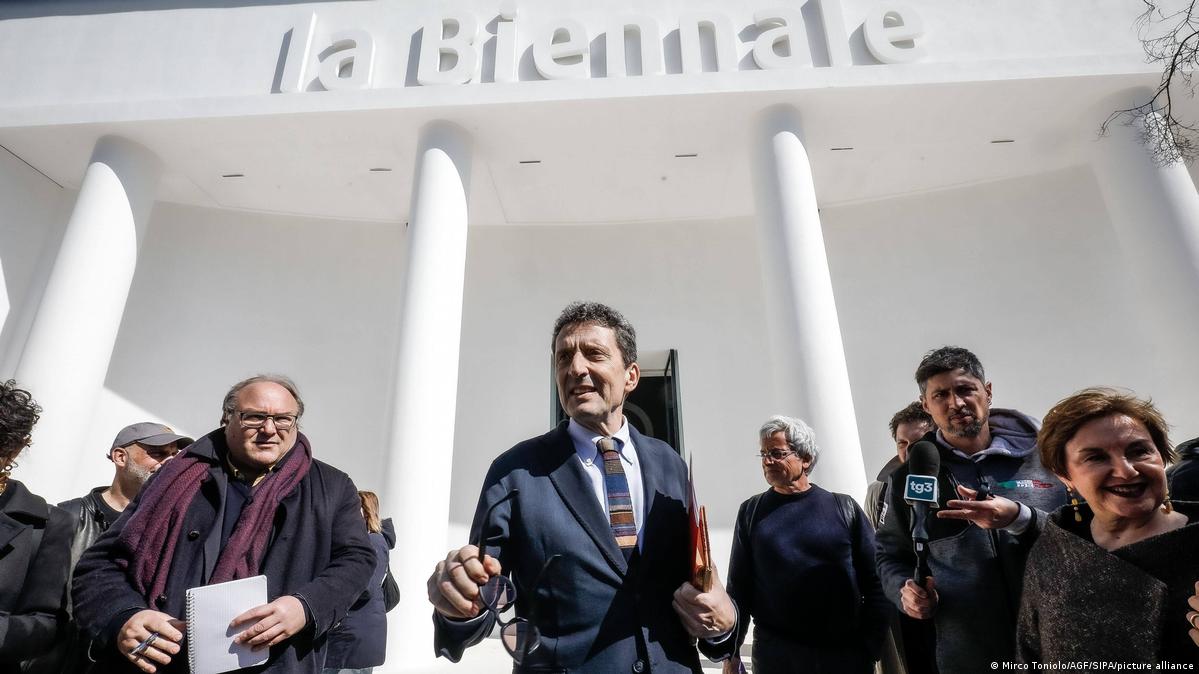
The Venice Art Biennale's official awards ceremony usually marks the event's opening, and the Golden and Silver Lion prizes typically contribute to launching artists' international careers.
But this year's Biennale — often described as the "Olympics of the art world" — is embroiled in controversy, and the traditional awarding of the coveted accolades at the start of the event on May 9 has been canceled after the entire jury in charge of selecting the prizewinners resigned, just days before the event.
Jury resigns over Israel and Russia debate
The five-member jury had previously announced in a statement that they would not consider any countries whose leaders are currently being charged by the International Criminal Court (ICC) — a decision that would have directly impacted the inclusion of Russia and Israel. The ICC has issued an arrest warrant for Russian President Vladimir Putin in 2023 based on accusations of war crimes in Ukraine, and in 2024, an ICC arrest warrant was issued for Israeli Prime Minister Benjamin Netanyahu for his country's actions in Gaza.
It remains unclear if the jury was asked to step down by the Biennale.
Instead of being selected by a jury, visitors will be invited to cast votes throughout the Biennale's run, and so-called "Visitor Lions" will be awarded on the final day of the exhibition, on November 22.
A posthumous exhibition by Koyo Kouoh
This year's event, held from May 9 to November 22, lists 100 national participations, with seven countries taking part for the first time: Guinea, Equatorial Guinea, Nauru, Qatar, Sierra Leone, Somalia and Vietnam. Iran announced its withdrawal on May 4, amid rising tensions and fears of renewed conflict in the Middle East.
The national entries accompany the Biennale's main international art exhibition, titled "In Minor Keys," which was curated by the late Cameroonian-born artistic director Koyo Kouoh, who died of cancer in May 2025, at the age of 57.
Kouoh, the first African woman chosen to curate the prestigious show, had already developed her curatorial project before her sudden death. The Biennale decided to posthumously carry out her exhibition, which features 111 invited participants.
"In Minor Keys" focuses on marginal or overlooked voices. In her concept, Kouoh defined a restorative form of resistance, which calls for attentive listening amid the present chaos.
"The minor keys refuse orchestral bombast and goose-step military marches and come alive in the quiet tones, the lower frequencies, the hums, the consolations of poetry," Kouoh wrote in her introductory text to the exhibition. "Though often lost in the anxious cacophony of the present chaos raging through the world, the music continues."
EU threatens to cut funding over Russia's participation
Following Russia's full-scale invasion of Ukraine in 2022, the country's artists and curators had voluntarily withdrawn from the event.
Russia's announced return to the exhibition in 2026 has triggered friction between Italian institutions and the EU; even within Italy's far-right government, there is deep disagreement on the issue.
The EU threatened to suspend their €2 million ($2.3 million) grant in funding for the next three years, after the Italian art exhibition allowed Russia to reopen its pavilion at this year's event.
While Italian Prime Minister Giorgia Meloni said her government opposed Moscow's presence at the Biennale, Deputy Prime Minister Matteo Salvini described the EU's threats to cut funding as "vulgar blackmail" against "one of the most important and free cultural bodies in the world."
Venice's mayor, Luigi Brugnaro, said in March that Russia's pavilion would be shut down if it engaged in propaganda, but added that the Biennale should remain a forum for dialogue.
Pietrangelo Buttafuoco, president of the Biennale Foundation, insists on keeping the Biennale "open to everyone. I close to no one," he told Italian newspaper La Repubblica. "There will be Russia, Iran, Israel. There will be Ukraine and Belarus. Everyone."
The Russian pavilion's commissioner, Anastasia Karneeva, is the daughter of Nikolai Volobuev, a former Federal Security Service (FSB) general — and the current deputy chief executive of Russian state-owned defense contractor Rostec.
Amid the fierce backlash, and following negotiations between the Venice Biennale leadership and Karneeva, Russia's pavilion will remain closed to the public and only be accessible during the preview days, from May 6-8. The Russian artists will be filmed during their performances and the video recordings will be broadcast in the pavilion's windows throughout the Biennale.
Pussy Riot's Nadezhda Tolokonnikova had previously condemned the Russian show: "Participating in the Biennale with an apolitical program is an attempt to polish Russia's image and make the world forget the victims of Russian terror," she told DW.
The Italian government should remove the representatives of Putin's Russia from the pavilion, Tolokonnikova suggested, "and instead present the works of Russian political prisoners who are now rotting in penal colonies because they spoke out against Russia's criminal war in Ukraine."
The iconic feminist art group will be traveling to the Biennale to put on a protest performance.
South Africa's pavilion to remain empty after 'divisive' work blocked
South African contemporary artist Gabrielle Goliath had been selected to represent her home country at the Biennale.
Her performance piece was to include a tribute to Palestinian poet Hiba Abu Nada, who was killed during an Israeli airstrike in October 2023.
But South Africa's culture minister Gayton McKenzie requested several edits to the work he described as "highly divisive."
Having refused to make the changes, Goliath was blocked from the pavilion, which will remain empty, as the South African government didn't nominate a replacement for the show after it was abruptly canceled in January.
A video installation version of Goliath's project will be shown at another venue in Venice that is not part of the Biennale. Goliath is suing her country's culture minister.
Australia revoked then rehired its artist
Similarly, Australia faced backlash from the arts community after dropping its commissioned duo, artist Khaled Sabsabi and curator Michael Dagostino, due to political concerns.
Right-wing politicians had accused the Lebanon-born artist, who moved to Australia at the age of 12, of antisemitism. Sabsabi's work frequently deals with his traumatic experience of civil war, as well as with Arab immigrant identity and Islamophobia.
Following calls for boycotts and resignations, as well as an independent review by an external body, the controversial decision to drop Sabsabi and Dagostino was reversed.
Calls to exclude Israel
Nearly 200 artists, curators and workers participating in the 2026 Venice Biennale have signed a letter organized by the Art Not Genocide Alliance (ANGA), calling for Israel to be banned from the show.
A second letter, signed by more than 70 artists and curators participating in the main exhibition, similarly calls to exclude Israel, but expands the call to include all "current regimes committing war crimes," including Russia and the US.
Another point of criticism in the letters is that the Biennale is providing Israel a space in the Arsenale, the central industrial complex where Koyo Kouoh's main exhibition is also held, as the Israeli Pavilion in the Giardini section is currently closed for renovation.
Romanian-born sculptor Belu-Simion Fainaru, who lives and works in Haifa, nevertheless plans on taking part in the international art show. "As an artist, I do not support cultural boycotts," Fainaru said in a statement. "I believe in dialogue and exchange, especially in challenging times."
At the previous Biennale in 2024, artist Ruth Patir closed her exhibition at the Israeli pavilion to the public on opening day, saying she would only reopen upon the establishment of a ceasefire in Gaza.
Meanwhile, there has never been a Palestinian national pavilion at the Biennale because only countries officially recognized by Italy can participate. A side exhibition, titled "Gaza — No Words," will be held in the Italian city throughout the Biennale.
'Ruin': German pavilion features late artist
Less controversially, Germany's show, titled "Ruin" is inspired by research on the GDR and the transformation period after reunification in 1990.
German installation artist Henrike Naumann, who died of cancer in February at the age 41, had completed her contribution to the German exhibition before her sudden death. "Ruin" will also feature works by Vietnamese-born Berlin artist Sung Tieu.
Patti Smith, Brian Eno, FKA Twigs to represent the Vatican
The 12th-century Saint Hildegard of Bingen, a German Benedictine abbess who is still celebrated today as a pioneer in science, ecology, music and feminist theology, will inspire the series of sonic compositions commissioned for the Vatican's exhibition, titled "The Ear is the Eye of the Soul."
It features an all-star roster of 24 artists, including Brian Eno, Patti Smith, FKA Twigs and many more.
Edited by: Sarah Hucal
This article was first published on April 23 and has been updated to reflect the ongoing changes affecting the Biennale.
AdvertisementСхожі новини

Россия атаковала Днепр: пожар на предприятии, три человека погибли, девять — пострадали

Больше чем машина. Сооснователь iRobot представил роботизированного домашнего любимца

В центре Киева прошла акция протеста против проекта нового Гражданского кодекса — фоторепортаж NV
