Ukrainian children held in Russia: militarized, 'reeducated'
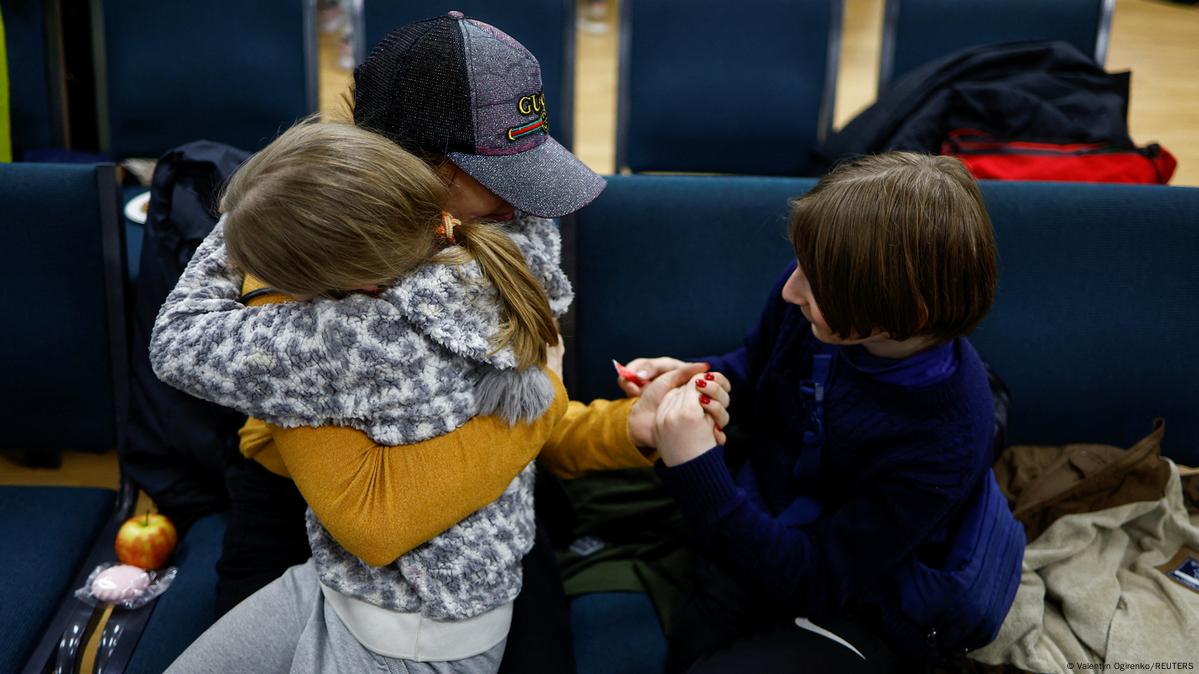
In March, the Independent International Commission of Inquiry on Ukraine of the UN Human Rights Council found that Russia had systematically deported and forcibly transferred Ukrainian children. These activities violate international human rights laws provisions and are classified as war crimes as well as crimes against humanity.
It also found that Russian authorities had "unjustifiably delayed" the repatriation of Ukrainian children, which counts as a separate war crime.
How many Ukrainian children remain in Russia?
Bring Kids Back UA, an initiative by Ukrainian President Volodymyr Zelenskyy, says it has records on about 20,570 abducted Ukrainian children.
"And those are just the cases we have more or less sufficient data on," project leader Maksym Maksymov told DW. "The true number is likely much higher."
Statements by Russian authorities appear to back this claim. In 2023, for example, Russia disclosed that it had "received" 744,000 children. That same year, Maksymov told DW, Russia reported to the United Nations Committee on the Rights of the Child that 46,000 Ukrainian children had received Russian passports.
The numbers are difficult to verify, and media reports vary widely. Children who have been successfully repatriated to Ukraine will sometimes speak of other missing children not recorded in Ukraine's database.
Identifying children and determining their whereabouts is additionally complicated by the lack of access to Russian-occupied Ukrainian territory.
"Russian authorities are arranging for children to be placed in the long-term care of Russian families and facilities," the office of Ukraine's prosecutor general told DW. "In doing so, they are violating international law which recognizes the right to reunification of families who have been separated in an armed conflict."
How many children have been repatriated so far?
So far, Ukraine has managed to track down and bring back 2,126 children that had either been deported to Russia, forcibly transferred within occupied territory, or subjected to Russian "reeducation."
Maksymov described two mechanisms for repatriating abducted Ukrainian children. One is through mediation, in which case Russian authorities receive lists with names of Ukrainian children and a human rights commissioner then negotiates their return to Ukraine.
However, Maksymov says, "each mediation only helps us return no more than ten children at once."
A second avenue is "organized repatriation." Civil society groups play a large role in this, Maksymov says.
"Sometimes this method makes it possible to bring back more children at once, but I'm not allowed to talk about how that works," he tells DW.
From deportation to 'reeducation'
"The children who are rescued are completely disoriented when they arrive,” he adds. "They mistrust adults."
He says one could clearly sense that Ukrainian children who had been deported to Russia had undergone ideological indoctrination. Without subjecting them to further "reeducation," these children receive reintegration and rehabilitation support upon their return.
Throughout the course of the war, Russia's goal to seize Ukrainian children has remained unchanged, the Ukrainian initiative says. What has changed, however, are the methods employed. In 2022 and 2023, for example, there were more instances of mass resettlements, in which groups of children were removed from children's homes and transferred to the occupied Crimean peninsula or Russia.
'Abducted children are taught to hate their native Ukraine'
To view this video please enable JavaScript, and consider upgrading to a web browser that supports HTML5 video
After the International Criminal Court (ICC) issued arrest warrants for Russian President Vladimir Putin and his commissioner for children's rights, Maria Lvova-Belova, on charges of participating in the unlawful deportation and transfer of children, Russian authorities changed tack, Maksymov says.
"They have created a multi-layered process in the occupied territories," he explains. "It spans all the way from militarization to indoctrination and brain-washing to 'Russification' and issuing Russian passports, ensuring that children grow up with a Russian mindset."
An estimated 1.6 million Ukrainian children live in Russian-occupied territory. There, Russian schools and paramilitary organizations abound. Classes are visited by "war heroes" fighting Ukraine, and students cannot access Ukrainian information sources.
Militarizing children and youth
Ukraine's prosecutor general's office says it is filing separate charges for Russia promoting military service to children, and for exposing children to military and "patriotic" education. Prosecutor General Ruslan Kravchenko has said schools and universities in Russian-occupied Ukrainian territory had been switched to Russian curricula.
"That means Ukraine's language, history and culture are being suppressed," he tells DW. "We're observing education being systematically instrumentalized to assimilate and militarize children in the occupied territories of Donetsk, Luhansk, Zaporizhzhia and Kherson. Children are being ideologically indoctrinated in these so-called 'reeducation camps.'"
He lists the Yunarmiya [the Young Army Cadets National Movement], Dvizheniye pervykh [the Movement of the First] and Voin [the Center for Military-sports Training and Patriotic Upbringing] as paramilitary youth movements that train children to use weapons, and force them to swear allegiance to Russia.
"This isn't about education, it's about preparing them for war," Kravchenko says.
He suspects that Russia plans to increase the number of youth enrolled in such movements to 250,000 by 2030, and particularly targets children in Russian-occupied Ukrainian territory to do so.
Between 2019 and 2025 at least 6,000 Ukrainian children were recruited into the young cadets movement. Kravchenko says there have been cases of Ukrainian children coming of legal age and then fighting against Ukraine.
These are classified as war crimes. Charges were being pressed against 18 individuals, and a total of 30 were under suspicion. Two have been sentenced so far, DW is told.
Ukrainian children visit US to spotlight mass abductions
To view this video please enable JavaScript, and consider upgrading to a web browser that supports HTML5 video
Andriy Pasternak heads the Security Service of Ukraine's joint center for the search and release of prisoners of war. He says children in Russian-occupied territories are becoming increasingly militarized, and adds that Ukrainian authorities were already holding prisoners between the ages of 19 to 20 who had been fighting for Russia.
He explains these prisoners had been born in the Donbas region, reeducated to fight for Russia, and then conscripted into the Russian army. "They are sending Ukrainians to fight Ukrainians," Pasternak said in April at a civil society conference for the Bring Kids Back UA initiative.
How does the international community support?
In late 2025, the UN General Assembly adopted a resolution on the return of Ukrainian children that authorizes Secretary-General Antonio Guterres and the UN Special Representative for Children and Armed Conflict, Vanessa Frazier, to request information about children, ensure humanitarian access to them, and ensure their safe return.
The International Coalition for the Return of Ukrainian Children, which currently includes more than 40 countries and organizations, also backs the resolution. The platform coordinates measures to help Ukrainian authorities locate, repatriate, and reintegrate children. It also helps document war crimes and advance investigations into them.
Maksymov says Ukraine has already proposed ways international partners can support the initiative's efforts, like helping locate abducted individuals, or verifying data to facilitate their return.
This article originally appeared in Ukrainian and was adapted from German.
Advertisement