Ukraine: EU sanctions Russians over 'systematic unlawful deportation' of children
What you need to know
- The EU announces new sanctions against Russians tied to child abductions at a special meeting
- Germany's Defense Minister Boris Pistorius visits Kyiv amid the shaky ceasefire declared by Donald Trump
- Ukraine's Zelenskyy says planned prisoner swap still being worked on with the US
- Sweden arrests two accused of helping Russia circumvent sanctions
- European politicians laugh off Russia floating Gerhard Schröder as a potential negotiator
- Finland's President Alexander Stubb says it may be time for Europe to talk to Putin
Follow DW for updates on news about or related to Russia's invasion of Ukraine on Monday, May 11.
Skip next section Sweden arrests 2 accused of helping procure advanced engineering kit for Russia05/11/2026May 11, 2026Sweden arrests 2 accused of helping procure advanced engineering kit for Russia
Sweden's SAPO security service on Monday said that two people had been detained on suspicion of helping Russia procure advanced engineering products that could be used in the war against Ukraine.
Agents suspected the equipment reached Russia in violation of EU sanctions, SAPO's Deputy Head of Operations Christoffer Wedelin told the Reuters news agency.
"The Russian war industry depends on technology, including from Sweden, to continue its war of aggression in Ukraine," Wedelin said.
Officers searched several sites in Stockholm and in southern and western Sweden amid the operation.
Court documents identified the suspects as two men, a Swedish and a Turkish national. One was formally detained at a Stockholm court on Friday, the other faced a detention hearing on Monday.
Several of the EU sanctions on Russia relate to so-called "dual-use goods," items that are not weaponry and have civilian uses but can also be put to use on the battlefield.
Swedish defense minister explains how Russia is testing NATO
To view this video please enable JavaScript, and consider upgrading to a web browser that supports HTML5 video
https://p.dw.com/p/5DayLSkip next section Germany's Defense Minister Boris Pistorius visits Kyiv05/11/2026May 11, 2026Germany's Defense Minister Boris Pistorius visits Kyiv
For the lowdown on German Defense Minister Boris Pistorius arriving in Kyiv this morning, not to mention all the other major news in Germany this Monday, look no further than our daily updates.
Pistorius met his counterpart Mykhailo Fedorov, and described Germany and Ukraine as "strategic partners."
"On the one hand, we continue to support you in your defensive struggle, but on the other, we are increasingly building a structured, long-term partnership to be reckoned with," Pistorius said.
He said the focus would be on "state of the art unmanned systems," particularly long-range ones.
Pistorius and Fedorov signed a declaration of intent on a new "Brave One" platform, a project that seeks to support developers who demonstrate promising defense innovations.
He was skeptical about Putin's weekend comments about the war nearing its end, saying the ball was ultimately in the Kremlin's court.
"If he sees the end of this war approaching, he could simply end this war," Pistorius said.
https://p.dw.com/p/5DawXSkip next section EU sanctions Russians allegedly linked to child abductions05/11/2026May 11, 2026EU sanctions Russians allegedly linked to child abductions
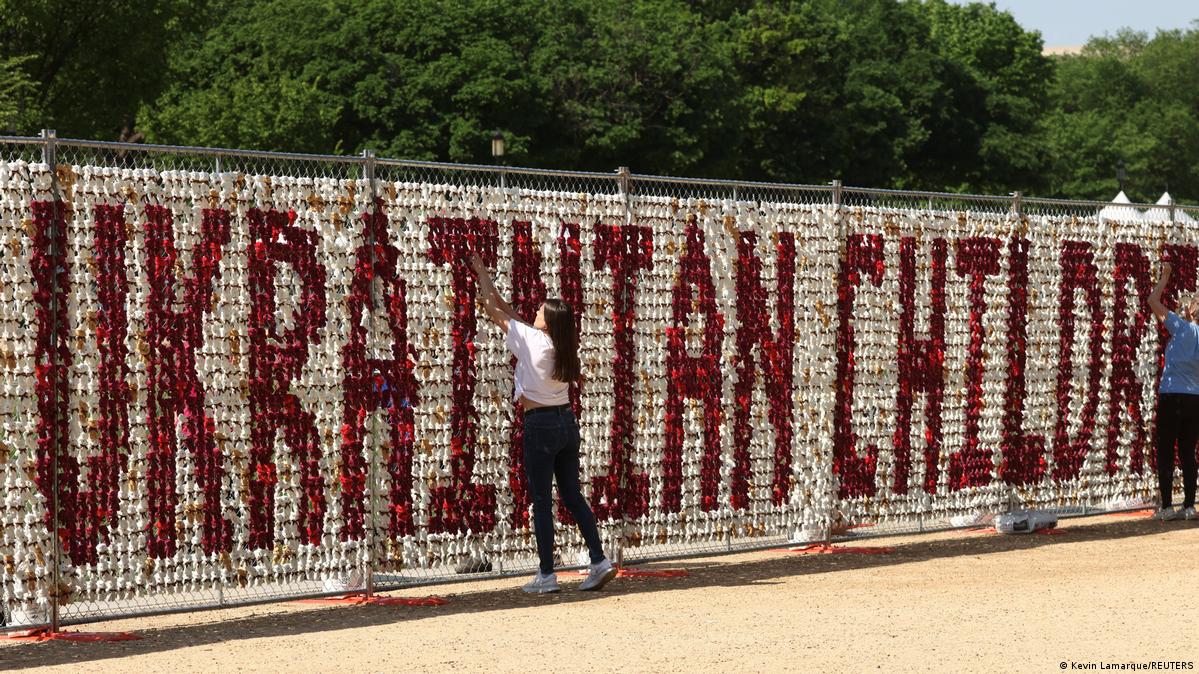
The European Council has announced new sanctions targeting 16 Russian individuals and seven entities "responsible for the systematic unlawful deportation, forced transfer, forced assimilation, including indoctrination and militarized education, of Ukrainian minors."
It said they were also involved in "their unlawful adoption and removal to the Russian Federation and within temporarily occupied territories," in reference to the areas internationally recognized as part of Ukraine under Russian control.
According to the Council, Russia is estimated to have deported and forcibly transported nearly 20,500 Ukrainian children.
"These actions constitute grave breaches of international law and a violation of the fundamental rights of the child and aim to erase Ukrainian identity and undermine the preservation of its future generations," the European Council said.
This topic of child abduction also underpins the longstanding International Criminal Court arrest warrant issued against Russian President Vladimir Putin.
The EU listed several entities tied to the Russian Ministry of Education and individuals, including some working in occupied Ukrainian regions.
It said those listed were subject to asset freezes — and travel bans in the case of individuals — and that EU citizens and companies were forbidden from doing business with or providing funds to them.
The European Council is the arm of the EU that brings together all 27 heads of state or government of the member states. It needs to sign off on major foreign policy issues like bloc-wide sanctions.
Ukrainian families face difficult search for missing kids
To view this video please enable JavaScript, and consider upgrading to a web browser that supports HTML5 video
https://p.dw.com/p/5DayISkip next section EU politicians reject Russia's Gerhard Schröder negotiation jab05/11/2026May 11, 2026EU politicians reject Russia's Gerhard Schröder negotiation jab
European governments on Monday rejected Russian President Vladimir Putin's suggestion that former German Chancellor Gerhard Schröder could represent them in potential future talks with Moscow on the war in Ukraine and European security.
Putin said on Saturday, amid Moscow's celebrations of the 81st anniversary of Nazi Germany's surrender at the end of World War II in Europe, that he believed the war in Ukraine was coming to an end.
European leaders said it was clear why Putin had floated Schröder, who took high-paying corporate jobs with Russian energy companies after his 1998-2005 tenure as chancellor, as his preferred negotiating partner.
"It's clear why Putin wants him to be the person — so that actually ... he would be sitting on both sides of the table," EU foreign policy chief Kaja Kallas told reporters in Brussels. "If we give the right to Russia to appoint a negotiator on our behalf ... that would not be very wise."
Germany's Europe Minister Gunther Krichbaum said Schröder was unsuited to the role, reinforcing similar comments hurriedly shared with the media by sources from government offices in Berlin on Sunday.
"He is, and certainly has been, heavily influenced by Mr. Putin," Krichbaum said. "Close relationships may be legitimate anywhere in the world, but they do not help one to be perceived as an impartial mediator."
Why Putin turned to ex‑German chancellor as a peace broker
To view this video please enable JavaScript, and consider upgrading to a web browser that supports HTML5 video
https://p.dw.com/p/5DayFSkip next section Welcome to our coverage05/11/2026May 11, 2026Welcome to our coverage
Mark Hallam | Alex Berry EditorHello and welcome to our updates on the war in Ukraine, amid a tense ceasefire that began on May 9 at the declaration of US President Donald Trump and was set to run for three days.
It was a charged week in Russia and Ukraine amid the 81st anniversary of the end of World War II in Europe and the arguments over whether and when to halt fighting amid the dates.
President Vladimir Putin gave a speech over the weekend in which he seemed to suggest that the war could be "coming to an end."
However, Putin also used the speech to make some fanciful suggestions like charging former German Chancellor Gerhard Schröder — also a former Gazprom executive with an at-best tarnished reputation in Germany and with a far less positive image in eastern Europe and Ukraine — with negotiating between the warring factions.
This was seen by some, including in Berlin, as an indication that the Russian leader's comments were not entirely sincere or serious.
https://p.dw.com/p/5DayGShow more postsСхожі новини
У 199-му навчальному центрі ДШВ на 40% зменшилася кількість СЗЧ - начальник штабу

Інфляція в Україні на кінець року прогнозується близько 9,4% - член Ради НБУ
Деякі країни Європи відмовилися надавати Україні ракети для систем "Патріот", - WP
