Ukraine: EU, Germany summon Russian envoys after Moscow tells diplomats to leave Kyiv
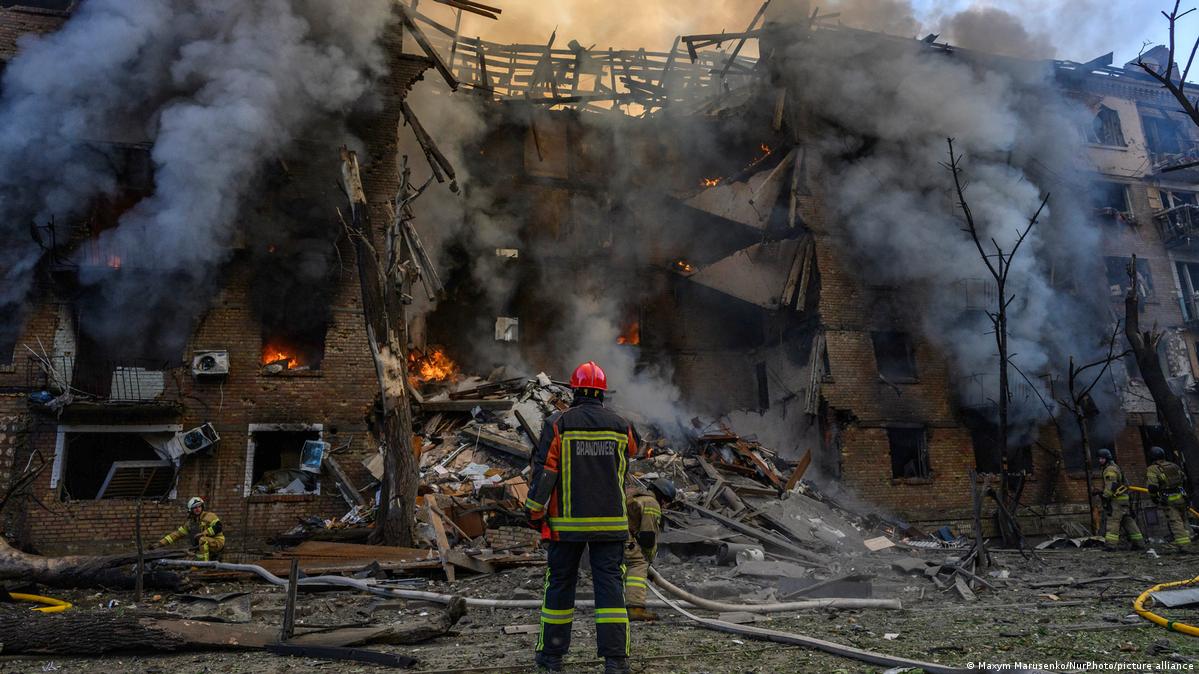
The EU, Germany, several UN members and Secretary-General Antonio Guterres all rebuked Russia on Tuesday for Sunday's bombardment of the Ukrainian capital Kyiv and Moscow's call for foreign diplomats to leave the city for their own safety.
Sunday's attack was one of the larger bombardments of Kyiv in the four-year Russian invasion. And on Monday, the Kremlin announced that it planned more such attacks that would "systematically" target what it said were defense companies and other military targets in the city.
Russia had first raised the prospect of widespread attacks on Kyiv earlier in May, amid the two sides' bickering over a possible ceasefire to mark the anniversary of the end of World War II in Europe in 1945. Both times it said it was responding to Ukrainian long-range drone strikes on Russian territory.
Russia launches drone barrages, hypersonic missile at Kyiv
To view this video please enable JavaScript, and consider upgrading to a web browser that supports HTML5 video
What did Germany and the EU say as they summoned Russian diplomats?
Germany's Foreign Ministry said online that it had summoned Russia's ambassador and made clear "that we will not be intimidated by threats and will continue to support Ukraine wholeheartedly."
It listed some of the sites struck on Sunday.
"Attacks on hospitals, schools and TV studios, calling on our embassy staff to leave Kyiv. Russia is doubling down on terror, threats and escalation," the ministry wrote.
The spokeswoman for the EU's foreign affairs chief Kaja Kallas said Russia's charge d'affaires was also called in in Brussels on Tuesday.
"Russia's threat to foreign citizens and diplomats to leave Kyiv is an unacceptable escalation," Anitta Hipper wrote. " [The EU] summoned the Charge d'Affaires, calling to stop hitting civilians and to engage in genuine peace talks."
She said the EU delegation would not be vacating its Kyiv offices.
UN's Guterres 'deeply concerned' by Russian threat as global conflicts proliferate
UN Secretary General Antonio Guterres also criticized Russia at the opening of a special General Assemby session in New York on proliferating global conflicts chaired by Chinese Foreign Minister Wang Yi.
Guterres said that violence was expanding "in scale and complexity, in the Middle East, Sudan, Ukraine and beyond," as the world faced the largest number of simultaneous conflicts since the founding of the United Nations.
"I must add that I am deeply concerned by the recent announcement by the Russian Federation to launch consistent and systemic strikes against Ukrainian defense enterprises in Kyiv, as well as against decision-making centers and command posts," Guterres said.
He noted Russia's stated rationale for the attacks, the strikes on a college building and dormitory in the occupied Ukrainian city of in Luhansk. According to Ukraine’s General Staff, the strike targeted a Russian military drone unit. The bombardment also comes amid intensifying long-range drone strikes on targets like oil refineries inside Russia.
"Now more than ever, it is imperative to avoid any escalation of a conflict that has already exacted a devastating toll on civilians, and that risks making the search for peace even more distant, prolonging the suffering of people," Guterres said.
At the same session on Tuesday in New York, Ukrainian Ambassador to the UN Andriy Melnyk read out a joint statement from 50 countries condemning Russia's attacks on Kyiv.
"We also condemn recent threats by Russia to diplomatic institutions and embassies in Kyiv. This is something which we cannot accept," the statement said.
An array of European and NATO countries, Japan, South Korea and others signed the document.
Russia's UN Ambassador Vasily Nebenzya complained that the country's deputy Foreign Minister Alexander Alimov had not been granted a visa to travel to the US and address the meeting. He said this was a breach of UN hosting standards and an affront to China's tenure as the rotating president of the General Assembly.
Nebenzya argued that it was Western nations more than Russia demonstrating "conempt" for the UN charter.
"Driven by a desire to preserve their dominant position in the world, Western elites have shed any remaining qualms about the use of brute force for the advancement of their political and economic interests," he said.
How drugs have spread on the front lines of the Ukraine war
To view this video please enable JavaScript, and consider upgrading to a web browser that supports HTML5 video
Edited by: Dmytro Hubenko
AdvertisementСхожі новини
Israel pushes ground ops beyond security zone after massive strikes in Lebanon
Wives not deemed maids, refusal to do household chores not cruelty: High Court
Ex-JPMorgan banker's lawyer resigns ahead of sex assault lawsuit hearing