UK Eurovision act: The BBC gave me a stress test to check I could cope under pressure

 EPA
EPAThere's an old adage that says confidence isn't about believing you'll win, it's about being comfortable with the fact you might lose.
If that's true, then Sam Battle must be the most confident person at this year's Eurovision Song Contest.
The musician – who performs under the name Look Mum No Computer – is almost comically unbothered about the scores that may await him (and therefore the UK) on Saturday night.
"It could go well or completely wrong - I'm just here for the ride," he says.
And if worse comes to worst, he'll look on the bright side. "It's a really good t-shirt - 'Look mum, no points'."
 Look Mum No Computer
With bookmakers ranking him as a 150/1 outsider to claim victory for the UK, it helps that Eurovision isn't a make-or-break moment for the 37-year-old.
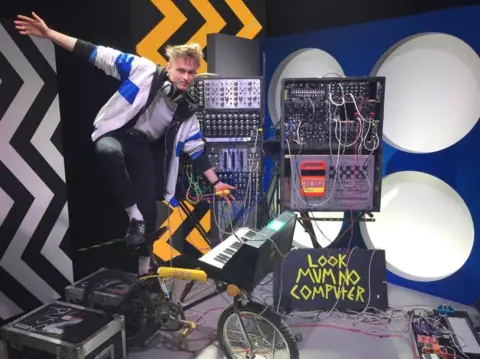
Before entering the contest, Sam already had a cult following for his music that uses home-brew synthesisers with a shouty brand of energised electro-pop.
Equally popular is his YouTube channel, where 700,000 subscribers watch him modifying vintage cars and repairing decrepit church organs with the manic energy (not to mention the electro-shock haircut) of Back to the Future's Doc Brown.
He also operates a museum in Ramsgate, Kent, dedicated to resuscitated audio technology. Oh, and four weeks ago, he became a dad for the first time.
"He's a healthy baby boy called Max and I love him very much," he grins.
In other words, Sam has enough to be getting on with. Whatever happens, Eurovision will be just another quirky addition to his CV.
More on the Eurovision Song Contest 2026:
- A guide to all 35 Eurovision songs
- Israel qualifies but Boy George is out of Eurovision
- As it happened: The first Eurovision semi-final
- Eurovision boss: 'We're watching the voting very carefully'
- Another year, another controversy for Eurovision - but fans are sticking by it
- Why Eurovision's fallout over Israel may change the competition forever
- Meet the UK's Eurovision entrant: 'The BBC is taking a risk on me'
- Everything you need to know about Eurovision
To hear him tell the story, though, he's here in Vienna by accident.
"I was at the pub with my friend Johnny, and we were saying, 'Wouldn't it be funny to try and do Eurovision?'" he explains.
Plan hatched, his manager emailed the BBC to ask how they could apply.
"And the BBC said, 'Oh, he seems interesting. Why not email us a song?'"
They were impressed enough with the result to invite Sam to a writing camp. He agreed on one condition - that he could bring Kosmo, his custom-made synthesiser and drum machine that travels in six separate flight cases.
It was Kosmo that ended up inspiring his Eurovision entry – a cheeky 1980s-style pop anthem called Eins, Zwei, Drei.
"I was actually moving a sofa to make room for my synth, and as we prepared to lift it I said, 'Eins, Zwei, Drei'.
"Everyone was like, 'That's the name of the song!'
"Twelve hours later, we're done. We had a lot of fun. But we were all thinking, it's never gonna get picked."
The very next morning, the BBC called to say they were blown away by the song's zany energy and its Euro-friendly lyrics about ditching an office job to take a mini-break in Germany.
Sam was asked to one final audition, "just to show that I am functional as a human being", after which he was officially selected as the UK's representative.
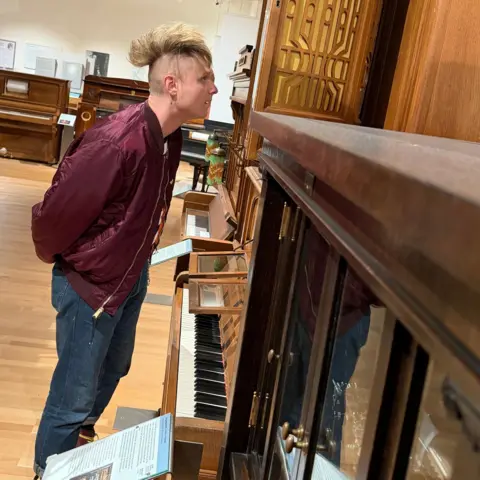
We meet him in the middle of rehearsal week at Vienna's Museum of Science and Technology, where the second floor is full of early mechanical instruments and historical synthesisers.
Hyperactive at the best of times, Sam enters the exhibition like a kid in a candy shop, who has eaten all the candy, then discovered a secret, second room full of even more candy on which to binge.
He charms the staff with his knowledge of these obscure machines – pointing out the bellows that power a church organ, and the pneumatic underpinnings of a piano roll player.
"That's the sound you hear on Strawberry Fields Forever," he says, indicating a Mellotron organ, an early sampler that used tape loops to produce orchestral sounds.
"And if you flick this 'rumba' button," he says, prodding at a Roland CR-78 drum machine, "you'll get the start to Blondie's Heart of Glass."
The museum's curator turns to me and observes: "He'd be a great tour guide. He almost knows more than we do!"
Sam immediately offers his CV, before adding: "I don't have a CV. But I'll write one."
Still, none of this excitement is conducive to an interview.
"Sorry! I'm forgetting I have a job to do," Sam apologises. "You've taken me to the worst place!"
Then he's off again, having spotted a Eurovision karaoke booth. Grabbing the mic, he launches into a squeaky falsetto version of Abba's Waterloo, followed by Tommy Cash's 2025 entry Espresso Macchiato, complete with its loose-limbed choreography.
Finally, this gives us an opportunity to discuss his own Eurovision performance.
"I'm literally not a dancer," he grins. "I'm awful.
"I've got two left feet and there are parts where I need to use my right foot. But I'm all up for an experience and a challenge. It's fun."
 EBU/Alma Bengtsson
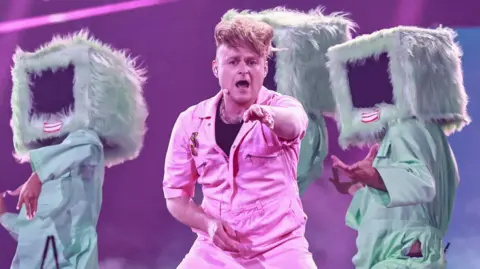
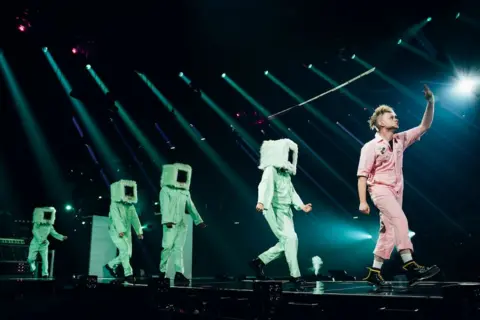
If you watched his performance at Thursday's semi-final, you'll know the staging makes a virtue of his bees-in-a-matchbox energy.
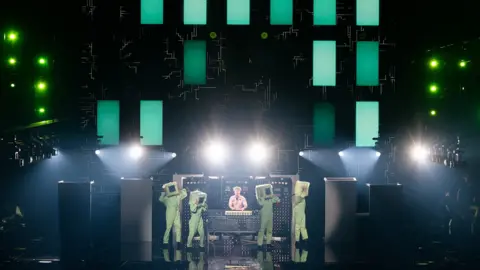
He begins the song trapped in the drudgery of a soul-crushing job, but as the music kicks in he breaks free and transforms his drab office into a flashing, buzzing electronic fairground – complete with dancers wearing fur-lined television sets on their heads.
Sam built most of the set himself, including banks of oversized synthesiser panels and custom electronics.
"Many holes were drilled," he laughs. "I drilled so many holes that my nipples chafed.
"I had the idea of using a car as well, but because the floor [of the stage] is an LED screen made of glass, there's a solid weight limit of 500kg for all the props, so we had to abandon that."
 EBU
EBUFor all his enthusiasm, he knows the UK has a habit of doing badly - very badly - at Eurovision.
With the exception of Sam Ryder's second-place finish in 2022, the UK has been locked outside the top 10 for more than 15 years. For the past two years, the voting public have awarded the UK exactly zero points.
Sam says the BBC took care to prepare him for the scrutiny and ridicule that can come with taking part.
"They gave me a stress test [to see] whether I could deal under pressure," he reveals, with a nervous "should-I-be-saying-this" glance towards his press handler.
"It's nothing, really, just making sure that you don't get too nervous and things like that."
For now, his nerves are under control. The only thing keeping him up at night is the thought he might fall over and embarrass himself.
But still – isn't there a little part of him that wants to do well?
"Watching the semi-finals yesterday I thought, maybe we've got something a bit different," he admits.
"What we're doing is Marmite – you either love it or hate it - but I think there's a slot open for our sort of thing."
For a moment, he almost allows himself to contemplate victory. Then he comes back down to earth.
"I always say to expect nothing," he says. "Because if you expect nothing, you lose nothing.
"And anyway, after Saturday night's over, I'm getting straight on the plane and going back to nappy changing duties."
Anti-work anthems, Boy George and controversial lyrics: A guide to all 35 Eurovision songs
Israel qualifies but Boy George is out of Eurovision
Croatia, Israel and favourites Finland among qualifiers for Saturday's Eurovision grand final
Eurovision boss: 'We're watching the voting very carefully'
Why Eurovision's fallout over Israel may change the competition forever
Here's what you need to know about the second Eurovision semi-final and grand final
Meet the UK's Eurovision entrant: 'The BBC is taking a risk on me'
Another year, another controversy for Eurovision - but fans are sticking by it
Eurovision Song ContestMusicСхожі новини
Ворог вдарив дроном по області на півночі України: поранені мати з донькою (фото)
У Тель-Авіві посол України обговорив із громадою протидію імпорту вкраденого РФ зерна
РФ вдарила по великому обласному центру: після «прильоту» місто затягнуло чорним димом — деталі