Trump says no change in Taiwan policy as China visit wraps
What you need to know
- Donald Trump's Air Force One has left Beijing for the United States
- Trump tells Fox News 'nothing's changed' on US Taiwan policy
- Trump said Friday that he and Xi made 'fantastic trade deals' without providing details
- China has shown little public interest in getting more involved in solving the war in Iran
- Xi also suggested differences over Taiwan could put his country and the US on the path toward conflict
Welcome to DW's coverage of the Trump-Xi summit in Beijing from May 13-15.
Skip next section IN DEPTH: US-China summit exposes Trump's limits on Iran war, Taiwan05/15/2026May 15, 2026IN DEPTH: US-China summit exposes Trump's limits on Iran war, Taiwan
Donald Trump hopes to have China help him end the war in Iran, but this goal seemed far from guaranteed as he wrapped up his two-day visit to Beijing. Xi Jinping, in turn, took the chance to warn the US over Taiwan.
The high-profile Beijing summit between Donald Trump and Xi Jinping ended with bombastic, positive statements — especially from the Trump White House, which called the US president "the dealmaker-in-chief" — but with little info known about concrete deals between the two rival superpowers.
Read the full story here
Conflicts remain after Trump-Xi summit ends
To view this video please enable JavaScript, and consider upgrading to a web browser that supports HTML5 video
https://p.dw.com/p/5DpNdSkip next section Trump says undecided on weapons sales to Taiwan 05/15/2026May 15, 2026Trump says undecided on weapons sales to Taiwan
US President Donald Trump in an interview with Fox News aired after meeting China's Xi Jinping said that there was nothing for Taiwan to worry about on the US position towards the self-ruled island, but added he "doesn't want somebody go independent and we're supposed to go travel 9,500 miles to fight a war."
Under the Taiwan Relations Act the US is bound to provide defensive weaponry to Taiwan, but is not bound by treaty to use military force to defend the island.
In December, a massive $11 billion weapons package for Taiwan was approved by Trump's administration, as was another $14 billion arms sale in January. However, Trump must approve both packages for them to move forwards.
Asked about approving the billions of dollars in US weapons sales, Trump said "we're going to see what happens … I may do it , I may not do it."
On Friday, Taiwan's Foreign Ministry said it had taken note of Trump's statements, and thanked the president for having approved previous arms sales.
"Regarding Taiwan-U.S. arms sales, they are not only a security commitment to Taiwan explicitly set out by the United States in the Taiwan Relations Act, but also a form of joint deterrence against regional threats," Taiwan's Foreign Ministry said in a statement.
US riles China with $11 billion arms deal for Taiwan
To view this video please enable JavaScript, and consider upgrading to a web browser that supports HTML5 video
https://p.dw.com/p/5DpMlSkip next section 'Nothing's changed' on Taiwan, but Trump warns against seeking independence05/15/2026May 15, 2026'Nothing's changed' on Taiwan, but Trump warns against seeking independence
US President Donald Trump on Friday warned Taiwan against seeking independence and relying on US support, suggesting he had no interest in joining a war triggered by such a move.
"We're not looking to have wars, and if you kept it the way it is, I think China's going to be OK with that," Trump told Fox News' Bret Baier in an interview. "But we're not looking at somebody saying, 'let's go independent because the United States is backing us.'"
The statements follow a high stakes summit with Chinese President Xi Jinping, who on Thursday warned the US that relations with China hinge upon the question of Taiwan and the extent of US support to the self-ruled island.
China considers Taiwan part of its territory and has not ruled out using force to bring it under its control. Xi has vowed to "crush" any attempt by Taiwan towards independence.
Since Taiwan's Democratic People's Party (DPP) came to power in 2016, China has stepped up diplomatic and military pressure on the island, as the DPP platform considers Taiwan to be an "independent sovereign, country" although it has never declared this outright. Beijing has called current President Lai Ching-te a "separatist."
While the US doesn't officially recognize Taiwan as a sovereign country, it maintains unofficial ties, and is the self-ruled island's main defense backer. In carefully crafted diplomatic wording, Washington officially "does not support" Taiwanese independence, rather than "opposes" it.
Any rhetorical move by Washington towards "opposing" independence, would represent a win for Beijing, and an upheaval for Taipei.
"Nothing's changed" on US policy towards Taiwan, Trump said in the Fox interview.
Why China is surging its nuclear forces
To view this video please enable JavaScript, and consider upgrading to a web browser that supports HTML5 video
https://p.dw.com/p/5Dp7FSkip next section China says agreed with US to expand 2-way trade, resolve market access concerns05/15/2026May 15, 2026China says agreed with US to expand 2-way trade, resolve market access concerns
China and the US have agreed to expand two-way trade and resolve market access concerns, Chinese Foreign Minister Wang Yi said on Friday.
In a Foreign Ministry statement, Wang said Beijing and Washington have agreed to establish a "Board of Trade" and "Board of Investment." They have also agreed to resolve concerns over market access for agricultural products, the ministry said.
The world's two largest economies also agreed to expand two-way trade "under [a] reciprocal tariff reduction framework," Wang said, breaking away from a trade war reignited last year by Trump's tariff policy.
"The delegations of the two countries reached overall positive results," Wang said in the statement, without sharing specifics.
Teams on both sides "are still consulting on the relevant details and will finalize the outcomes as soon as possible," he added.
https://p.dw.com/p/5DouhSkip next section Xi to visit US in autumn at Trump's invitation05/15/2026May 15, 2026Xi to visit US in autumn at Trump's invitation
Chinese President Xi Jinping will visit the US in the autumn, at the invitation of US President Donald Trump, China's Foreign Minister Wang Yi said on Friday, Chinese state news agency Xinhua reported.
During a banquet dinner in Beijing on Thursday, Trump extended Xi an invitation to the White House for a visit on September 24.
https://p.dw.com/p/5DoszSkip next section Taiwan says it's monitoring outcome of Trump-Xi talks 05/15/2026May 15, 2026Taiwan says it's monitoring outcome of Trump-Xi talks
Taiwan has said it closely monitored talks between the US and Chinese leaders in Beijing and remains in contact with Washington.
Foreign Minister Lin Chia-lung said Taipei was maintaining strong communication with the United States and would deepen cooperation with partners in the Indo-Pacific.
US President Donald Trump had said he discussed Taiwan with Chinese President Xi Jinping when the two leaders met, but did not share details of the conversation.
The issue of Taiwanese independence is a red line for Beijing, which considers Taiwan to be part of China, that will one day be "reunited" with the mainland. Analysts ahead of the summit had expected Xi would push Trump on softening US support for Taipei.
On Facebook, Lin said many Taiwanese had been "concerned" by Trump's meeting with Xi.
Speaking aboard Air Force One to reporters about Taiwan talks with Xi, Trump said he "heard him out" and did not take a position, adding he had made no commitments either way.
About the two massive US arms deals for Taiwan still on the table that need Trump's approval to move forward , the US president only said "I will make a determination." The US is Taiwan's main defense backer, and the issue of arms sales is a sore point in US-China ties.
Taiwan simulates response to Chinese invasion
To view this video please enable JavaScript, and consider upgrading to a web browser that supports HTML5 video
https://p.dw.com/p/5DobzSkip next section Trump says he spoke a 'lot' about Taiwan with Xi, downplays risk of conflict05/15/2026May 15, 2026Trump says he spoke a 'lot' about Taiwan with Xi, downplays risk of conflict
Speaking to reporters aboard Air Force One on his return from China, Trump said he and Xi "talked a lot about Taiwan" but added that he did not believe there was conflict over the issue.
"We'll be fine," Trump said when asked about whether he believes there's a risk of conflict with China.
Trump also said Xi asked directly whether the US would defend Taiwan if China attacked the island, but that he declined to answer.
"There's only one person that knows that, and it is me. I'm the only person," Trump said. "That question was asked to me today by President Xi. I said, I don't talk about that."
China claims Taiwan as its own territory and has long opposed US weapons sales to the island, which Beijing sees as interference in its internal affairs.
The US, despite lacking formal diplomatic ties with Taiwan, remains Taiwan's biggest defense backer.
https://p.dw.com/p/5DnsCSkip next section Putin to visit China 'soon,' Russia state news agency reports05/15/2026May 15, 2026Putin to visit China 'soon,' Russia state news agency reports
Russian President Vladimir Putin is planning a trip to China "very soon," Russia's state news agency TASS reported.
An official announcement is soon to come, Kremlin spokesman Dmitry Peskov said, noting that Moscow didn't want to get ahead of its partner.
Preparations for the visit have been completed and coordinated, TASS reported Peskov as saying.
Russia and China share strong ties and Beijing has provided an economic lifeline for Moscow amid the war in Ukraine.
Shortly before launching the war in 2022, Putin met Xi Jinping at the Winter Olympics in Beijing and announced a "strategic partnership of coordination" that had entered "new era," reaching an "unprecedented level" and becoming a "model of efficiency, responsibility, and aspiration for the future."
Statements from both Russia and China demonstrate a shared interest to counter what they consider to be US-led Western "hegemony."
China eyes Iran, Ukraine wars amid push to rival US military
To view this video please enable JavaScript, and consider upgrading to a web browser that supports HTML5 video
https://p.dw.com/p/5DncjSkip next section 'Story is not over' because Trump-Xi summit will be judged by what happens next05/15/2026May 15, 2026'Story is not over' because Trump-Xi summit will be judged by what happens next
DW's chief international editor, Richard Walker, said that the summit will be judged against the outcomes in the coming months and years.
"We can breathe a sigh of relief" at this stage, Walker said, but the "story is not over yet" since we're yet to hear from Donald Trump who mainly stuck to the script over the course of the summit.
On Taiwan: "US policy on the issue of Taiwan is unchanged as of today and as of the meeting that we had here today. It was raised. They always raise it on their side. We always make clear our position, and we move on to the other topics," Secretary of State Marco Rubio told NBC News.
Walker noted the use of "as of today" that might signal that there could be more communication that we can expect from Trump in the coming days.
US Treasury Secretary Scott Bessent told CNBC that he expects Trump to say more on Taiwan soon too.
On AI: Both Trump and China are locked in competition over AI, Walker said. Tesla's Elon Musk and Nvidia's Jensen Huang stayed close to Trump during the welcome ceremony, symbolizing how important AI was to US-China ties.
DW correspondent in Taiwan, Rik Glauert, said all of that shows just how important "strategic connectedness" is — that both sides have a chance to work together but there's also an underlying desire to maintain dominance.
Trump says he and Xi agree on Iran, need to open strait
To view this video please enable JavaScript, and consider upgrading to a web browser that supports HTML5 video
https://p.dw.com/p/5DnMcSkip next section China makes clear closer ties with US involve question of Taiwan, expert says05/15/2026May 15, 2026China makes clear closer ties with US involve question of Taiwan, expert says
"China has been following its strategic focus to a T" and has been undertaking sweeping efforts to strengthen its military, political analyst Cathryn Clüver Ashbrook told DW.
Chinese leader Xi Jinping, who heads China's military as chairman of the Central Military Commission, has made it a top priority and relentlessly pushed for progress.
Chinese businesses have rapidly embraced AI, facilitating its swift and widespread adoption in almost every possible field.
In this sphere of competitiveness, she said, Xi made it clear that any meaningful improvement in relations with the US would come with conditions — notably on Taiwan.
Xi delivers warning about Taiwan issue
Chinese state media reported Thursday that Xi told Trump that the Taiwan issue was the "most important issue" in China-US relations.
"If mishandled, the two nations will experience collision or even clashes, pushing the entire China-US relationship into a highly dangerous situation," Xinhua News Agency quoted Xi as saying.
The Day with Nicole Frölich: differences remain after summit
To view this video please enable JavaScript, and consider upgrading to a web browser that supports HTML5 video
https://p.dw.com/p/5Dmw7Skip next section Trump and Xi tried to stabilize relations but China remains a rival, says expert05/15/2026May 15, 2026Trump and Xi tried to stabilize relations but China remains a rival, says expert
Political scientist Cathryn Clüver Ashbrook told DW that the relationship between the US and China has been characterized by economic rivalry for many years, and that's unlikely to change.
China has an interest in making sure that the US lifts sanctions, and that could potentially be a signal that could reset relations, she said.
However, little is known about the extension of the trade truce that the two superpowers reached last October.
Not much has also been announced about Chinese assistance in reopening the Strait of Hormuz, which many Asian allies rely on, she added.
https://p.dw.com/p/5DmhISkip next section WATCH: Did Xi outsmart Trump?05/15/2026May 15, 2026WATCH: Did Xi outsmart Trump?
As US President Donald Trump concludes his high-stakes trip to China, we ask: who came out on top in the meeting between the world's two biggest superpowers — Donald Trump or Xi Jinping?
The White House says Trump delivered on his promise, calling him the "dealmaker in chief" who gets results.
Follow along as we speak with DW's chief international editor, Richard Walker, DW correspondent in Taiwan, Rik Glauert, and political analyst Cathryn Clüver Ashbrook from the Bertelsmann Foundation.
https://p.dw.com/p/5DmgDSkip next section Little known about potential deals05/15/2026May 15, 2026Little known about potential deals
US President Donald Trump said both sides made "fantastic deals" earlier today during closing remarks. But there is little known about what those deals entail.
China's Xi Jinping spoke about a positive turn in relations between the two countries.
"This visit is a historic and landmark visit. Together, we affirmed the new position of a constructive, strategic and stable China-US relationship," the Chinese president said, according to a readout from the state-run CCTV channel.
"The visit is also beneficial to promoting mutual understanding, deepening trust in each other, and increasing the well-being of the people of both countries," Xi added.
The Chinese leader said both countries should carry out the "important consensus" reached during Trump’s visit and keep the relationship on the right track.
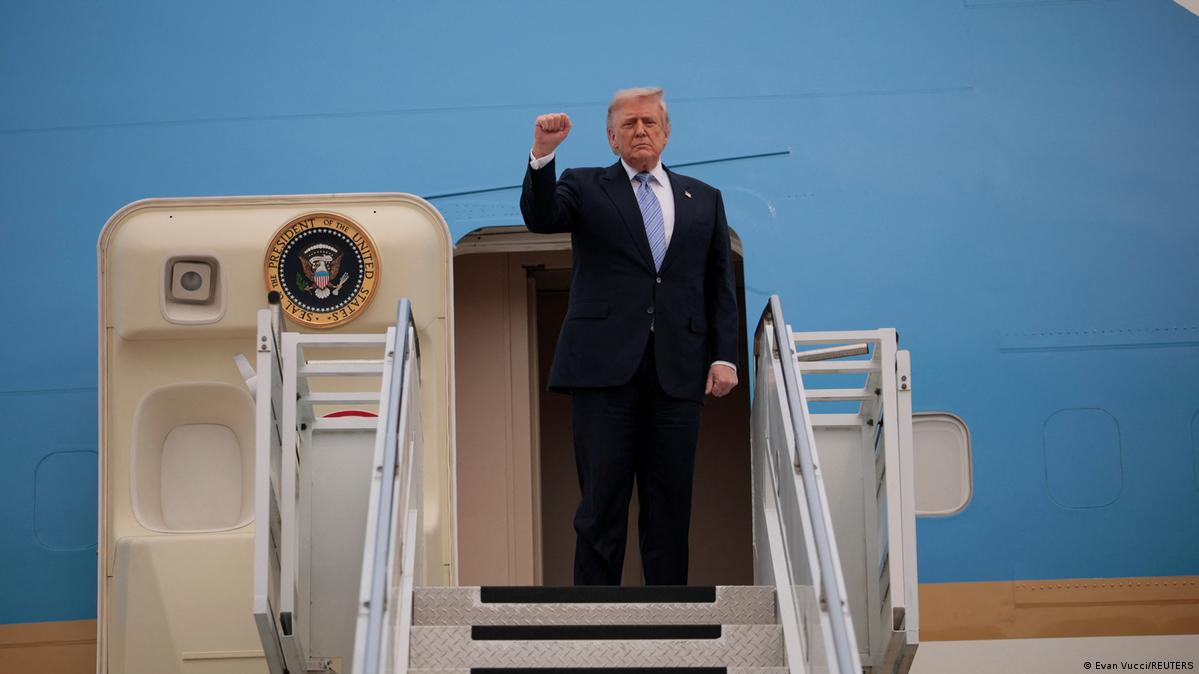
https://p.dw.com/p/5DmY7Skip next section Trump's Air Force One departs Beijing05/15/2026May 15, 2026Trump's Air Force One departs Beijing
President Donald Trump has left Beijing after a high-stakes meeting with China's Xi Jinping.
https://p.dw.com/p/5DmUKSkip next section Trump arrives at Beijing airport05/15/2026May 15, 2026Trump arrives at Beijing airport
President Donald Trump's motorcade has arrived at the airport in Beijing as he prepares to return to Washington.
Schoolchildren dressed in some of Air Force One's light blue and white colors waved American and Chinese flags.
"Farewell, farewell," they chanted. "Warm farewell!"
Chinese Foreign Minister Wang Yi saw a smiling Trump off at the airport.
Trump turned at the top of the stairs and pumped his fist and waved before entering the aircraft. But he didn't speak with reporters before departing for home.
https://p.dw.com/p/5DmTzShow more postsСхожі новини
Ebola outbreak confirmed in DR Congo, Uganda: African health agency
Middle East: Israel, Lebanon agree to extend truce, US says

Russia resumes military shipments to Syria