Trump and Xi hold talks but no trade deal agreed

 Getty Images
It was a day heavy with symbolism in Beijing, marked by choreographed ceremonies and carefully staged optics, but there was no sweeping trade breakthrough or major business agreements.
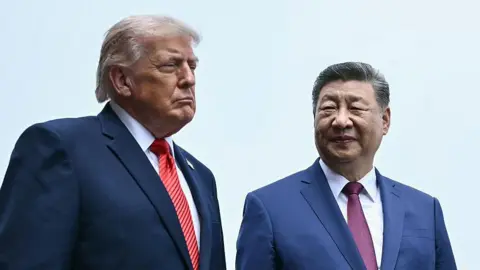
US President Donald Trump met Chinese President Xi Jinping on Thursday for more than two hours of talks, describing the US-China relationship as "the world's most consequential economic relationship".
The White House described the meeting as "highly productive". Trump, speaking at the Great Hall of the People, called it potentially "the biggest summit ever".
President Xi said previous trade negotiations between the two countries in South Korea had delivered "progress", according to China's foreign ministry, but he paired that with a stark warning on Taiwan, saying: "If mishandled, the two nations could collide or even come into conflict."
Tech and trade
This was a visit where optics have mattered as much as outcomes, with one of the most closely watched moments coming as Air Force One touched down in Beijing.
Elon Musk stepped off the presidential aircraft ahead of senior cabinet officials including Pete Hegseth, Marco Rubio and US Trade Representative Jamieson Greer - on a trip that was always going to be defined by trade.
Musk and Nvidia chief Jensen Huang also remained close to Trump during the welcome ceremony.
The symbolism was hard to miss. Musk and Huang represent some of the most sensitive pressure points in the US-China economic relationship: electric vehicles, artificial intelligence (AI) and semiconductor microchips.
Both are also exposed to China. Tesla depends heavily on its Shanghai gigafactory and Chinese consumers, while Nvidia's chips sit at the centre of the global AI race and US export controls designed to limit China's access to advanced computing.
Huang's presence was particularly notable given he was not on the original delegation list, fuelling speculation that AI and chip access may feature more centrally in discussions than previously expected.
Flattery and fanfare as Trump welcomed to China - but thorny issues remain
No deal but fragile trade truce continues
Despite the choreography, there was no major trade deal or structural agreement.
Both sides instead pointed to continuity in the October trade truce, under which Washington suspended steep tariff increases on Chinese goods while Beijing eased back from restricting rare earth exports.
The White House said both leaders agreed to establish a "Board of Trade" - a mechanism to manage the relationship without having to reopen tariff negotiations.
US officials have cautioned, however, that there is a lot of work to be done before it is fully operational.
US Treasury Secretary Scott Bessent said he expected "large Boeing orders" to be announced during the visit, alongside broader Chinese purchases of US energy and agricultural goods.
Market access and co-operation
According to the White House, the talks included discussion of expanding Chinese market access for US companies and increasing Chinese investment into US industries.
Beijing signalled it would increase purchases of US agricultural and energy products.
Farmers in the US have been seeking more Chinese access for soybeans, beef, poultry, but no firm details were announced.
Bessent downplayed expectations of major new agricultural breakthroughs, suggesting some soybean commitments had already been addressed under previous agreements, but said there was scope for China to increase purchases of US energy, including LNG.
Xi told US business leaders that China's "doors will open wider" and that American firms would have "broader prospects" in the Chinese market, according to news site Xinhua.
He also called for expanded cooperation in trade, agriculture, healthcare, tourism and law enforcement, describing bilateral ties as "mutually beneficial" and delivering "win-win results".
For US companies, China remains both a major market and a difficult operating environment due to regulation, red tape and geopolitical uncertainty.
The 'most sensitive' issue
One of the clearest shifts emerging from the summit was how directly Beijing is now linking Taiwan to the broader economic relationship with the United States.
Over the past year of trade talks, Taiwan had largely been treated as one of several friction points between the US and China - particularly US collaboration with semiconductor companies, US-Taiwan trade ties, and arms sales to Taipei.
But Chinese messaging from the meeting suggested Taiwan is increasingly being framed as a condition for the US-China trade relationship.
According to Beijing's readout, Xi said the two sides had agreed to a "new positioning" for relations based on "constructive strategic stability", but warned that Taiwan remained the most sensitive issue.
"The Taiwan question is the most important issue in China-US relations," Xi warned during the talks, according to Chinese state media.
"If mishandled, the two nations could collide or even come into conflict," he said.
Unresolved fault lines
Technology remains the biggest divide between the US and China.
US export controls on advanced semiconductors and chipmaking equipment - aimed at limiting China's access to frontier AI capabilities - remain in place.
Beijing continues to push for greater access to advanced technologies, while criticising what it sees as efforts to constrain its industrial development.
Trump also entered the talks hoping for Chinese cooperation on the Iran conflict and oil market stability.
Oil price volatility and repeated disruptions to supply routes have increased China's import costs and pushed up prices across the world.
Trump has said that China could use its influence to encourage Iran to stabilise flows through the Strait of Hormuz, a key global energy artery.
Chinese readouts indicated the Middle East was discussed, though again, details were limited.
United StatesDonald TrumpChinaXi Jinping