Tigray tensions raise fears of Ethiopia-Eritrea war
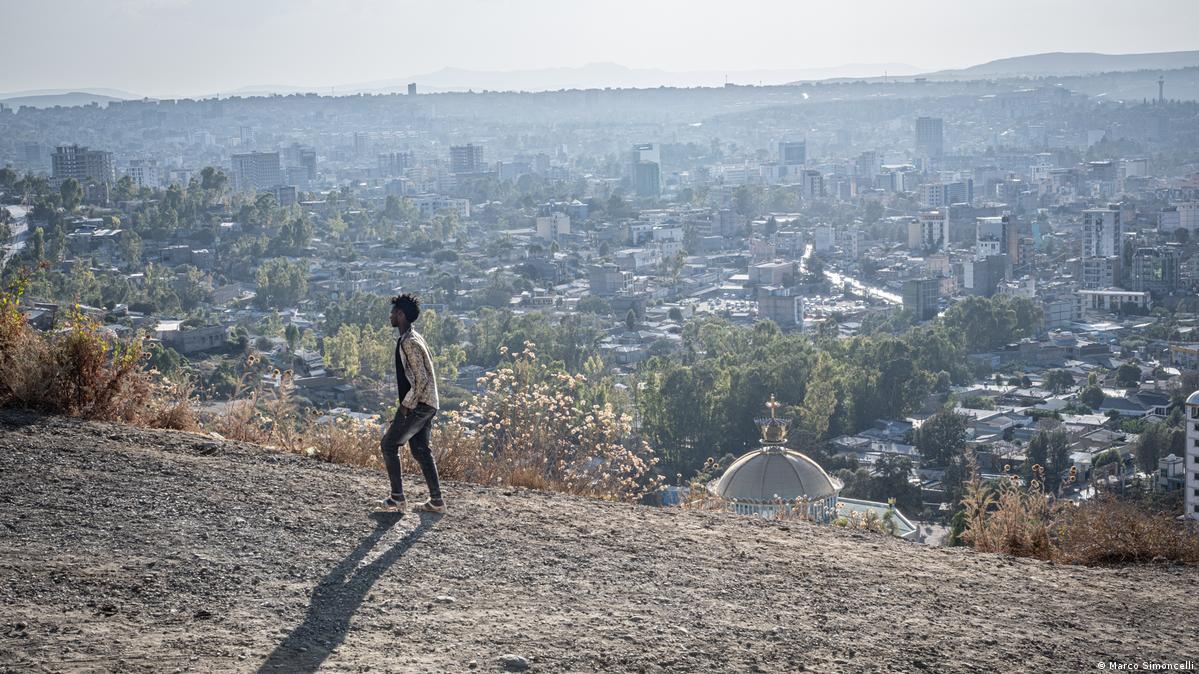
In 2020, Ethiopia's government under Prime Minister Abiy Ahmed postponed the country's planned elections due to the COVID-19 pandemic.
The Tigray People's Liberation Front (TPLF), the largest and most dominant party in the country's northern Tigray region, accused Abiy of unconstitutionally extending his government's term.
The TPLF arranged local elections — which it won — and denied the federal government's legal authority over the Tigray region, leading to a conflict that escalated into military hostilities between the TPLF and the Ethiopian National Defense Force (ENDF).
Between 2020 and 2022, an estimated 600,000 people died in the fighting. Both sides accused each other of having initiated the conflict.
In November 2022, the results of the 2020 local elections were annulled following the Pretoria peace agreement between the Ethiopian government and the TPLF.
Since then, an Interim Regional Administration was established in Tigray, sidelining the TPLF's wartime leaders.
Explainer: How did Ethiopia's Tigray war start?
To view this video please enable JavaScript, and consider upgrading to a web browser that supports HTML5 video
After three years, disagreements arose between the region's interim administration and the TPLF.
In April, the Tigray State Council, which had been dissolved under the peace agreement, was restored by the TPLF.
And on May 5, TPLF leader Debretsion Gebremichael was elected as the new president of Tigray.
"The interim administration no longer exists," the party's deputy, Amanuel Assefa, told AFP news agency.
Debretsion entered the president's office and stated that he started working, Mulugeta Atsbeha, a journalist and former correspondent for the Voice of America (VOA) Tigrigna service, told DW.
The TPLF is reinstating its control of Tigray
This move appears to pose a challenge to Tadesse Werede, the president of the Tigray Transitional Administration appointed by the Ethiopian government.
Werede said in a social media post cited by The Reporter Ethiopia that the group attempting to seize power by force was responsible for the destruction and danger facing the people of Tigray.
Atsbeha said Werede viewed the TPLF's approach as wrong and unproductive, stressing that dialogue was the only solution. He added that Werede had no intention of stepping aside voluntarily and warned that any attempt to remove him by force would be illegitimate.
No reaction of the federal government yet
"Tigray finds itself in a very dangerous moment currently," according to Amanuel Gedebo, a researcher at the Clingendael Institute, an international think tank based in The Hague.
Gedebo added that there is currently a lot of uncertainty.
"We don't know what the federal government's response is. So far they haven't put out a statement or made any response directly," he told DW.
However, some analysts say there are signs of increased military activity.
Journalist Mulugeta Atsbeha told DW that on May 5 and 6, Ethiopian military jets were seen in the sky over Tigray's capital Mekelle.
"Now Addis Ababa is sending MiG fighter jets over Mekelle as a show of force," said Magnus Treiber, an anthropologist and expert on the Horn of Africa at the Ludwig Maximilian University in Munich.
"And the ENDF … are positioning themselves in the neighboring states of Amhara and Afar," Treiber told DW.
"Defense installations are also evidently being expanded along the access roads to the capital, Addis Ababa, from the north."
Ethiopia faces multiple armed challenges, including the TPLF in Tigray, Fano militias in Amhara, and the Oromo Liberation Army in Oromia, alongside rising regional tensions involving Eritrea and Sudan.
"The TPLF remains the biggest challenge for [Ethiopian Prime Minister] Abiy Ahmed, who is likely becoming increasingly isolated internationally due to his alleged cooperation with the United Arab Emirates (UAE) and the Sudanese Rapid Support Forces (RSF)," said Treiber.
While regionally still very powerful, the TPLF was effectively banned as a political party in Ethiopia last year.
"Abiy Ahmed has in fact failed to oust the TPLF's old guard and establish an opposition loyal to him in Tigray, either politically or militarily," Treiber said.
Is there a possible solution?
"From the Ethiopian side we know what they want," Amanuel Gedebo tells DW. "They want access through the port of Assab, which, of course, Eritria sees as a threat to its sovereignty."
So Eritrea is trying to build alliances with actors like Egypt and the Port Sudan government, Gedebo explains. "And also within Ethiopia itself, with actors like the TPLF and the Fano."
Treiber, the Horn of Africa expert, suggested that Eritrea maintains stability through its internal dictatorship and by fueling conflicts in neighboring countries, benefiting from instability in places like Ethiopia and Sudan.
"The logic there seems to be Eritrea trying first to deter the Ethiopian government and also preparing for any potential showdown down the line if things come to it," Gedebo said. "So that they don't face the much stronger Ethiopian army on their own."
The impact of the Iran war
The war in Iran, of course, is also being felt in the Horn of Africa. Ethiopia and Eritrea are affected economically, said Gedebo. "From the Ethiopian side we have heard reports of fuel shortages and also inflation taking up. That might discourage the Ethiopian government from any escalatory moves in the north."
Why can't Ethiopia and Eritrea be friends?
To view this video please enable JavaScript, and consider upgrading to a web browser that supports HTML5 video
The war even has an huge impact on the two highly active actors in the region: the UAE, which supports Ethiopia, and Saudi Arabia, which supports Eritrea, for example with plans to spend billions on modernizing the port of Assab.
But the UAE and Saudi Arabia apparently have other priorities right now, Gedebo noted.
"Because those governments might not have the bandwidth actually to be as actively involved as in the past, while they are having this conflict in their own home region," he told DW.
"So that could be a factor also that might discourage the two governments from further escalating."
The war in Iran has also led to renewed US interest in geostrategically well-positioned Eritrea, noted Treiber.
"The lifting of US sanctions, imposed by the Obama and Biden administrations, was apparently held out as a prospect," he told DW.
"Human Rights Watch is entirely justified in criticizing the fact that the appalling human rights situation in Eritrea has not improved."
"War has often been a realistic political option in recent Ethiopian history. Whether it will actually come to that, however, is impossible to predict," Treiber noted.
"There still seems to be room for international mediation."
The new crisis facing Tigray’s families
To view this video please enable JavaScript, and consider upgrading to a web browser that supports HTML5 video
Azeb-Tadesse Hahn contributed reporting.
This article was originally written in German.
AdvertisementСхожі новини
Путін змінив губернаторів двох областей, які межують з Україною

Мститель на бездорожье. Jeep представил спецверсию Wrangler в стиле Капитана Америки
Alien smuggling and ...: Iranian national pleads guilty in US court to two serious crimes
