‘There is real danger’: landline phone users voice fears over digital switchover

Rural dwellers reveal failings in backup plans, as campaigners call for deadline to be extended from 2027 to 2030
“Every time there is a power failure I lose all means of communication with the outside world,” says Robert Dewar of life in a remote village in the Scottish Highlands since the landlines were transferred from the old copper cable network to broadband connections.
Blackouts also knock out the village’s mobile phone signal. “Our most recent power cut lasted for 42 hours,” Dewar says. The interruption outlasted his five-hour emergency backup battery. “If I had had a heart attack there is damn all I could have done about it, except compose myself, say my prayers, and await the outcome.”
Dewar was among the more than 100 readers who contacted us with their experiences as the old infrastructure – the public switched telephone network (PSTN) – used to make calls is replaced with digital lines.
It is one of the biggest tech upgrades since the analogue television signal was switched off more than a decade ago, a change that forced Britons to convert their TVs or buy a new digital set. This time copper phone cables are being replaced with a “digital voice” service that uses your broadband connection.
The overhaul of the phone network has been a huge undertaking but is now in its final year, with roughly 3.2m homes (about a fifth of the original number) still connected to the PSTN, which is scheduled to be switched off in January 2027.
For many the switchover simply involves plugging the phone handset into the broadband router instead of the socket on the wall. However, for vulnerable Britons, or those living in remote locations such as Dewar, without a mobile signal, it can be much more complex to make sure they are not cut off from the outside world when something goes wrong.
In its 2025 Connected Nations report Ofcom predicted the pace of customer migrations would increase this year to meet the approaching deadline. To date, telecoms providers have focused on the easiest homes to switch, and the communications regulator acknowledged it is “likely that more complex customers will make up a larger proportion of the remaining PSTN customers”.
Silver Voices, the UK campaign organisation for the over-60s, has big concerns about the safety of the programme. It is calling for the deadline to be extended until 2030 so that better safety products can be developed. Its “save our landlines” petition has gathered more than 100,000 signatures.
“This is a disaster waiting to happen,” says the Silver Voices director, Dennis Reed, with the organisation concerned that the onus is on vulnerable customers to contact their provider for help.
“There are many reasons why vulnerable customers are not able to self-identify and they face being switched off in their droves whatever their circumstances.
“Reports continue to emerge of landlines being switched off before help has been given.”
How it works
Ernest Doku, a broadband expert at the comparison website Uswitch, says that although digital voice calls rely on a router rather than copper cables, this does not mean having to pay for a full broadband package if you don’t need one.
“As a universal service provider, BT must ensure access to a basic service, which may include voice-only or low-data options, while other providers usually deliver ‘voice’ services as part of a broadband package or as a migration path for their existing customers,” he says.
BT says supporting customers through the switchover is a “top priority”.
It says: “We offer a range of support, including enhanced protection for customers with additional needs, such as telecare users and those who are solely reliant on their landline. This includes free in-home assistance and backup power solutions where needed.
“We also have dedicated solutions in place for landline-only customers and for those who do not yet have access to full fibre.”
Industry estimates suggest that less than 1% of BT landline customer’s premises have insufficient mobile signal to make an emergency call and that this number will drop it invests in strengthening mobile coverage in rural communities.
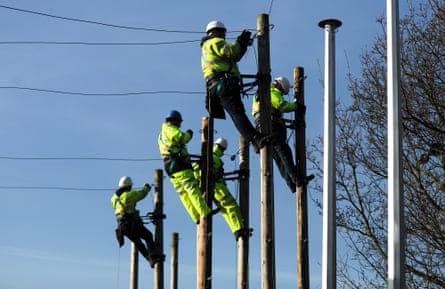
Prior to the switch, customers should be given several weeks’ notice by letter or email. They may also be sent equipment such as a new router.
The companies involved must guarantee that customers who rely solely on their landline have access to emergency services for at least one hour during a power outage. This is often done through a backup battery and “should be provided free of charge to people who are dependent on their landline”, Ofcom says. Doku says these typically cost £60-£100 if you need to buy one.
Care alarms and security alarms may also be connected to the landline. If you have one, it may need to be replaced or reconfigured so it still works. To help vulnerable users, BT’s infrastructure arm Openreach has a dedicated telecare service it says is supported by more than 4,000 specially trained engineers.
Doku says it is vital to disclose any medical devices or telecare alarms to your provider, as it has signed a government charter to ensure you are not refused service or left without compatible equipment.
He adds: “If you have any concerns about your equipment or costs, contact your provider directly. Ask them specifically how the switch will affect your devices and what backup solutions they can offer to ensure you stay connected during a power cut.”
‘No means of contacting emergency services’
A vulnerable Cornish woman told us she is terrified at the idea of a power cut after a recent outage lasted more than 24 hours: “Once that one hour of battery backup has expired I will have no means of contacting emergency services, or anyone else as there is no mobile reception at my home.”
She has researched buying a longer-lasting battery but says they are too expensive. Out of desperation she is “considering setting up a local walkie-talkie group with other vulnerable neighbours”.
Many respondents told Guardian Money they had spent hours helping vulnerable relatives replace their home phone set-up. Even IT and engineering professionals confessed to having been left tearing their hair out.
“In January 2025 I contacted BT to cancel my mum’s broadband because she has Alzheimer’s and can no longer use a computer,” Hertfordshire-based Peter* says. “It was costing nearly £70 a month for a service she was no longer capable of using.

“I was told that to cancel her broadband, which was out of contract, it had to be upgraded to fibre because the exchange was due to be upgraded.”
Openreach is simultaneously rolling out a full-fibre broadband network, and once an exchange can serve 75% of homes, companies stop selling legacy phone and broadband services.
Peter adds: “The work was finally completed last June and involved digging all the plants out of the border of her front garden; gardening is her one remaining pleasure in life.
“Although I had to argue my case, BT also agreed to refund the difference between what mum had been paying and what she should have paid had they completed the work within the terms of the service level agreement. The result was just over £1,000 in compensation.”
It worked out well in the end, he says. His mother has a basic telephone-only contract that costs £12 a month – a saving of £56 a month, and BT provided a backup battery free of charge. However, Peter is concerned how people “without a determined advocate could be affected”.
‘Incorrect information’
David, who lives in a remote valley in Wales, says: “The torture began in May 2025 when an email from Plusnet advised that our landline will no longer be supported after the switchover. We live in an isolated location where mobile reception is poor outdoors and nonexistent indoors.”
He contacted Plusnet and agreed to move to EE after being told he could get a broadband, phone service and a free backup battery for £26 a month. However, when he spoke to EE he was told he would have to buy the battery and the monthly cost was £10 more than billed, so he cancelled the move.
Last month, he received an email that said if he hadn’t made a decision about remaining with Plusnet within 30 days, it would begin moving his broadband and home phone to EE. If he stayed with Plusnet and gave up his landline, his monthly bill would drop from £32 to £22.50. If he transferred to EE it would be unchanged at £32.
When he told EE that he was in his 70s and has health problems, he was told “without doubt” he would be issued with a free one-hour backup battery. To keep their landline for the sake of incoming calls, David and his partner decided to go with EE but to use their mobiles for all outgoing calls.
The couple have invested in simple system that uses an antenna sitting on a window-ledge outside the house. “It conveys the mobile signal to a signal booster (or repeater) inside one room, enabling use of our mobile phones within that part of the house,” David says.

However, EE reneged on its promise on the battery, saying it does not supply a free one-hour backup device to all elderly people living in areas with poor mobile reception, only those with a telecare device. He rejected its offer to buy a battery for £80 or £150.
He says the saga has made him feel that the companies involved appear to be operating without meaningful oversight. “Providers should be held to the commitments made to customers during the switchover process,” he adds.
“If there is a requirement to supply free batteries to those who need them, then it should be enforced. People need to know they’ll be able to call for help in an emergency during a power outage.
“They aren’t making it easy. The call to arrange the transfer with EE this morning lasted one hour and nine minutes. I’m skilled in using digital technology, I hate to think what frustrations less computer literate people are experiencing.”
‘Hollow promises’
In a similar vein South Devon-based Tony Roberts has found it difficult to find a telephone supplier willing to take on someone who considered their landline to be essential. “Often if you try to sign up, they ask: ‘Do you rely on a landline’ or ‘Do you have a care device’ and if you say yes, simply say that their service isn’t suitable despite digital voice services being the only ones available for new orders.”
He adds: “The promise of a backup battery is often a hollow one, either offering short backup time or being very hard to obtain without significant cost. I had to pretend that I don’t need my essential landline in order to switch supplier and then provide my own battery backup separately.”
Roberts is concerned that a network that was robustly maintained and backed up at central exchanges is being replaced by a fragmented system with multiple points of failure. “On top of that, there is no guarantee that mobile masts have significant backup either.
“There is a real danger that whole communities find themselves with no connectivity at all in the case of a widespread power failure,” Roberts says. “It’s also worrying me that this is often reported as a problem for old people: it’s a wider issue than that.”
Ofcom says that it has made clear to companies their duty to “identify, protect and support vulnerable customers. We’ve been keeping a close eye on progress, including publishing industry guidance and stepping in to remind companies of their obligations.”
The switchover process
If your landline is still plugged in to the traditional telephone socket, look out for a letter or email from your phone company giving notice of your digital switchover date.
What happens next will depend on the company you are with, and the equipment they use.
If you already have an internet connection, it may be as simple as plugging the phone into your broadband router rather than the wall.
You can usually keep your number and carry on using the same phone. The pricing of your phone package is not affected, but if your landline and broadband are with different companies you will have a choice.
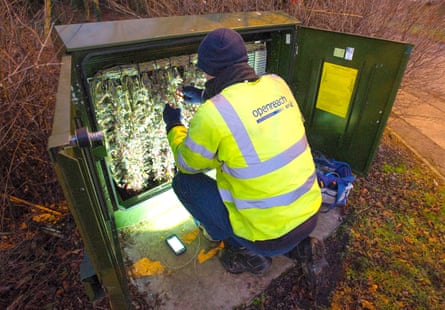
If you are migrating to a digital line without upgrading to full fibre, then the new service will use the wiring that is already in place. There is lots of information about the whole process on the digital landline switchover website.
Upgrading to a full-fibre service is a bigger deal because fibre optic cables need to be installed.
An engineer will have to set up the service which will involve either overground or underground cables. They will need to drill a small hole in an outside wall to connect you.
Your new digital phone line will be powered by your home electricity, so if there is a power cut you will not be able to make landline calls. If there is no mobile coverage in your area, or you have a telecare device, you need to let your phone company know.
In these cases, they should offer you a solution, such as a backup battery, to allow you to call the emergency services, at the very least, during a power cut.
To assist vulnerable customers, BT has a dedicated telecare service it says is supported by more than 4,000 specially trained engineers.
* Name has been changed
Explore more on these topicsShareReuse this content