The stolen trophy that honours 'the world's most cheerful loser'

 Bettmann/Getty
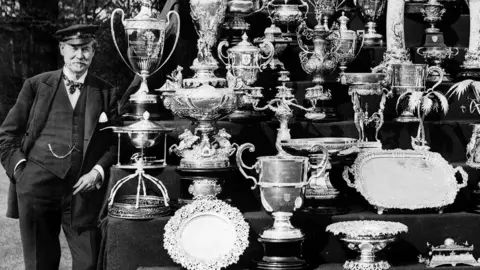
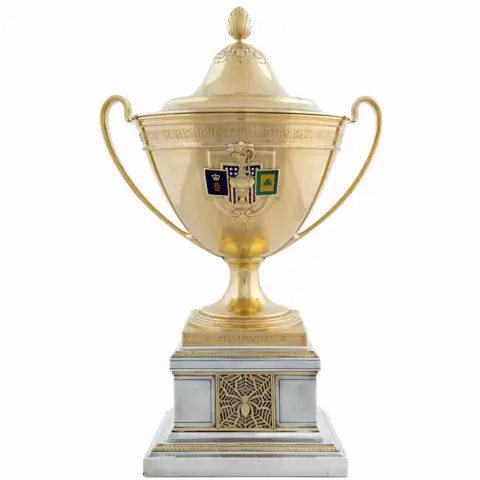
The theft of an 18-carat gold trophy from Glasgow's Riverside Museum, revealed last week, has made news headlines but the Lipton Cup already had an extraordinary story long before a thief made away with it.
In December 1930, weeks after his fifth and final attempt at winning the greatest prize in yacht racing, Sir Thomas Lipton was presented with an honour unique in the history of sport.
It was not the America's Cup, the silver winner's trophy he had been chasing for three decades.
Instead it was something far more meaningful - a respectful and affectionate tribute, paid for by public subscription, to a Scot who had won the hearts of the American public as the "world's most cheerful loser".
Yachting is often thought of as a rich man's pastime and by the start of the 20th Century Lipton was very rich indeed - but he wasn't born that way.
The young Tommy Lipton grew up in the Gorbals area of Glasgow, the son of Irish immigrants, often pushing a wheelbarrow from the docks to restock his father's shop.
At the age of 15 he set off with just a few pounds in his pocket to America where a job in a huge New York department store opened his eyes to a new way of shopping.
When he returned to Glasgow in 1871 he had a vision for how to make his fortune.
 Glasgow Life
Within a few years Lipton's grocery stores were spreading across Britain. And in the 1890s he identified the mass market potential of tea, purchasing his own plantations in Sri Lanka.
As his fortune grew he gained a reputation for philanthropy and global fame as a sportsman - particularly sailing.
Between 1899 and 1930 Lipton made five unsuccessful challenges for the America's Cup, representing Great Britain against the US for the most prestigious trophy in yachting.
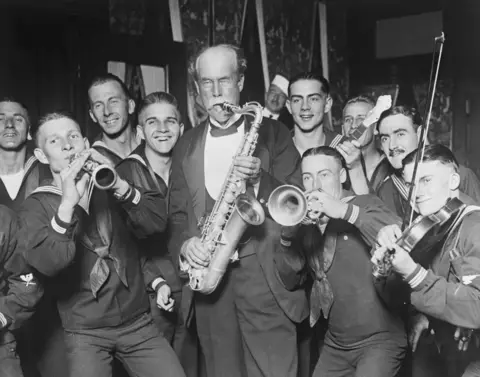
While his boats were crewed by elite professionals, Lipton was the owner and public face of the challenge with his personal charm and gracious attitude in defeat making him a sporting hero on both sides of the Atlantic.
 Bettmann/Getty
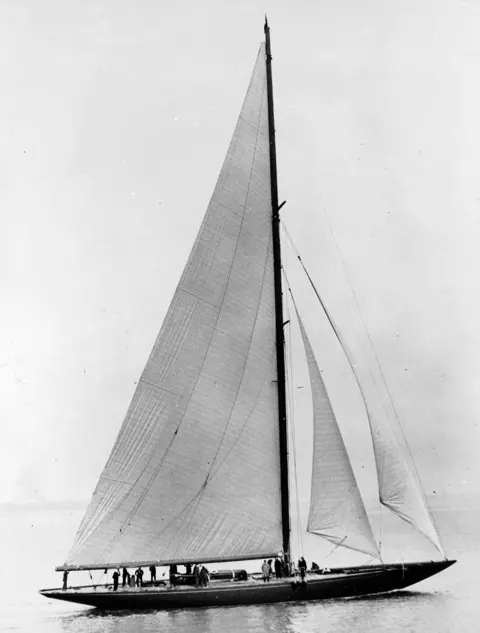
Lipton's racing yachts were all called Shamrock, each one pushing the boundaries of yacht design.
He came closest to victory with his fourth attempt in 1920, winning two races with the best result by a British challenger in decades, but the final score was 3-2.
Shamrock IV won the first race after the sail of the American yacht Resolute was badly damaged - and Lipton played down the victory as a fluke.
It was typical of the sportsmanship that endeared him to the public
For his final attempt in the 1930 series - the first involving the sleek and iconic J-class racing yachts - Shamrock V had a hollow spruce mast to reduce weight.
But the Americans always seemed one step ahead. The US defender of the trophy, Enterprise, used technology from the aeronautical industry and had an even lighter mast made of aluminium.
A large section of the American public seemed to be rooting for the Scotsman rather than their own countrymen - but that "auld mug" as Lipton called the America's Cup was to elude him once again.
At the finish as the crew of Enterprise celebrated a decisive 4-0 victory, Lipton was seen smiling as he watched, again endearing him with Americans for his spirit of competition but grace in defeat.
He described the America's Cup as the most "elusive piece of metal in all the world" but said the thirty years he spent chasing it brought him some of happiest hours of his life and "splendid friends".
 Roger Viollet Collection/Getty
Lipton was by now 82 and his American supporters were determined that his good-humoured pursuit of his great sporting ambition should not go unrecognised.
The Hollywood actor and newspaper columnist Will Rogers and the mayor of New York organised a public appeal to raise money for an alternative trophy for the man who Rogers had often described affectionately as the "world's best loser".
Thousands of Americans contributed. Donors included future US president Franklin D Roosevelt and miners from Utah who supplied 25kg of silver which was used by Tiffany's to construct the trophy's base.
The two-handled cup itself was made of solid gold, decorated with shamrocks with the inscription "To the Gamest Loser in the World of Sport".
Laurence Brady, director of the Sir Thomas Lipton Foundation, says the generosity was all the more remarkable given that it was at the height of the Great Depression.
"People lined the streets applauding him as he made his way from his hotel to the presentation ceremony at New York City Hall," he said.
"It was a gift from ordinary Americans to a man whose sense of humour and sportsmanship they admired."
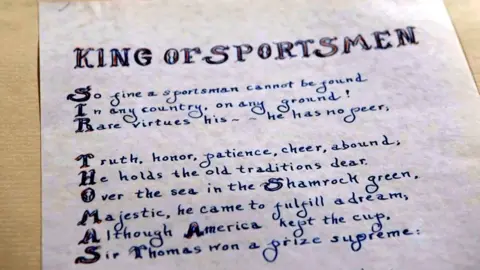
The many letters sent in by contributors were turned into a bound volume presented to Lipton along with the spectacular trophy.
The mayor Jimmy Walker joked that he was "possibly the world's worst yacht builder but absolutely the world's most cheerful loser".
Roosevelt wrote: "Sir Thomas and his good sportsmanship are a lesson to every American."
Lipton was so overcome by emotion that he was unable to finish his speech and a friend had to step in to deliver his words of thanks.
Sir Thomas Lipton died a year later. He bequeathed the bulk of his fortune "to benefit the poor of Glasgow" while his many sporting trophies were also donated to the city of his birth.
The fate of the Lipton Cup is currently unknown. Its monetary value is estimated at £490,000.
As a symbol of sportsmanship, many would argue it is priceless.
The tea tycoon who was 'world's best loser'
Historic gold trophy worth nearly £500k stolen from Glasgow museum
Riverside MuseumGlasgowYachtingСхожі новини

Who is William Savitt? Sam Altman hires lawyer who beat Elon Musk once before

Mayon Volcano eruption: 1,500 families evacuated, airspace restricted near Manila

'Hot for them too': British man praised online for rescuing dehydrated bird amid Delhi’s brutal heatwave