The fight against foreign developers buying Caribbean beaches

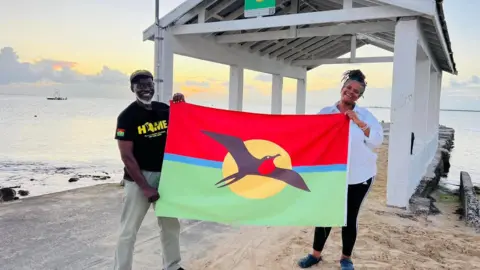 BLRRC
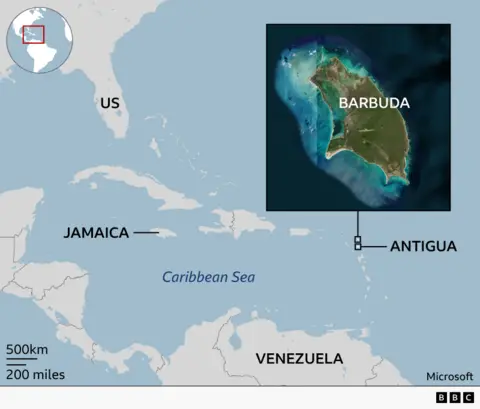
BLRRCOn the small Caribbean island of Barbuda, the Pink Sands Beach Bar played host to locals - and the occasional tourist - for more than 20 years.
"It was a very warm place," says Miranda Beazer, its former owner, describing how people used to gather there to play dominoes, or to relax after church on Sundays.
Named after the rose-tinted sand it stood on, the bar was a cornerstone of the local community, until Hurricane Irma hit the island in 2017, when all of the roughly 2,000 Barbudans were evacuated to sister island, Antigua.
Miranda's bar - and her house - were destroyed. "There's nobody that was unscathed... it was devastating. I cried for two weeks," she says.
Before the bar could be rebuilt, her husband died. Foreign developers started to offer her large amounts of money for her plot - but she refused them all.
"It's not the money that I'm after," Miranda says, "I actually want to retain my land."
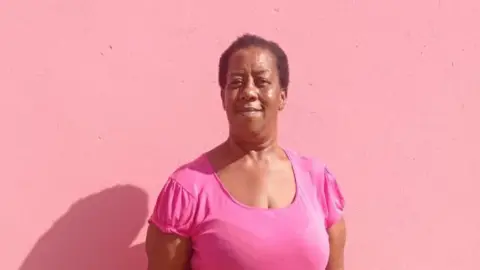 Miranda Beazer
Then, the bulldozers came. What remained of the bar after the hurricane was demolished by foreign developers, Miranda alleges.
Since then Miranda has been fighting a legal case to regain access to what she argues is her land.
However, this is complicated by Antigua and Barbuda's property laws.
Land ownership in Barbuda is collective, meaning that individual citizens have the right to occupy a plot of land by applying for a lease, but technically, they do not privately own it. Instead, all land is owned communally, and citizens share the collective right to be consulted and to have the final say on major developments.
The ownership system was established after slavery ended in Barbuda in 1834 and was officially recognised by the government of Antigua and Barbuda in 2007, when the Barbuda Land Act was passed.
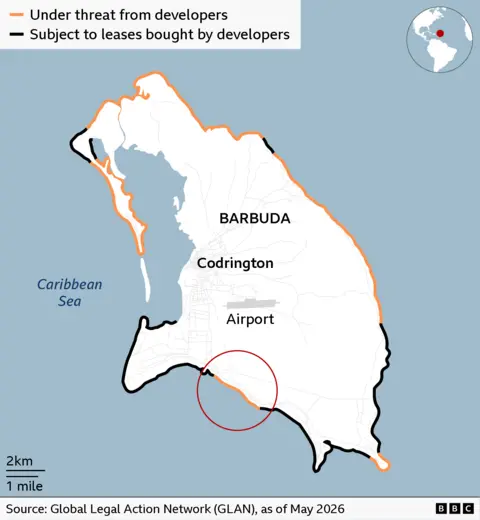
Miranda says she owns the lease to 30 acres of coastline, but currently she only has access to eight.
The Global Legal Action Network (GLAN), a network of lawyers that is supporting her, says the rest of the land is being illegally occupied by foreign developers Murbee Resorts and Peace Love and Happiness (PLH).
 Getty Images
In a statement, Murbee says that it is a legal lease holder in Barbuda and "has not carried out construction activity on any land for which it does not have legal authority to do so, or at all".
PLH says it "does not and has never" occupied the land, and has "strictly followed" all agreements since entering a lease for land in Barbuda in February 2017.
But Miranda says, like many other Barbudan campaigners, that she remains committed to fighting for access. "If you were to ever come here and experience it yourself, you would really understand why we're so committed to this little piece of rock that we have."
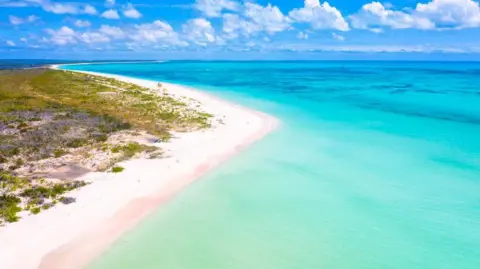
Miranda's land is the last strip of Barbuda's southern coastline that is still accessible to locals.
But like many beaches on islands across the Caribbean where locals are not protected by property laws, it is now under threat from wealthy developers, who want to turn it into an exclusive retreat reserved solely for tourists.
 Mondadori Portfolio via Getty Images
One property investor just a few miles down the coast from Miranda's plot is the Oscar-winning actor Robert de Niro.
Along with the Australian billionaire James Packer, he is part of Paradise Found, the developers of The Beach Club Barbuda.
This sprawling 400-acre resort, which is due to be completed later this year, will include Nobu Beach Inn, a luxury hotel made up of 17 villas. There will also be 25 beach-front homes.
Locals say they can no longer visit or even see the beach the resort is built on, after a bypass road that was recently built to ringfence the complex. The price of a plot on the Beach Club site is said to start from $7m (£5.2m).
On its website, the resort is described as a "rare Island community on one of the Caribbean's last untouched shores".
But John Mussington, the chairperson of Barbuda Council, the local authority, argues that this "community" was only made possible by flouting the 2007 Land Act.
To allow construction of The Beach Club to go ahead, the government passed a new law, the Paradise Found Act, in 2015. It stipulates that the 2007 act does not apply to the Beach Club complex.
Campaigners mounted a legal challenge which was taken all the way to the highest court for Antigua and Barbuda - the Judicial Committee of the Privy Council (JCPC) in the UK. Antigua and Barbuda maintained this legal structure after it gained its independence from the UK in 1981.
In 2022, the JCPC found in favour of the Antiguan and Barbudan government, ruling that "the rights accorded to individual Barbudans solely on account of their status as Barbudans… do not constitute an interest in or right over property".
Paradise Found said in a statement that The Beach Club was "developed in accordance with the laws and approval processes of Antigua and Barbuda" and that public access to Princess Diana beach, which is now part of the complex, "remains unchanged".
Barbuda is not the only Caribbean island where colonial-era laws sit at the heart of land disputes.
Head 1,600 km (1,000 miles) west, and there is another long-running campaign for greater access to beaches for locals in Jamaica.
Devon Taylor, president of the Jamaica Beach Birthright Environmental Movement (Jabbem), says the country's current land legislation discriminates against Jamaicans, as "it clearly states we have no rights in or over the foreshore".
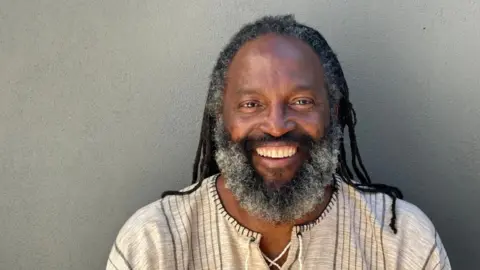 Devon Taylor
The Jamaican government recently proposed a new law to improve beach access for locals, but Taylor argues that instead of improving Jamaicans' land rights, it places more restrictions on where they can go, by encouraging hotels to sell beach passes to locals.
"You're selling back the access to the people," he says, adding that he believes this takes the country back to a kind of "colonial logic".
The Jamaican government has been approached for comment.
According to Jabbem, less than 1% of Jamaica's coastline remains freely accessible to locals. Along with other local groups, they are currently fighting the Jamaican government and private developers in five separate legal challenges over beach access for locals.
As tourists start to look further afield, seeking out less well-known destinations, smaller Caribbean islands such as Grenada are also seeing legal disputes.
Kriss Davies, chairperson of the campaign group Grenada Land Actors, fears that as demand grows, the arrival of more large resorts could make Grenada lose the charm that makes it unique for locals and tourists alike.
According to the United Nations Development Programme, the Caribbean "is the most tourism-dependent region in the world". Of all the holidaymakers to the region, roughly half are American.
For governments across the region, the continuing growth of the sector offers an enticing path towards economic growth and development.
But, as Devon says: "Travel is never neutral - it carries both an economic and moral weight.
"These developments often displace residents from ancestral coastlines, restrict public access to beaches, and channel wealth away from the very people whose culture sustains the tourism experience."
As the demand for a portion of paradise only continues to grow, Caribbean land defenders remain concerned that, rather than bringing opportunity, tourism could irrevocably change the place they call home.
Read more global business storiesWhy does Amazon have no Western rivals?
Big tech bets on new mascots in bid to seem more cuddly
Cyber-crime increasingly coming with threats of physical violence
Amsterdam bans public adverts for meat and fossil fuels
GrenadaTourismWorld of BusinessImpacts of tourismInternational BusinessCaribbeanJamaicaAntigua and BarbudaСхожі новини
The Problem With Tesla’s NON-Automatic Windshield Wipers

Electrifying your fleet isn’t just about going green – it’s about staying in business