The devil owns Amazon: big tech has infiltrated the fashion world - will we see a revolt?

Anna Wintour has welcomed the Bezoses – and their patronage – with open arms. But after a controversial Met Gala, industry insiders are less enthusiastic
The press conference for the Met Costume Institute’s spring exhibition is always a stately affair, but this year it was giving “feudal lady addresses her serfs” or perhaps “Marie Antoinette during the last days of Versailles”. Here, among the spectacular marble sculptures of the art museum’s American wing, was a beaming Lauren Sánchez Bezos, who Anna Wintour introduced as a “force for joy”, before adding that “she and her husband, Jeff, have shown with this event that they genuinely, genuinely care about giving back”. Meanwhile, in the outside world, protests against the Bezoses’ involvement had been raging for days. The discrepancy between the word on the street and the deference within the glass-ceilinged room was head-spinning.
The Met Gala has recently become a magnet for anti-excess protests, but this was its most controversial yet, owing to the $10m patronage of its honorary co-chairs, centibillionaires Jeff Bezos and Lauren Sánchez Bezos. It was not the first time Jeff Bezos bankrolled the gala – Amazon was its lead sponsor in 2012. But this year’s event came at a moment of soaring inequality, as Bezos’s personal wealth has mushroomed and his Donald Trump-appeasing decisions have made him less popular than ever with New York City’s left-leaning fashion and arts crowd.
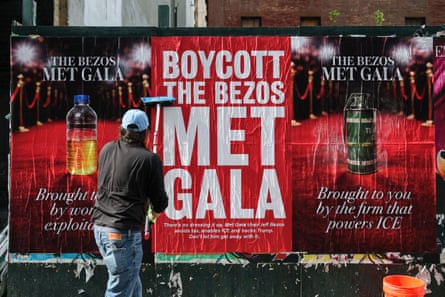
In protest of the gala, the group Everyone Hates Elon projected interviews with disgruntled Amazon workers on to the side of Bezos’s Manhattan penthouse and circulated 300 containers of fake urine within the museum, to highlight Amazon drivers’ reports of having to work so relentlessly they must pee in bottles. Some of the pushback came from fashion insiders themselves: former US Vogue editor Gabriella Karefa-Johnson co-hosted a rival Ball Without Billionaires, putting Amazon workers on the catwalk, and turned down work with a dream client to boycott the event. “Fashion has always had a talent for laundering. In these moments, it wraps the most sinister individuals in silk, under the warm glow of flashing lights, and manages to convince us it’s culture. This is not new. But I have my limits,” Karefa-Johnson wrote on her Substack.
A further strand of criticism came from a very unlikely source: The Devil Wears Prada 2, a movie whose iconic editrix, Miranda Priestly, was inspired by Wintour herself. Released a few days before the gala, its spookily on-the-nose plot centred on tech baron Benji Barnes’s attempts to buy the depleted Runway magazine for his girlfriend, Emily. While Barnes is a fictional character, he has certain Bezos-like qualities, including his post-divorce makeover (in the movie it is fueled by Sculptra, Ozempic and testosterone shots), and the storyline echoes unsubstantiated rumors that Bezos wants to buy Vogue for his wife. Barnes delivers a chilling monologue about AI, anticipating a world where the magazine will publish without human involvement. “The future just comes rushing at us like the lava of Pompeii,” he says, with a shrug, while Priestly – the villain of the first movie – heroically pushes back. She slams Emily’s efforts to muscle her way into Runway using her partner’s cash with the very Priestly burn: “You’re not a visionary, you’re a vendor.”
According to screenwriter Aline Brosh McKenna, the plot’s similarity to real-world rumours is a coincidence – but casting a rapacious Silicon Valley oligarch as tyrant to the fashion class in one of the year’s biggest popcorn movies is also a reflection of the zeitgeist. The cultural backlash has been such that you have to wonder whether fashion’s burgeoning relationship with the barons of tech will rupture.
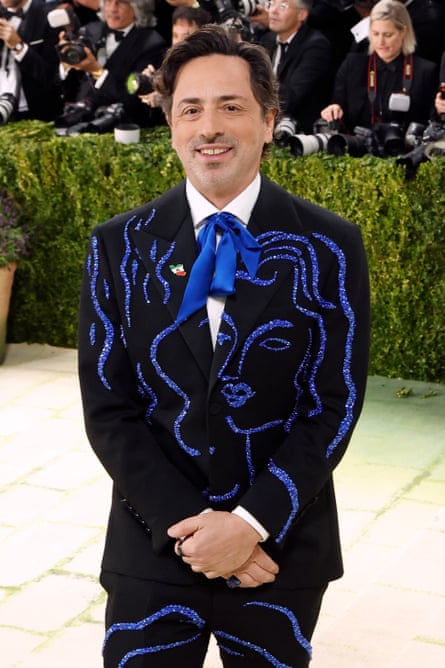
The Met Gala plays a unique role in fashion culture, as the only major annual red carpet that enables designers to pursue their wildest, most creative instincts – which is why the frocks are so much riskier, and at times hilarious, than those at the Oscars. The gala also funds the Met’s Costume Institute, one of the world’s biggest and most comprehensive collections of historical clothing, and its exhibitions, the most recent of which, Costume Art, saw Sánchez Bezos (and her cash) playing a particularly prominent role. This year, the gala raised $42m. Tickets were a chilling $100,000, up from $35,000 in 2022, an inflation coinciding with an increasingly tech-oriented guestlist, which included Google co-founder Sergey Brin, Mark Zuckerberg and staff from OpenAI. Any suggestion that Bezos, Brin and Zuckerberg, who have buddied up to Trump as his administration has defunded the arts, attended the Met Gala because they care about the preservation of archival garments feels slightly ridiculous.
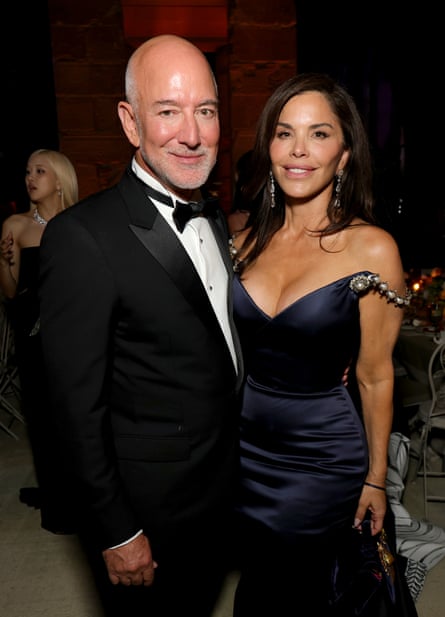
What the tech barons do want from fashion, seemingly, is cultural cachet. For the Bezoses, the event is just the latest in an ongoing campaign to win fashion kudos, much of it facilitated by US Vogue. The magazine ran a glowing Sánchez Bezos profile in 2023, then doubled down on that endorsement with a digital wedding cover in 2025. In the past six months, the couple has sat front row at Paris fashion week shows, and announced donations of tens of millions of dollars in grants and scholarships devoted to sustainable fabrics. Wintour, who stepped down from her role as editor of US Vogue in 2025 to take on a bigger role at publisher Condé Nast, continues to oversee the Met Gala. She has a history of bringing people she deems culturally and commercially potent into the fashion fold – Kim Kardashian, for example – even when the peanut gallery argues they have not earned the prestige. The industry usually sees things Wintour’s way. Indeed, many top designers have worked with Sánchez Bezos, including “image architect” Law Roach and Schiaparelli, who dressed her for the Met Gala in her preferred cleavage-centric, hourglass aesthetic (though, tellingly, on Instagram, neither appears to have put an image of their work on the grid).
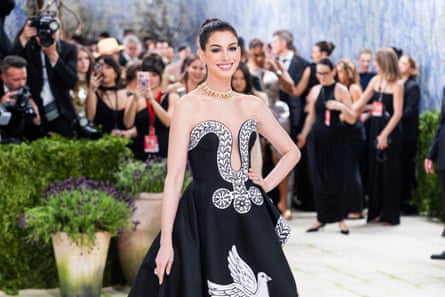
As the dust settled on the gala, the fashion insiders I spoke to expressed continued discomfort about the Bezos sponsorship, which they felt was disappointingly representative of the direction at Condé Nast, which recently closed its most progressive outlet, Teen Vogue. They were disappointed too, that so many otherwise politically vocal celebrities attended the gala despite the outcry. (Those who glided down the red carpet included Anne Hathaway, Bad Bunny, Rihanna, Margot Robbie, Beyoncé, Nicole Kidman and Venus Williams. Taraji P Henson and Mark Ruffalo were among the few to post anti-Amazon videos; media reports of boycotts from Meryl Streep and Zendaya were not confirmed.)
But then, the insiders I spoke to themselves did not feel able to speak out. One creative in the fashion world told me that he had found the event “horrific” and “naff”. “If it was up to me, it would be the end of the Met Gala,” he said, but he did not want to slam good friends – designers and stylists – who had worked on red carpet looks. Another emerging designer, whose work appeared in the Costume Institute’s spring exhibition, told me she was not aware of the Bezoses’ involvement until long after she had started working on the show. She felt deeply conflicted about the whole thing, concerned that she was being tokenized, “because we know that the Jeff Bezoses of this world don’t care what broke people have to say”. Ultimately, she decided she could not turn down the exposure. “It’s so hard to try to fight it before you have any power to make change.”
The situation in fashion feels bleak, she said. One of the reasons that tech billionaires are on trend is because so many luxury brands – the customary sponsors of exhibitions like the Met’s – are struggling. Last year, Burberry announced plans to cut 1,700 jobs while Kering, which owns Gucci, Saint Laurent and Balenciaga, closed 133 stores. “It’s hard to watch: people who have been working for years in the industry that should be protected and have given so much of their creativity, are getting laid off, losing work,” the designer said. “And, at the moment, people like the Bezoses are the only ones funding this stuff.”
For all the backlash, Amy Odell, fashion journalist and author of the Back Row newsletter, doesn’t think the tech billionaires are going anywhere. She doesn’t buy the rumours of Bezos acquiring Vogue, but there are so many other reasons why he would want to be part of the fashion industry. Amazon has long sought to get closer to luxury fashion, facing sometimes haughty rebuffs (LVMH chief financial officer Jean-Jacques Guiony said in 2016 that “the business of Amazon does not fit with LVMH full stop”).
And there is the glamour, of course. Maybe the Bezoses are wooing fashion because “it’s fun for them,” Odell speculated. “He’s having a midlife crisis, he’s getting some new clothes. His wife wants to be photographed and in the spotlight.” In an oligarch attention economy, she theorized, “the tech people you can name” are becoming the Kardashians. “They bring publicity. I think fashion is going to continue to embrace them. The question is whether they become normalized the way the Kardashians did.”
There are even more reasons those at the top of the fashion industry would be keen for this to happen. For one thing, Sánchez Bezos is what Odell describes as “a VIC”, or very important client, one of the “2% of luxury buyers who account for 40% of sales – that’s the bread and butter for luxury brands, not aspirational customers”. Condé Nast, meanwhile, would view Bezos as an ally, whether for Met Gala-style donations or for deals such as a recent agreement allowing Amazon to pull content from Conde’s publications for AI-generated podcasts.
Whether because the gala has become so complex and incendiary, or because Wintour, 76, will one day retire, the Costume Institute does seem to be considering its next move. Its lead curator, Andrew Bolton, told the New York Times that by 2028 or 2030 the institute will have saved enough money in a “quasi endowment” that it will no longer need annual gala support. Bolton said: “The Met Gala is extraordinary, but sometimes it dwarfs everything,” and added that the department’s reliance on it felt precarious. “What if there was another global disaster, and people were like, ‘I can’t come to a party?’” Each year, he said, the gala has become bigger and more high profile, and “there will be a point where that’s not sustainable”.
That said, Odell points to a post-gala podcast interview with Condé Nast’s CEO, Roger Lynch, in which he said that this year’s controversy was “good … the intrigue around this event just seems to grow!” Perhaps, Odell said, “they count on the internet’s memory being short. Perhaps they just don’t care, because they don’t talk to normal people.”
If it’s true that those at the top of the industry can’t hear the outcry from the little people at all, it’s easy to imagine the gala – and the luxury industry it represents – spinning ever further into oligarchland, with tech barons playing all of the starring roles.
At which point, the creatives whose ideas and elan have always driven the fashion industry forward may not want to cheer them on. They may want to eat them.
Explore more on these topicsShareReuse this contentСхожі новини

Варварський удар по об'єктах культури у Києві: постраждали Житній Ринок, книгарня та галерея
'The Mandalorian and Grogu' is Disney's lowest-ever Star Wars film opening

Зруйнований музей Чорнобиля, вирвані двері в НАМУ: Росія била по культурних пам'ятках у Києві