The Best Way to Burn 100 Gallons of Gasoline Fast
 May 20, 20261 hour
Zachary Shahan
0 Comments
Support CleanTechnica's work through a Substack subscription or on Stripe.
May 20, 20261 hour
Zachary Shahan
0 Comments
Support CleanTechnica's work through a Substack subscription or on Stripe.
Ah, yes, of course — who wants to burn gas fast when it costs $4.43/gallon?! But, look, I got your attention.
Naturally, people want to save money on gas right now. One thing early-generation electric vehicle owners can tell you is there’s one big, obvious way to reduce your gas usage.
A decade ago, electric cars had a lot less range and EV charging stations were much less abundant. There were plenty of cases where EV drivers had to be careful in order to not run out of charge. Those of us who lived through that era and ever drove on a highway discovered that driving fast burned up our battery capacity much faster. What’s not commonly known for those who didn’t go through that era is that the energy used goes up exponentially as you increase your driving speed.
In short, if you drive 60 mph instead of 50 mph, you are burning a LOT more gasoline than if you drive 50 mph instead of 40 mph. If you go 70 mph instead of 60 mph, you are again going to burn a LOT more gasoline than you would driving 60 mph versus 50 mph.
“Aerodynamic drag is proportional to the square of velocity, and hence the power needed to overcome drag is proportional to the cube of velocity. This means that there is a very strong relationship between the speed that a vehicle is travelling and the proportion of the fuel used to overcome drag,” as the Auto Research Center says it. Here’s how Google summarizes it:
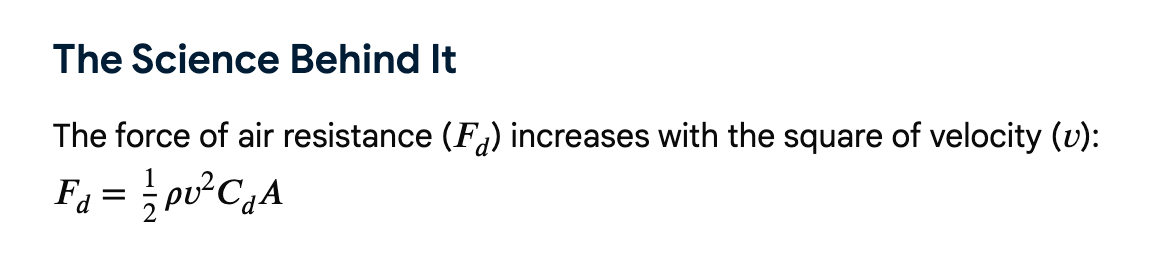
So, yeah, if you want to save money on gasoline (or electricity), drive slower, and it’s especially important to cut your speed down on those faster roads. Driving 25 mph instead of 35 mph on a 25 mph road is helpful, but what you really want to do is not go above 50 mph on a 50 mph road, and you really don’t want to be driving 70+ mph!
Again, for those of us who were ever driving an EV on a highway and questioning if we can make it to the next charger, we’ve seen the benefit of driving slower. Tesla’s system has been particular good at showing this in my experience since the estimate of how much battery capacity you’ll have at your destination adjusts very effectively while you’re driving. I drove a 2015 Tesla Model S on the German Autobahn, and my goodness, driving very fast ate into that battery capacity estimate in a freaky way. I guess there’s no way to explain that experience in a way that is as shocking and visceral, but just understand this key point: to save money on gas, don’t drive fast. If you want to burn gasoline in absurdly quick time, go drive fast on the Interstate or the Autobahn.
Sign up for CleanTechnica's Weekly Substack for Zach and Scott's in-depth analyses and high level summaries, sign up for our daily newsletter, and follow us on Google News! Advertisement Have a tip for CleanTechnica? Want to advertise? Want to suggest a guest for our CleanTech Talk podcast? Contact us here. Sign up for our daily newsletter for 15 new cleantech stories a day. Or sign up for our weekly one on top stories of the week if daily is too frequent. CleanTechnica uses affiliate links. See our policy here.CleanTechnica's Comment Policy
Share this story!
Схожі новини
Leaving the V8 in the past: The all-electric Mercedes-AMG GT 4-Door