Tehran, Taiwan, trade … what are the hazards facing Trump on Xi summit tightrope?
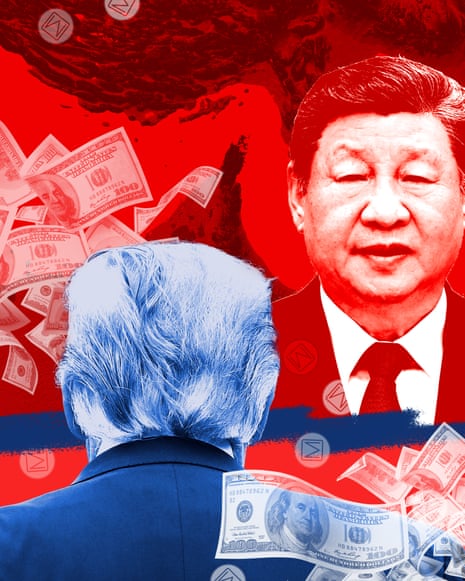
US leader enters talks with superpower rival from vulnerable position, but will be hoping for economic wins amid turbulent backdrop
If all goes to plan over the next few days – and that is a big if – Donald Trump will arrive in Beijing on Wednesday for a highly anticipated summit with Xi Jinping, China’s leader.
The trip will mark the first time a US president has visited China in nearly a decade. The last visit was also made by Trump, during his first term, in 2017.
Back then, Beijing pulled out all the stops. On the three-day trip Trump and his wife, Melania, were treated to a private tour of the Forbidden City, the sprawling palace that housed Chinese emperors for centuries, and sat for a traditional Peking opera performance. The Chinese described it as a “state visit-plus”.
But in the intervening nine years there has been a trade war, a global pandemic, an intensification of concern in Washington about Chinese military activity, and another trade war.
Now, as the president of the world’s biggest superpower prepares to visit his country’s biggest competitor on the global stage, the mood has shifted. Trump’s trip has been delayed by his attack on Iran, a stunning demonstration of the limits of US power, and cut to just two days.
“The idea of an American president going to a summit with our foremost competitor at a time where he has just experienced the most catastrophic strategic debacle in recent memory is going to be a striking moment,” Suzanne Maloney, vice-president and director of foreign policy at the Brookings Institution thinktank in Washington, told reporters on Thursday. “From a US perspective, this absolutely changes the sense of our ascendance at this point in time and what it means for the relationship.”
The optics of the summit will be heavily scrutinised. Trump – less hawkish on China than in his first term – is known to relish the pageantry of diplomacy and often speaks of his personal friendship and trust in Xi, contrasting with his frequently abrasive tone toward traditional US allies. Emulating soft power displays from heads of state including King Charles III, Xi is likely to flatter the US president while subtly highlighting Trump’s weaknesses and asserting his own strengths.
Whatever bonhomie Xi and Trump are able to muster during the 48-hour summit that brings together the men who together control more than 40% of the world’s economic activity, the frictions, heightened by the war in the Middle East, will not be far from the surface.
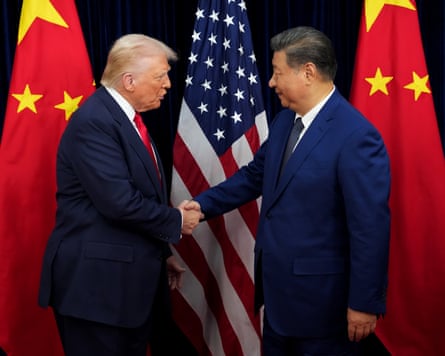
Zhao Minghao, a professor of international studies at Fudan University, said there was a “very prominent mutual distrust” between the two countries. “Both sides still have profound disagreements on a number of issues, economic and trade issues, military-to-military relations, and Taiwan-related issues.”
The biggest items on the agenda in the world’s most important bilateral relationship will be trade, Tehran and Taiwan.
Building bridges
The road to the Xi-Trump summit was set in Busan last October, when the US and China agreed a temporary truce in the trade war Trump unleashed last year, during which tariffs on China reached as high as 145% at one point. An effective embargo on Chinese exports to the US risked crippling the Chinese economy at a time when it was already struggling to recover from the pandemic and structural problems created by demographic challenges.
China had responded to the tariffs by restricting the export of rare earths, elements that are vital to global industrial supply chains and US military technology. It did not take long for some factories in the US to grind to a halt.
Jake Werner, east Asia director at the Quincy Institute for Responsible Statecraft, said in a briefing this week that the Busan meeting “established a sense of respect on both sides”.
“Trump came into office last year, with the sense that he was going to reduce the Chinese and force them to acknowledge his power over them,” Werner said. “He discovered that he could not do that because the Chinese were able to fight back effectively.”
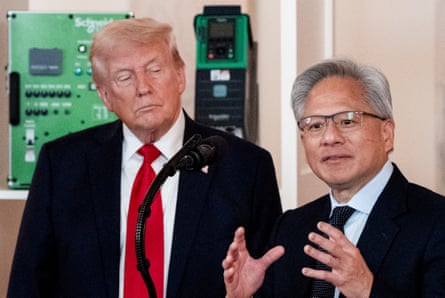
Eager for tangible “wins” before the November midterm elections, the Trump administration has reportedly invited chief executives from Nvidia, Apple, Exxon and other major companies to accompany the president, with the Boeing head, Kelly Ortberg, and Citigroup leader, Jane Fraser, confirmed as attending.
China is seeking to extend the current trade truce, preserve access to US technology and halt or roll back the tightening of US export controls. In return it may offer substantial investments in the US economy, mirroring deals the Trump administration has previously struck with nations such as Japan and South Korea.
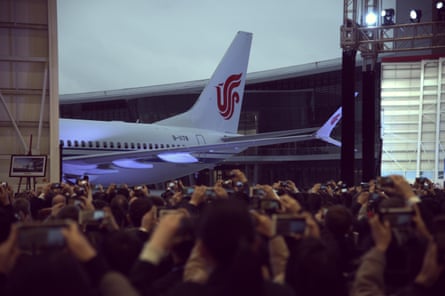
Beijing has been in prolonged talks with Boeing for a deal that could include 500 737 Max jets plus dozens of wide-body planes. This would mark China’s first major Boeing order since 2017 and serve as a headline-grabbing victory for both leaders. Agricultural buys are also on the table, with Washington pressing Beijing to commit to buying 25m tonnes of soya beans annually for the next three years, alongside increased purchases of US poultry, beef, coal, oil and natural gas.
Beyond traditional investments, China holds a significant wild card: the rare earth mineral supply chain. Analysts suggest Beijing may dangle a stable, long-term commercial arrangement, akin to a general licence, for US access to rare earths and rare earth magnets, provided they are not utilised for military end-uses.
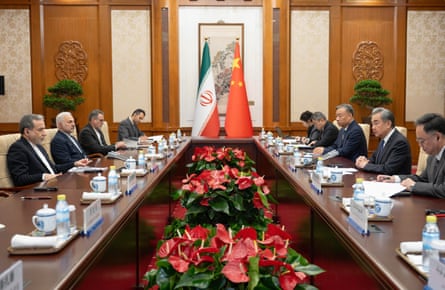
Iranian influence
The war in Iran has shifted the summit’s dynamics, absorbing a massive amount of Trump’s attention. The conflict has resulted in the closure of the strait of Hormuz, through which a fifth of the world’s oil traditionally flows, posing a severe threat to China’s economy and its delicate relationships in the Gulf. Trump’s erratic statements, by turns declaring the war is over only to then threaten annihilation, have created diplomatic whiplash. On Thursday Pakistani officials again claimed that the US and Iran were nearing a temporary agreement to halt the conflict.
China has been credited with pushing Iran towards the ceasefire. This week the US Treasury secretary, Scott Bessent, called on China to “step up with some diplomacy” – essentially asking for Beijing’s help in a war that Washington started – while the trade representative Jamieson Greer said Trump planned to address China’s ongoing energy purchases from Iran.
As the biggest buyer of Iranian oil, China does have some influence over Tehran. And it is keen to avoid a global recession that would reduce demand for its goods – the export of which props up the Chinese economy.
But relations between the two countries are far from cosy. “It would be too much to say that China could cajole or twist the arm of Iran,” said Dali Yang, a professor of political science at the University of Chicago, who described the relationship as “delicate”.
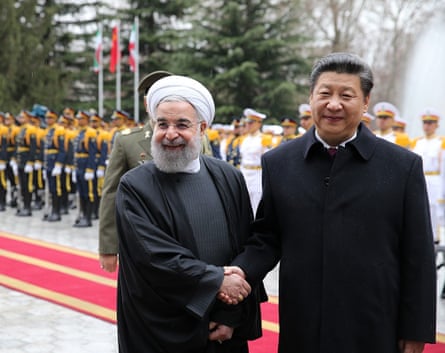
Xi visited Iran in 2016 but in an apparent snub was made to share a sofa with the then president Hassan Rouhani in a meeting with the then supreme leader, Ayatollah Ali Khamenei (Rouhani was cropped out in the version of the picture shared by the Chinese government).
“China knows that the Middle East is not an easy place to try to get things done,” Yang said.
Wang Wen, a professor at Renmin University, said: “China cannot control Iran, nor does it possess the absolute power to unilaterally dictate the course of the Hormuz crisis.”
Beijing sees the war in Iran as a crisis of the US’s own making. It is also, despite the global ramifications, a crisis far from China’s borders.
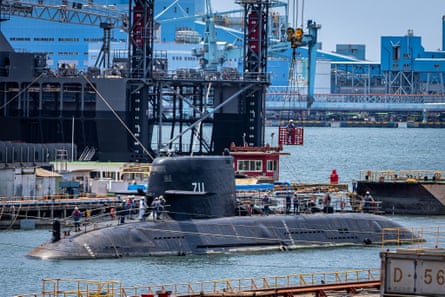
Taiwan rhetoric
Xi is more concerned with China’s own sphere of influence, where no issue is more important than Taiwan. China’s foreign minister, Wang Yi, said this week it was the “biggest risk” in US-China relations.
Beijing claims the self-ruled island of 23 million people as part of its own territory and has vowed to take control of it, using force if necessary. The US does not formally recognise Taiwan but supplies it with the means to defend itself – namely through arms sales. In recent years, the threat of a military conflict with China in the Indo-Pacific has animated Washington’s China hawks and intensified efforts to limit China’s military prowess.
But Trump appears to have taken a softer stance on Taiwan than previous presidents. He has described it as an economic competitor, particularly in the semiconductor industry, rather than a democratic ally. An $11bn US arms package for Taiwan has reportedly been stalled by the state department before the Xi-Trump summit.
Beijing may push for the US to modify its official rhetoric on Taiwan, such as shifting its stance on Taiwanese independence from “does not support” to “opposes”.
Mira Rapp-Hooper, who was the top White House adviser on the region during Joe Biden’s presidency, said: “While it is rather unlikely that we will see a formal change in declaratory policy on Taiwan … what I think American allies will be watching most closely is for any reporting that suggests that President Trump has acknowledged President Xi’s prerogatives or interests over Taiwan, even if that concession comes in a casual or off-the-cuff way, or indeed that President Xi has persuaded President Trump to delay or in any way change the nature of arms sales to Taiwan.”
Extending cooperation to counter the flow of fentanyl and other synthetic opioids and their precursors into the US could also be on the agenda. Human rights cases involving figures such as Jimmy Lai and Pastor Jin Mingri remain potential flashpoints depending on Trump’s shifting focus.
Perhaps no issue will have more profound long-term consequences than the current AI arms race between the US and China, amid fears that both countries are prioritising speed over safety in order to be first. Xi could view the summit as a premier opportunity to demonstrate on the world stage that the two AI superpowers can cooperate on global standards, framing it as a mutual victory.
Mired in a Middle Eastern conflict, and with his domestic disapproval at a record high of 62%, Trump enters the talks from a position of vulnerability. Paradoxically, the more successful the meeting, the more concerns many observers will have about what concessions Trump has made.
Jonathan Czin, a former CIA expert on China now based at the Brookings Institution, observed: “I actually think that a very positive, adulatory meeting could be the worst possible outcome in some ways because it’ll spook the rest of the region – it means that we’ve made some kind of accommodation.
“If Beijing is very happy with how the meeting has gone, that’s probably a worrisome sign in some way for the United States and our position going forward.”
Additional research by Yu-chen Li
Схожі новини
Катар відправив першу партію СПГ через Ормузьку протоку з початку війни в Ірані
Retailers are on a hiring spree. But consumers are sending warning signs