Struggling High Streets fuel sense of neglect for voters ahead of local elections

 BBC
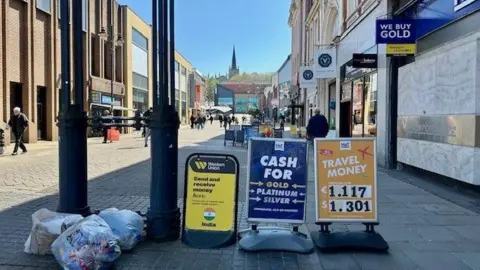
BBCOn a sunny midweek morning, there are plenty of people strolling or shopping in the centre of the West Midlands town of Walsall - but many of them share a common complaint.
"It's not like it used to be."
Debbie Tapper, who's lived around Walsall her whole life, recalls a bustling market that used to stretch the length of the High Street as she gestures sadly to the shops and stalls that remain.
"I am proud to be from Walsall," she says. "But I'm not proud of the way the country is at the moment."
The town faces many of the same challenges that plague High Streets across the country. A combination of online shopping, out-of-town retail parks, and wider societal and economic shifts means once-thriving town centres are scattered with shuttered shops, while destination department stores have given way to barbers, vape stores and bookmakers.
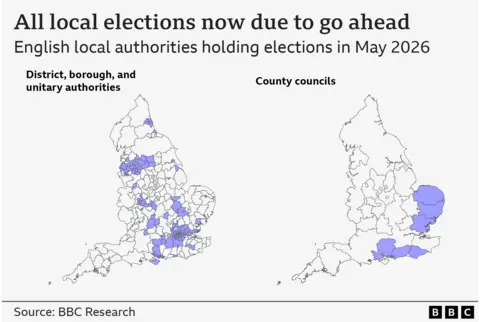
Beyond the frustration this causes local residents, there's evidence it is fuelling a wider sense of political discontent which could prove crucial in the forthcoming elections for English councils in May.
Luke Tryl, UK director of polling company More in Common, says: "It's clear that the public judge their local area and community by the state of the High Street. Signs of neglect are seen as symptoms of wider decline."
Tryl says it's part of a "wider malaise" that may seem minor or cosmetic, but "chips away" at Britons' perceptions of their local area, making them feel their communities are "neglected or forgotten".
In Walsall, it's something shoppers Sharday Hodges and Carmel Yates recognise. They are proud of the town, but say it's in desperate need of improvement.
"It's really run down," Carmel says. "There's a lot of deprivation. There's a lack of jobs about, unfortunately, so I think that has a knock-on effect... People haven't got the money to spend."
Sharday points to high rents and parking charges as barriers for businesses and shoppers.
"We used to have such a rich market history and it's such a shame," she says. "You see all the stalls and they're just not here anymore."
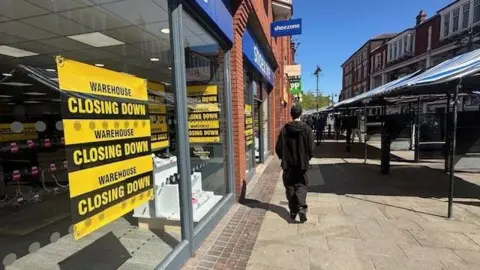
There have been efforts to improve High Streets across England, from central government funding to re-imagining the use of town centres with a mix of housing or public services like health centres.
Historic England ran a four-year programme to repurpose derelict and underused buildings as community spaces such as cinemas and market halls, and run cultural events, while in Walsall a £1.5bn regeneration project is planned.
But the solutions to a complex challenge aren't coming quickly enough for many voters.
"The council has come up with their 2040 plan and that's amazing, " Sharday says. "But if I've got to wait until I'm 41 for Walsall to be great again that's not good enough."
The challenge of town centre decline is far from exclusive to the Midlands and the North of England, but it is particularly acute in communities where deprivation is embedded.
Last year, the Centre for Cities think tank found the performance of town centres was linked to the performance of local economies. It found one in 12 High Street units in London and Cambridge were empty, compared with close to one in five in Bradford.
"Some High Streets are doing well, especially in and around London and the greater South East," according to the think tank's director of policy and research, Ant Breach.
"In places where people have less money to save or spend, the local High Street has suffered," he said.
Breach described High Streets as one of the most "visible barometers" of how a local economy is faring, saying where High Streets are performing badly voters expect intervention which requires more than cosmetic change.
Which areas are due to get share of £5bn funding boost?
Reeves 'particularly concerned' about pub business rates
'Shop local' and back small firms, people urged
While the state of town centres might once have been dismissed by some Westminster politicians as a parochial concern, there does now seem to be an awareness of how crucial the issue is to voters.
Communities Secretary Steve Reed agrees that High Streets are one of the things people look at when they're judging whether politics is working.
"Fixing High Streets is critical to showing people that politics is back on their side," he said.
"They go there today and they find a wasteland of boarded up shops, fly tipping everywhere, and metal grills covered in graffiti, and they perceive, they see visibly the sense of loss that has come to their locality and they feel angry because instead of the future looking better, the future's looking worse. And we can't allow that situation to continue."
The government has announced a £301m funding pot to revitalise High Streets, a wider £5.8bn "Pride in Place" scheme for people to improve their local areas, powers for councils to limit bookmakers and bring empty shops back to use, and plans to boost trading standards' ability to tackle "dodgy businesses".
But there is no easy solution to the High Street challenge given cash-strapped councils, pressured public services, sclerotic economic growth and regional inequalities.
In government, the Conservatives promised to "level up" the country with a central government funding programme; now they say their focus is on cutting taxes, pledging to scrap business rates for retail, hospitality and leisure businesses up to an annual limit of £110,000 per year; as well as outlining plans to cut electricity bills for businesses and hiring 10,000 police officers to tackle crime.
Conservative Party chair Kevin Hollinrake says: "We've got to make it as easy as possible for businesses to be in business.
"The fact you see High Street shops are closing, you see shoplifting, rough sleeping, that proliferation of vape shops… and maybe you'll think my area is going to hell in a handcart. You need a raft of policies to deal with that."
The Liberal Democrats are calling for a temporary cut in VAT for pubs, cafes and local attractions, as well as setting out proposals to reduce energy bills for business, encourage homes above shops, promote public transport, review parking charges and fund pedestrianisation projects.
Business spokesperson Sarah Olney said: "To truly turn our town centres around we need to see a return to proper community policing and more support for small businesses to invest in CCTV and tools to flag offenders to the authorities, to restore a sense of safety and pride."
The obvious, but crucial, question is whether voters trust what have traditionally been Westminster's dominant parties to provide the solutions - or whether the discontent they feel prompts them to turn elsewhere.
More in Common polling from last June suggested the sense of neglect that's often epitomised by declining High Streets is highest amongst Reform UK voters.
The party says it would abolish business rates for pubs to drive footfall to High Streets, with further policies set to be announced in due course.
A party spokesman said: "Sky-high business rates and parking charges imposed by local authorities that don't understand business is crippling the great British High Street."
The Green Party leader Zack Polanski has launched a three-step "plan to revive High Streets", including affordable leases for local business, powers to bring long-term empty shops back into public use and citizens' assemblies.
"Green Party Councillors would put the interests of the local community first - above a corporation's private property rights, and will use the powers local authorities have to over empty and derelict properties," Polanski said.
The challenge of declining High Streets isn't new.
There have been attempts to find solutions with success in some places, but in many town centres voters still look around and see decline.
Now there's a plethora of policies and pledges on offer, but perhaps one central point: politicians ignore the plight of the High Street at their peril.
What you need to know about the 7 May elections in England, Scotland and Wales
England elections 2026: What do local councils do?

Sign up for our Politics Essential newsletter to keep up with the inner workings of Westminster and beyond.
England local elections 2026Conservative PartyReform UKGreen Party (England and Wales)Labour PartyLiberal DemocratsUK High StreetsСхожі новини
'Not anymore': Ukraine hits two shadow fleet tankers carrying oil near Russia, launches 300+ drones

У Чехії масштабна пожежа охопила нацпарк «Чеська Швейцарія», залучені сотні рятувальників
Військові та будівельні відходи в Україні можуть стати додатковий джерелом енергії - турецький експерт
