Strategic neutrality: How Syria is winning in the Iran war
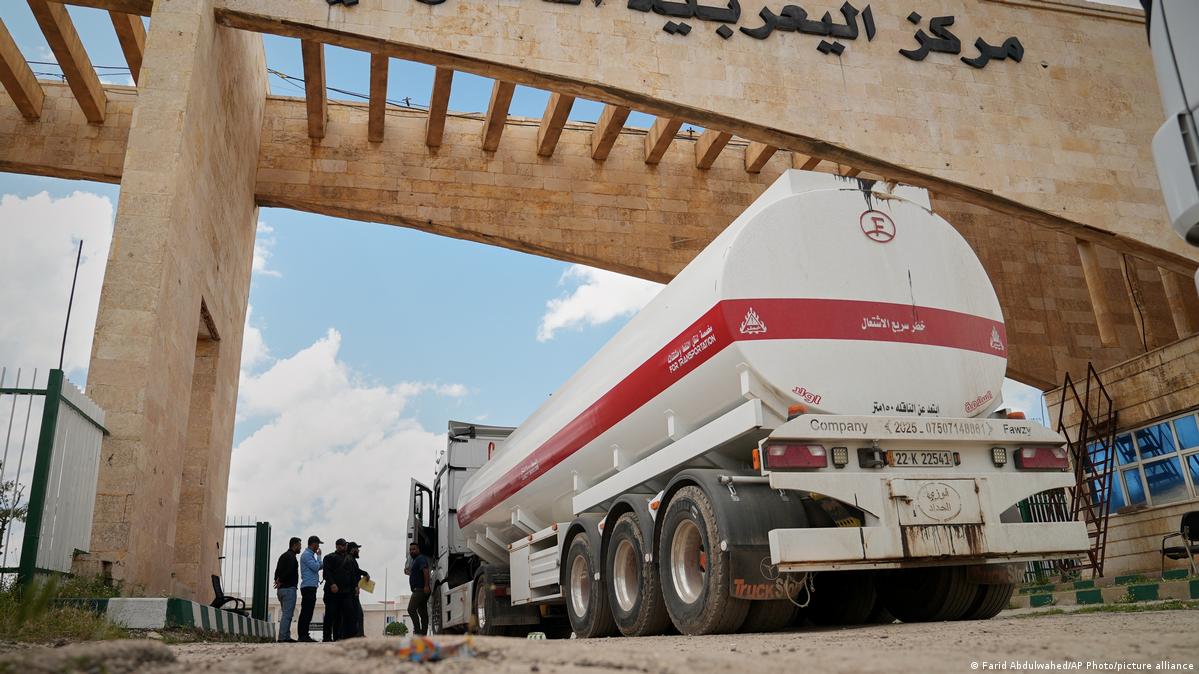
Descriptions of Syria have changed a lot over the past year. From a much-maligned state sponsor of terrorism, to a country ruined by civil war, to — now — a potential energy hub connecting the Middle East and Europe, a hub that could help save the world from the inflationary impacts of the Strait of Hormuz blockade.
The positive description has come about due to the current Iran war. After Israel and the US attacked Iran in late February, Iran closed off the Strait of Hormuz, one of the most important waterways in the world for the transport of crude oil from Iraq, Saudi Arabia, Kuwait and the United Arab Emirates.
Syria is now presenting itself as a possible alternative for the oil and gas producers that have no way of getting their wares to market. The country's location in the middle of the region and a foreign policy that has deliberately kept it out of the Iran war means the idea has been greeted with enthusiasm.
In some aspects, the idea is already being implemented. In early April, Syria and Iraq re-opened their border at so that Iraqi oil tankers could make their way to Mediterranean ports.
In mid-April, London-based media outlet Al Majalla sighted a leaked document that was attributed to Tom Barrack, the US special envoy to Syria, in which he too advocated for an "overland bridge through Syria." Barrack was referring, Al Majalla reported, to thousands of kilometers of pipelines, which could link Gulf states and Iraq to European markets.
'Strategic neutrality'
This is just one way in which Syria is benefitting from a position observers have described as "strategic neutrality" in the Iran war.
Syria's interim government is made up of rebel groups that ousted the country's long-time dictator Bashar Assad in late 2024. Iran and various proxy groups in the region, such as Lebanon's Hezbollah, supported the Assad regime and fought against the rebel groups.
"The new authorities in Damascus came to power with one overriding concern: to prevent Syria from again becoming a front for regional conflicts," Kheder Khaddour, a nonresident scholar at the Carnegie Middle East Center in Beirut, said in a March discussion. "That is why, since the conflict with Iran began, the Syrian authorities have focused more on managing the spillover from that conflict than on direct involvement in it."
Since they came to power, Syria's interim authorities have distanced themselves from Iran by reinforcing their own borders and clamping down on smuggling of weapons, cash and drugs to Iran-sponsored proxy groups in Iraq and Lebanon.
Additionally, unlike Iraq, Syria did not file an official complaint at the United Nations about the US and Israel using its airspace to attack Iran, Samy Akil, a nonresident fellow at the Tahrir Institute for Middle East Policy, noted in a March analysis. That has been interpreted by some as Syrian approval of the campaign against Iran, he says.
But, as Akil continued, "Syria's position appears less a choice than a necessity ... Its international reintegration, sanctions relief and reconstruction financing all depend on maintaining credibility with Washington and the Gulf states."
Syria's interim president, Ahmad al-Sharaa, has also been on something of a diplomatic offensive, during which he has regularly stressed just how useful his country could be.
In the Middle East, he has talked up regional security coordination mechanisms and a joint operations room with the Gulf states.
He also traveled to Europe, including to Germany. "Syria is a strategic hub between Europe, the Gulf states and the Indo-Pacific," German Foreign Minister Johann Wadephul said after the interim Syrian president's visit to Berlin in March.
In late April, the European Commission proposed that the EU resume its 1978 cooperation agreement with Syria. On May 11, the bloc is due to hold a high-level political dialogue with Syrian authorities.
"The intensified diplomatic campaign pursued by al-Sharaa since the start of the war … suggests an effort to leverage the war to present Syria as a constructive and valuable actor," Carmit Valensi, a senior researcher at Israel's Institute for National Security Studies, confirmed in a briefing late March.
Many opportunities
There are economic opportunities too. Besides the plan to facilitate oil exports, Syria is in talks with major international energy companies about oil and gas exploration. Road and rail traffic between Iraq, Syria and Jordan could grow as could logistics corridors and electricity networks.
Syria could also play an important role in the laying of land-based digital and telecommunications cabling.
In April, Iran warned that the submarine telecommunications cables running through the Strait of Hormuz might also be vulnerable to attack. In February, Saudi Arabia said it would prefer to lay fiber-optic cables for what's known as the East to Med Corridor (EMC) with Greece, through Syria rather than Israel, as had originally been planned.
While it sounds optimistic, whether the new Syrian government can actually exploit all these opportunities will depend on resolving some fairly large questions around the country's transition away from dictatorship and civil war, observers point out.
"Investment interest is real," Syrian journalist Mazen Ezzi wrote last week for The Amargi, an online media outlet focused on the Middle East and based in the city of Leipzig in eastern Germany. "But it remains contingent on political stability, regulatory clarity, security guarantees and the rehabilitation of basic infrastructure."
Fragile governance and an unsteady financial system, security threats due to community tensions in Syria or extremist actors like the "Islamic State" group could all cause problems. A lot of the required infrastructure either doesn't exist or needs to be modernized, sector experts say. Additionally there's a lot unexploded ordinance that still needs to be cleared.
Outside the country, there is pressure from states such as Iran, Israel and Russia, larger geopolitical rivalries on the energy market and the possibility that other transit countries won't play along with Syria's plans. There's also competition from alternative routes that bypass Syria.
At the moment, Syria is having a hard time just generating enough power for its own people, let alone efficiently shipping oil and gas to other countries, the Karam Shaar Advisory, a consultancy specializing in Syria's economy, pointed out.
"Syria's potential as an energy hub has regained attention," the researchers wrote in late March. But, they argued, "a critical distinction must be made between a transit hub and a transit state. A hub shapes routes, pricing and diversification. A transit state merely hosts infrastructure determined by external actors. Official [Syrian] discourse … aspires to the former. Yet current realities suggest the latter."
The Iran war has definitely created a strategic opening for Syria, Haid Haid, a senior non-resident fellow at the Paris-based Arab Reform Initiative, agreed in an April analysis. But there are no guarantees these will work out, he argued. "Without sustained reform, improved governance and a credible investment environment, Syria's re-emergence as a regional corridor risks remaining partial and temporary," Haid concluded.
Edited by: A. Thomas
AdvertisementСхожі новини

Львів’ян запрошують на обговорення тарифів на проїзд в громадському транспорті
У Солонці біля Львова відкрили новий сервісний центр МВС
Внаслідок ракетного удару по Дніпру загинули четверо людей