Solar Grazing Is Not Just For Sheep Any More
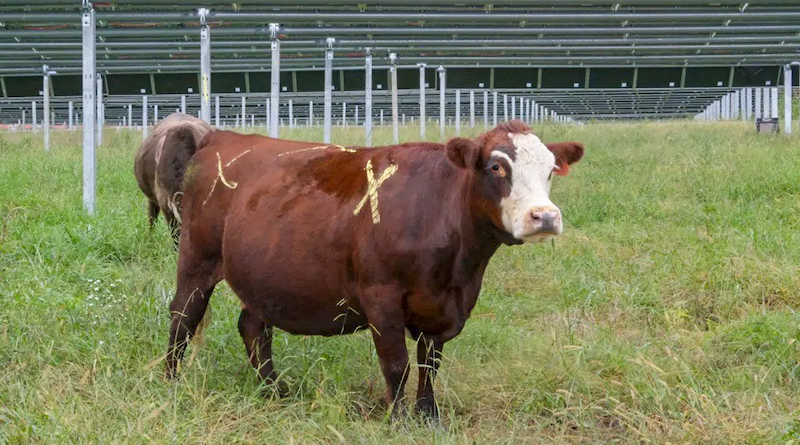 The US solar developer Silicon Ranch is exploring a new solar grazing model optimized for cattle ranching, carbon sequestration, water conservation, and land restoration all in the same space (cropped, courtesy of Silicon Ranch).
April 23, 202641 minutes ago
Tina Casey
0 Comments
Support CleanTechnica's work through a Substack subscription or on Stripe.
The US solar developer Silicon Ranch is exploring a new solar grazing model optimized for cattle ranching, carbon sequestration, water conservation, and land restoration all in the same space (cropped, courtesy of Silicon Ranch).
April 23, 202641 minutes ago
Tina Casey
0 Comments
Support CleanTechnica's work through a Substack subscription or on Stripe.
The fast-growing solar grazing movement emerged just a few years ago, and sheep have already nailed down the preferred spot due to their advantage in size and grazing efficiency. Cattle were at first deemed too large and awkward to graze for fodder around solar panels, but the US solar developer Silicon Ranch has spotted an opportunity for the domestic cattle industry to climb onto the solar grazing train, too.
Solar Grazing, Coming Soon To A Solar Power Plant Near You
Solar grazing is a subset of agrivoltaics, in which farming activities and solar power share the same land. Solar developers have been recruiting herds of sheep as a low-emission, low-cost way to keep vegetation from encroaching over the solar panels. Solar grazing also helps build community relations by conserving farmland for agricultural operations. By providing additional fields for grazing in a community, solar developers can also open up opportunities for new shepherds to start a grazing business, and for existing shepherds to expand their flocks (see lots more agrivoltaic background here).
As solar grazers, sheep have several advantages over other livestock. Due to their relatively small size, they are easier to transport from field to field, and they can reach spots under the solar panels where conventional motorized equipment can’t fit. Unlike goats, sheep are also incapable of jumping on the solar panels. Solar developers have also been concerned that larger livestock will rub against the supporting hardware, knocking it askew.
Researchers have been investigating how cattle and other large livestock can safely integrate with solar arrays. So far the evidence shows that they can. That finding could help solar developers and cattle ranchers reach collaborative agreements on land use, particularly regarding the fraught issue of who gets to lease public lands.
Less Cattle, Pricier Beef
Last year’s sharp U-turn in federal energy policy included hanging a “closed” sign over the use of federal lands for wind and solar development. That decision has been contested in court. Meanwhile, plenty of non-federal land is still in play, and the US cattle market offers new opportunities for solar developers on the prowl for new grazing opportunities.
The regenerative farming and solar grazing specialist Silicon Ranch, for example, points out that there are 17 times more cattle than sheep in the US, and eight times more cattle ranches than sheep ranches.
“By co-locating cattle ranching and solar energy production, we can help provide a boost for existing and aspiring cattle ranchers similar to the one we are providing to the growing community of shepherds in rural communities across the country,” Silicon Ranch emphasizes.
As for why the cattle ranching industry needs a boost, that’s open to debate. However, putting aside the contribution of livestock to global greenhouse gas emissions, under the current state of affairs the domestic cattle industry plays a significant role in the US economy, its workforce, and its food systems. None of that is going to disappear overnight, but cattle herds in the US have been shrinking for years, and small herd size is among the factors pushing up the price of beef.
“The U.S. cattle herd continues to shrink,” the American Farm Bureau Federation affirmed earlier this year.
“All cattle and calves on feed in the United States on Jan. 1, 2026, totaled 86.2 million head, a 75-year low, down about 300,000 head, or 0.3%, from 86.5 million head in 2025,” AFBF elaborated. The organization also anticipates that an expansion of the herd will not occur until 2028, possibly later, partly due to the relatively small number of heifers available for breeding this year and next.
To help accelerate the action, the Trump administration is opening up more federal lands for cattle grazing despite the potential for environmental damage. That’s actually not going to help reduce the cost domestic beef at the supermarket any time soon. As AFBF points out, to the extent that fewer cattle are the cause of the price spike, beef consumers will not see relief until 2028 or later.
In addition, the price of beef at the supermarket is sensitive to energy-sucking feed, water, transportation and processing costs all the way from ranch to the shelf, and Trump’s war in Iran has pushed up those costs for the foreseeable future, too.
The Solar Cattle Solution
To the extent that both the US cattle industry and the solar industry will live to see another day, solar grazing provides an opportunity to reduce land use conflicts and environmental impacts. Silicon Ranch, for one, would like to see that happen as a matter of benefit to the solar industry.
The company is developing an integrated PV design and management platform to optimize cattle grazing in solar arrays, which it has trademarked under the name CattleTracker. Research for the project is hosted by the 4-megawatt, 20-acre CattleTracker test lab at the company’s Christiana Solar Project in Rutherford County, Tennessee.
Solar Ranch lists agrivoltaics experts, animal welfare scientists, regenerative ranchers, and soil and ecosystem scientists among the project team members, working under a 39-month timeline. “Members range in expertise from soil science, rangeland ecology, meteorology, natural resource management, atmospheric science, ranching, and animal sciences to engineering and biogeochemical modeling,” Silicon Ranch adds.
One of the two main goals of the study period are to establish a commercially scalable design for co-locating cattle grazing with utility scale solar power plants.
Ecosystem dynamics are another focus of study. “The ultimate goal of this component of the project is to develop a methodology for modeling and verifying ecosystem services and carbon dynamics on utility-scale agrivoltaics projects under different land management strategies, including cattle grazing, sheep grazing, and conventional mowing,” Silicon Ranch explains.
On the financial end, the CattleTracker platform also includes carbon sequestration and offset elements and the monetization of ecosystem services, alongside modeling energy and market scenarios.
If all goes according to plan, the optimal solar grazing model for cattle will be one that makes more land available for all three lead stakeholders: cattle ranchers, solar developers, and land conservationists, while revitalizing substandard land and cutting the cost of energy produced by solar power plants. Silicon Ranch anticipates that the attention to soil health will help improve water infiltration and vegetation, with a ripple effect on carbon sequestration.
The study period will continue into 2028, so it’s too soon to anticipate widespread uptake by cattle ranchers. Meanwhile, if you spot similar studies taking place elsewhere around the US, drop a note in the discussion thread.
Photo: The US solar developer Silicon Ranch is exploring a new solar grazing model for optimized for cattle ranching, carbon sequestration, water conservation, and land restoration all in the same space (cropped, courtesy of Silicon Ranch).
Sign up for CleanTechnica's Weekly Substack for Zach and Scott's in-depth analyses and high level summaries, sign up for our daily newsletter, and follow us on Google News! Advertisement Have a tip for CleanTechnica? Want to advertise? Want to suggest a guest for our CleanTech Talk podcast? Contact us here. Sign up for our daily newsletter for 15 new cleantech stories a day. Or sign up for our weekly one on top stories of the week if daily is too frequent. CleanTechnica uses affiliate links. See our policy here.
CleanTechnica's Comment Policy
Share this story!
Схожі новини
Nissan to ramp up Egypt carmaking in bid to boost Africa sales
XPeng Chairman on Global Partnerships and Flying Car IPO

Engine dilemma lies at heart of successful take-off for China’s C919