So dumb it just might work: can these dumbphone evangelists convince you to dump smartphones?

As part of a growing anti-tech movement, startup dumb.co is pushing flip phones as a way for young people to find ‘social and spiritual freedom’
“They aren’t as dumb as they look,” our facilitator said, referring to the dark gray flip phone in his hand. He just as easily could have been talking about us, the 28 New York residents before him who had signed up to use the device for the entire month of March. He explained that the relic was loaded with WhatsApp, iMessage, Google Maps, Uber, Microsoft 2FA – nothing like my seventh-grade flip phone.
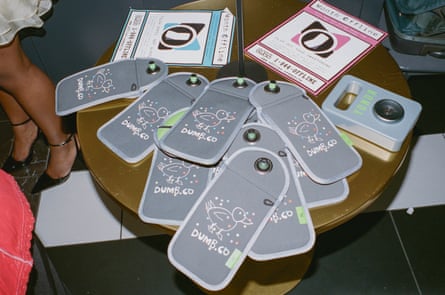
We each had paid $75 to participate in Month Offline, or MO, a program that challenged us to swear off our smartphones entirely. Another $25 went to dumb.co, the company behind MO, for the so-called dumbphones we would use as we navigated daily life.
In its early days, MO had given out flip phones so dumb – no maps, no ride-sharing, iffy texting – that participants struggled to use them during and after the month-long experiment. So my MO cohort was the first to test dumb.co’s souped-up version, a discontinued TCL Flip 2 bolstered with the messaging and mapping functions many of us are dependent upon.
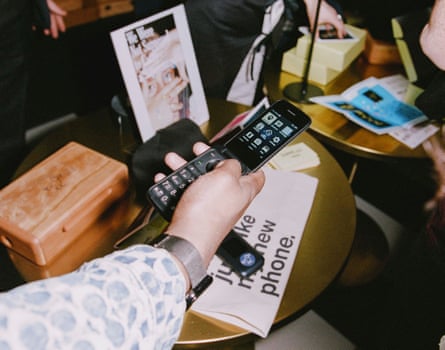
I was skeptical. Most of us came to MO sick of being glued to the supercomputers in our palms, angling hours of our attention downwards each day. Disaffected with tech companies and their devices, we were eager to dabble in the growing analog movement and compelled by MO’s mission to restore “our social, psychological, and spiritual freedom”, as per the offline pledge we signed on day one.
But if “less is MO,” why was the dumbphone being enabled to do more?
Was dumb.co authentic in its offline aspirations, or was it really a tech startup trying to ride the anti-tech zeitgeist?
“We all have iPhones,” Danny Hogenkamp, CEO and co-founder of dumb.co, told me of his nine-person team. Their headquarters in Washington DC was soon to be flush with summer interns. “They just don’t leave the office.”
Hogenkamp, 31, founded his first company, a DC data and technology firm called Grassroots Analytics specializing in fundraising for progressive causes, when he was just 22 years old. It became ground zero for his “dumbing down”. After instituting device-free meetings when his team returned to the office after Covid-19 lockdowns, Hogenkamp observed an increase in creativity and productivity – from his staff and himself.
Hogenkamp’s experimentation with de-digitizing escalated to the point when, in 2023, his roommate gave him a flip phone as a joke. The phone, Hognekamp said, “barely worked” – which is to say, it really worked. In addition to gaining back what would have otherwise been screen time, Hogenkamp noticed he simply felt better. (Indeed, research papers have indicated that low levels of screen time are linked to better quality of life in children and adults.)
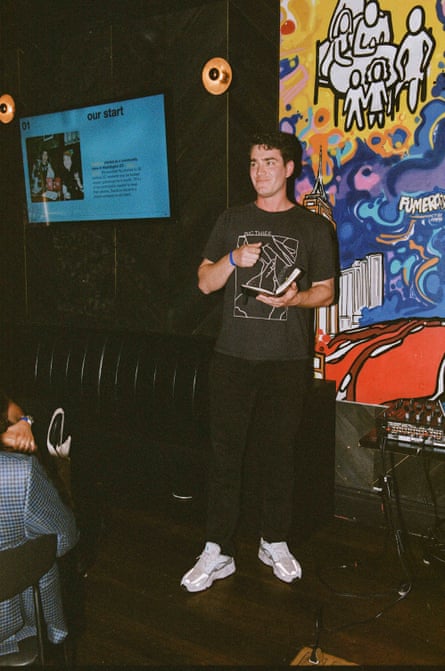
And so Hogenkamp decided that the future is dumb. With the money he made from his first company, he tried seven different “dumb ideas”, including investing in an app that let users bet against each other’s screen time, a phone-free bar in DC, and various charity and political efforts. He also bought 150 Yondr pouches, fabric bags that phones are magnetically locked into, and started hosting his own phone-free parties in DC just for fun. “I was the pouch guy,” he said.
In 2024, Hogenkamp and his pouches were summoned to enable a phone-free Shabbat dinner. Grant Besner, 29, who had recently moved to DC after stints on a regenerative farm in Virginia and as a natural building apprentice in upstate New York, showed up too. When Hogenkamp tried to check his phone in at the door, Besner held up a low-tech phone of his own – a habit he picked up after struggling to write his master’s thesis with his smartphone lurking nearby.
Hogenkamp and Besner were both gobsmacked; it was rare to meet a fellow traveler. They became friends and started brainstorming, eventually coming up with the idea for MO in early 2025. “We’re probably going into this dystopian hellscape, where everyone is a slave to their device,” Besner said of their thought process. “But what if there was a different future where we branched off and everyone started getting flip phones? Might as well try that.”
Hogenkamp, who was funding the project, bought flip phones for MO participants to borrow and enrolled in the first two cohorts in DC. While happily participating (and realizing his “lifelong dream to hang out with other people with flip phones”), Hogenkamp noticed that people were having “deeply spiritual experiences”, with many wanting to keep their flip phones at the end of the month. “How do we make that happen for them? I guess that’s just what a phone company is,” he said.
This sense of shared awakening underpins many of the other neo-luddite communities sprouting up offline, with analog advocacy groups such as the Luddite Club hosting regular chapter meetings across the country, and the New York-based Strother School of Radical Attention facilitating workshops to “build sanctuaries of attention” and protest “coercive digital technologies”. MO participants in my own cohort shared that “flipping off” their smartphones felt like waking up. We got lost, talked to strangers, and had the disturbing and unending experience of being the only person looking up in a subway car. A sense of enlightenment seemed to emerge simply from being more mindful (a conclusion I imagine will prompt Buddhists to think: well, duh).
By summer 2025, participants were given the option to keep their TCL Flip 2s after MO ended. In December, Hogenkamp retired from Grassroots to focus on dumb.co – a tech startup, lifestyle brand, and yes, phone company – building a team of loosely anti-tech gen Zers, many plucked from MO, and courting investors. Meanwhile, his team began smartening up the dumbphones.
Danielle Hirshberg, an early investor and chair of dumb.co’s board, is a firm believer that the dumbphone “still needs some basics”. As a woman she wouldn’t feel comfortable in a city without the ability to call an Uber or see where she is on Google Maps. (The new Maps feature is clunky, anyway – I didn’t use it once. But she’s right, I did feel better knowing it was there.) Women make up about three-quarters of dumbphone users, most residing in DC and New York, with an average age of 24.
What’s motivating to Hirschberg, a relative dumb elder at 33, is that “these gen Zers have grown up in a world where we’re expected to carry a supercomputer in our pockets. And they’re saying it’s not an inevitability.” She stressed that dumb.co was trying to give people their lives back, not stick them with another phone plan. “In an ideal world, we would give away these phones for free. We haven’t figured out a way to do that,” she said. As it is, dumb.co operates MO at a loss.
More than 1,000 people are active dumbphone users, paying $20 for the device and as low as $15 a month for a text, call and data plan, while 300 people have signed up for MO in the past year. Lydia Peabody, the company’s chief dumb organizer (“which you may know as chief marketing officer”, she said), is in the process of open-sourcing MO’s materials so that people can become dumb evangelists and spread the gospel through their own communities, recruiting dumbphone customers in the process.
Peabody’s outreach is crucial given that a red line for dumb.co is advertising on social media. Nevertheless, spikes in dumbphone users tend to come after bouts of virality; a recent CNN segment turned TikTok brought in 300 dumbphone sales in five days.
Email is another red line; I wasn’t yet able to check mine on the dumbphone and dumb.co insisted I never would. “You don’t want to be checking your email in the bathroom when you’re taking a shit,” Besner said. (He left dumb.co in April.)
To Peabody, MO is all about what you cultivate and create with the hours gained, the nifty flip phone almost beside the point. “This was never supposed to be a business model,” she said. “It’s just fun.”
And it was fun. Our MO meetups had the energy of supervised group playdates, in which we recreated our experiences living sans smartphones in crayon, drawing vignettes of friction points related to that week’s theme: communication, memory, navigation or boredom. I doodled my first morning waking up to an alarm clock instead of my iPhone, when I had to run back to my apartment to grab my wallet after realizing I didn’t have Apple Pay to get me through the subway turnstiles. These Crayola creations made up a “dumb scroll” at an end-of-MO event where we displayed what we had done in lieu of screen time.
For dumb.co though, the flip phones are the point. Software engineer Jack Nugent, 29, designed the company’s “dumb OS”, which on 1 May was updated even further with a weather app, music streaming (Spotify, Apple Music, and podcasts) and a version of the radius-based messaging app Yik Yak.
“Totally there’s a little bit of a contradiction in what I do, because we wanna get people off of devices but I’m also designing a device,” he said. “[Tech] companies have pushed us into certain business models that maximize profit by addicting us to our devices. But technology is a neutral thing that can be used for whatever purpose, good or bad, and so I like the idea that I can spend time doing tech stuff so that one day, hundreds of millions of people won’t have to.”
Without better functionality Nugent claimed the average person will not – or cannot – use a dumbphone at all: “An important part of tech and organizing in general is you have to meet people where they are.”
When MO first started, participants used the 404 number associated with their loaned flip phones – an Atlanta area code the MO folks chose as a riff on HTTP errors. Now the dumbphone is designed to be used in tandem with your smartphone, not replace it entirely: messages and calls are forwarded to your dumbphone, so you can leave your smartphone plugged in at home or work and still be reachable.
Even so, I hardly ever used my dumbphone for sending messages. The T9 keyboard was tiresome and frankly I kept forgetting I had a phone to check – a foreign and welcome development. I was relieved to no longer find myself halted between the bedroom and bathroom on account of a ding. Or worse, reflexively reaching for my iPhone unprompted for the 100th time in a day.
Instead, once I returned home from my day, I sat in my designated “internet chair” (ideally a desk chair, per MO doctrine) and replied to messages on my laptop for a half hour, treating digital communication like a chore on my to-do list. Slower response times aside, my offlineness verged on undetectable to others. Still, it put into perspective what was urgent (almost nothing) and what wasn’t (almost everything).
The phone syncing was probably for the best: too much friction, and I would’ve been tempted to remove my iPhone from the yellow, MO-issued cardboard box under my bed more than I already had. Gasp! Yes, I was regularly violating the MO pledge I signed, mainly to use Citibike. After a dozen circuitous emails with customer support, I had given up on ordering the fabled physical keycard advertised as an alternative to the smartphone app.
There were other allowances: during my Month Offline, I was informed that I could access ChatGPT through my dumbphone by dialing 1-800-CHAT-GPT. (At dumb.co’s DC office, I noticed that Besner and Nugent often suggested the other “ask Claude” to complete a coding task. When I asked Hogenkamp if he had any holdups about using AI, he allowed that “Claude Code is great.”)
Anyone aiming to take a principled anti-tech stance would have been better off with the hardcore luddites. But as someone interested in feeling less consumed by my smartphone while hesitant to give up all of its conveniences, dumb.co’s two-phone, one-number model suited me just fine. I didn’t want to be dumb all the time.
“Anyone is capable of a two-device system,” said Tali deGroot, Hogenkamp’s partner, as we settled into a booth at their favorite Tex-Mex spot in DC for fajitas and frozen avocado margaritas.
DeGroot, a political strategist, wasn’t totally onboard when Hogenkamp first started using a dumbphone. She was supportive, of course, but not a convert herself. That was until they took a trip to Japan last spring. She was doing all of the routing and reading of reviews and started to feel resentful. Hogenkamp wasn’t going to begin carrying his iPhone around, so she stopped carrying hers.
The flipside of this dynamic, being the dependent one, was frustrating too: during MO I felt guilty and burdensome whenever I asked strangers to look up an address on their smartphone and give me street-by-street directions, or when friends had to scan QR code menus for me.
“It’s selfish,” deGroot agreed, to offload screen time on to others.
What MO is really preaching, and what dumb.co is selling, is not abstinence but moderation. (“We’re literally harm reduction,” Peabody, a former mental health worker, told me gleefully.) As neo-luddites urge us to get offline as much and as soon as possible, and big tech tries to keep us gorging ourselves on endless scrolls, dumb.co appears to offer a third way – not on, or off, but somewhere in between. Hogenkamp insists that the apps that have been retrofitted to the dumbphone are those that users reported they needed in a society that organizes itself on a handful of platforms. Obviously WhatsApp and iMessage don’t feature on Maslow’s hierarchy of needs, but love and belonging do.
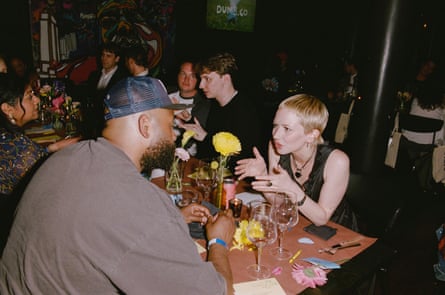
Hogenkamp is steadfast that people will start “flipping off” in droves. “I think we’re gonna be the fourth largest phone company in America. In like five months,” he said. It was a grandiose prediction. The fourth largest wireless provider in the US after Verizon, T-Mobile and AT&T, with their combined 400 million users, is Boost Mobile, which has 7.5 million subscribers; dumb.co would have to expand by 7,530 times to take Boost’s spot.
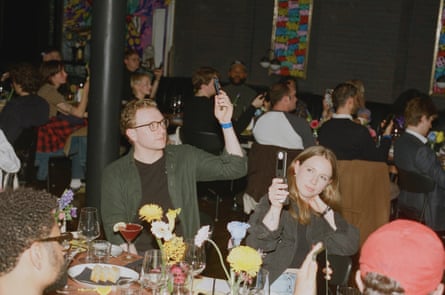
Undeterred, Hogenkamp assured people at dumb.co’s 1 May event, marking the subsuming of MO by dumb.co and official product launch of the revamped dumbphone, that he expects to become a Fortune 500 company.
Back at the Tex-Mex spot, he sucked up the last of his horchata and meditated on smartphone supremacy. “I sincerely believe everyone knows deep down that this is not the way to spend their one human consciousness,” he said.
“People are dumb,” deGroot said, shaking her head.
Hogenkamp quickly corrected her: “Stupid, not dumb.”
Схожі новини

Streamer D4vd becomes center of alleged $1.2M insider betting scandal involving a Google engineer