Should We Dam The Bering Strait To Keep The AMOC From Collapsing?
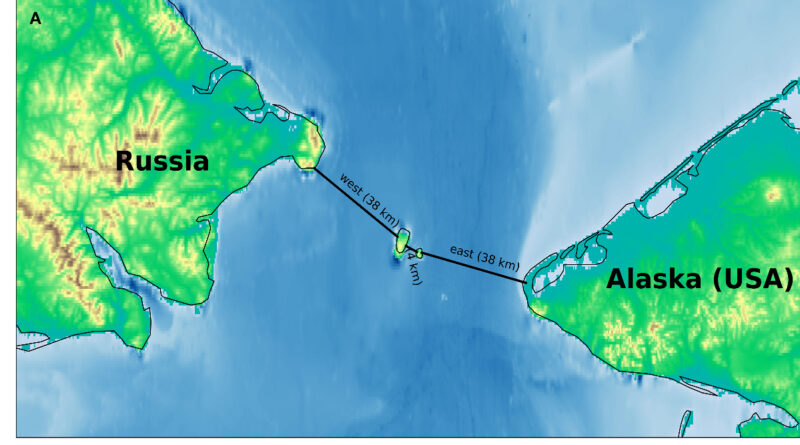 Credit: Science Advances
April 25, 20262 hours ago
Steve Hanley
0 Comments
Support CleanTechnica's work through a Substack subscription or on Stripe.
Credit: Science Advances
April 25, 20262 hours ago
Steve Hanley
0 Comments
Support CleanTechnica's work through a Substack subscription or on Stripe.
My old Irish grandfather was a prickly fellow. In conversations with him, he invariably would say at some point, “Son, that is an idea. It’s no damn good but it is an idea!” Hard to argue with that. Scientists in the Netherlands this week published a study that examines whether building a dam across the Bering Strait would help keep the Atlantic Meridional Overturning Circulation — better known as AMOC — from collapsing.
CleanTechnica has published dozens of articles about the AMOC, all of them pointing out that if it were to slow or stop, that would lead to significant changes in the climate of northern Europe and raise ocean levels along the east coast of the United States and the Canadian Maritimes by a foot or more.
The AMOC is powered by two primary factors — temperature and salinity — and don’t forget the Coriolis effect. Warm, salty water at the Equator travels north along the east coast of North America, then runs eastward toward Europe and the UK. There it picks up cooler, fresher water from the Arctic, which causes it to sink as it runs southward to the Equator once again.
Take away AMOC, and the UK and Europe would have about the same climate as Toronto. Who cares, you might ask? Put on a sweater! That might help, but there are other factors to consider. Farmers in those countries would find their growing season is much shorter and some of the staple crops they have been cultivating for centuries might no longer grow. If you think energy security is a problem, imagine the consequences of food insecurity.
Build A Dam!
On April 24, 2026, Jelle Soons and Henk Dijkstra of the Institute for Marine and Atmospheric Research at Utrecht University in the Netherlands published a study in the journal Science Advances in which they examine the possibility of constructing a 55-mile-long dam across the Bering Strait between Russia and Alaska.
The Bering Strait is relatively shallow, as ocean areas go, with an average depth of 30 to 50 meters (98 to 164 feet). In theory, it would be possible to construct a dam across it. Soons and Djkstra claim doing so could help keep the AMOC flowing, but should we? My old Irish grandfather might have something to say about that notion.
In the abstract to their study, the authors said:
“The Atlantic Meridional Overturning Circulation (AMOC) is a major tipping element in the present-day climate and could potentially collapse under sufficient freshwater or CO2 forcing. While the effect of the Bering Strait on AMOC stability has been well studied, it is unknown whether a constructed closure of this Strait can prevent an AMOC collapse under climate change. Here, we show in an Earth system Model of Intermediate Complexity that an artificial closure of the Strait can extend the safe carbon budget of the AMOC, provided that the AMOC is strong enough at the closure time.
“Specifically, an equilibrium AMOC under a sufficiently low additional freshwater flux has an increased safe carbon budget given a timely closure of the Strait, while for higher freshwater fluxes (and corresponding weaker AMOC), a closure reduces this budget. This indicates that constructing this closure could be a feasible climate intervention strategy to prevent an AMOC collapse.”
Timing Is Everything

Hmmm … what to make of all this? Yes, we know the AMOC is slowing down, and yes, we know why. We also know how to address the slowing process — we must stop burning fossil fuels. But that would result in catastrophic financial losses for fossil fuel companies and a major disruption in the lives of hundreds of millions of people.
Reduced to its essence, the question is whether the God-given right to drive ponderous pachyderms powered by petrol should take priority over the God-given imperative to be good stewards of the Earth. If that were put to a vote, the outcome would likely be heavily in favor of the former.
New York Times climate reporter Raymond Zhong wrote this about the study: “At first glance, the Bering Strait’s role in all this isn’t obvious. In fact, the strait is a gateway for large quantities of fresh water to flow from the Pacific Ocean into the Arctic Ocean, and from there into the Atlantic. Damming it would change the balance of fresh and salty water between the three oceans.” Less fresh water would help maintain the flow of the AMOC.
Using computer modeling, Soons and Dijkstra found that a dam across the Bering Strait could affect the AMOC in major ways. If the AMOC is strong, then closing the strait would cause less fresh water to flow out of the Arctic Ocean and into the Atlantic. That would help keep the North Atlantic salty and the AMOC stable. But if the AMOC is already near collapse, then closing the strait would have the opposite effect, destabilizing the AMOC further. The timing, in other words, is key.
[I am not a scientist, nor have I ever played one on TV, but my understanding is the AMOC is already weakening, so how this proposed dam would help the situation is a bit of a mystery. This might have been a good idea 50 or 100 years ago, but now? Too little too late, in my estimation.]
Unknown Unknowns
At the moment, scientists don’t know exactly how close the AMOC is to collapsing, Aixue Hu, a climate scientist at the National Center for Atmospheric Research in Boulder, Colorado, told Zhong that some projections suggest it could happen before the end of this century, but “the uncertainty is very, very large.” That makes it hard to be sure whether damming the Bering Strait would help or hurt the AMOC, he said. Yet considering the unimaginable ham to the environment and a large part of the world’s population, it is still an idea worth exploring, he added.
Another consideration is that, once built, the dam would be very hard to remove if it proved to have negative consequences. Thomas Haine, a professor of Earth and planetary sciences at Johns Hopkins University, told Zhong the study’s conclusions are too uncertain, and a dam’s potential consequences for fisheries and ship traffic too great. “Even if you could be confident that it would stabilize the AMOC, I think there are plenty of reasons it would be a really bad idea,” he said.
Geoengineering Is A Band-Aid
As humans continue to race toward a climate apocalypse, more and more geoengineering schemes are being put forward. Every one of them is a band-aid for a gunshot wound — self-inflicted, I might add. One idea is to dump iron and other nutrients into the oceans to force them to absorb more atmospheric carbon dioxide. That would in fact cool the Earth, or at least parts of it, but as the discovery of whale skeletons in the Altacama Desert in Chile demonstrates, it could be devastating to marine life.
There are a large number of people who believe — without evidence — that we will somehow magically “science our way out of” the climate crisis. That belief allows them to continue doing what they have always done, which is being totally dependent on fossil fuels. That “know nothing” attitude calls to mind this little ditty by YIP Harburg, the satirist/song writer who wrote “Over The Rainbow.” I offer it here for your amusement and edification:
God made the world in six days flat.
On the seventh, he said, “I’ll rest.”
So he let the thing into orbit swing,
To give it a dry run test.
A billion years went by,
Then he took a look at the whirling blob.
His spirits fell as he said,
“Oh, well. It was only a six day job.”
We are not going to science our way out of anything. We are going to dig the hole deeper and deeper until there is no way to climb out. We know what to do. We should start doing it.
Sign up for CleanTechnica's Weekly Substack for Zach and Scott's in-depth analyses and high level summaries, sign up for our daily newsletter, and follow us on Google News! Advertisement Have a tip for CleanTechnica? Want to advertise? Want to suggest a guest for our CleanTech Talk podcast? Contact us here. Sign up for our daily newsletter for 15 new cleantech stories a day. Or sign up for our weekly one on top stories of the week if daily is too frequent. CleanTechnica uses affiliate links. See our policy here.CleanTechnica's Comment Policy
Share this story!
Схожі новини

Face ID проти відбитка пальця: що краще для безпеки вашого смартфона
Anthropic created a test marketplace for agent-on-agent commerce
The AI Industry Is Discovering That the Public Hates It