‘She does not back down’: the couple seeking to legalise same-sex marriage in Botswana
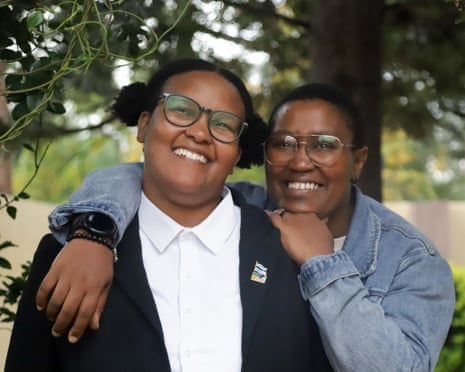
Bonolo Selelo and Tsholofelo Kumile are going to court for right to wed but face fierce opposition from church groups
Bonolo Selelo was at Botswana’s national museum for a Gaborone Pride event when she spotted Tsholofelo Kumile and was struck by her good looks. The two initiated a conversation and when Kumile expressed anxiety about what a tarot reading at the event might hold, Selelo thought nothing of offering her a hug. The reading turned out positive but Kumile claimed her hug anyway and they talked for hours.
That was 1 October 2023. Two months later, they moved in together. Then, on a hike during the Easter holidays in 2024, Selelo proposed to Kumile. A year later, they visited a local government office to register their intent to marry and were told it wasn’t legal.
“It was kind of expected. But I don’t think they expected the response,” Kumile said. She looked affectionately at Selelo. “She does not back down.”
The couple launched a court case, claiming the right to marry. Hearings are scheduled for 14 and 15 July. If they succeed, Botswana would become the second African country to legalise same-sex marriage, after South Africa in 2006. However, the case is facing fierce opposition from the government and traditional and church groups.
“We did have a frank discussion about it,” said Selelo, sitting next to her fiancee in the office of her law firm, which Kumile also works for. “I said … I want us to get married, because I love you, but there’s also the practical part.”
As a lawyer, Selelo worried what would happen to Kumile if she died. “I feel that I would be able to withstand a lot of legal pressure, but I wouldn’t want her to be harassed if I am no longer there to offer that protection. And, for me, marriage would give her that added protection that no other institution would be able to give her.”

Botswana decriminalised same-sex relations in 2019 when the high court ruled that a British colonial-era ban was unconstitutional. The decision was upheld on appeal in 2021. The government is now defending its ban on same-sex marriage.
A spokesperson for Botswana’s Attorney General said: “The Attorney General’s position... is that the Marriage Act stipulates that a valid marriage is one between a bride and a bridegroom and or a husband and wife, connoting a bond between a man and woman in the conventional sense. The Marriage Act does not provide for same sex marriages.”
Selelo and Kumile argued that another law, the Interpretation Act, supports their case, due to the law stating: “In an enactment words importing the male sex include the female sex and words importing the female sex include males.”
Much of southern Africa and the continent’s island states are relatively liberal compared with the rest of Africa, where 32 of 54 countries criminalise consensual same-sex intimacy. Since 2012, Lesotho, Mozambique, Seychelles, Angola, Mauritius and Namibia have legalised same-sex relations.
However, some countries on the continent have passed harsher laws amid a global backlash against LGBTQ+ rights. Uganda in 2023 and Senegal this year increased the prison times for consensual gay sex and both criminalised the “promotion” of homosexuality.
Opinions in Botswana about LGBTQ+ people have become more negative since the 2019 decriminalisation ruling. In a 2021 survey conducted by the pan-African survey organisation Afrobarometer, half of Botswanans said they either would like or would not care about having gay people as neighbours, the joint fifth highest out of 34 countries surveyed. Three years later, the figure had fallen to 41%.
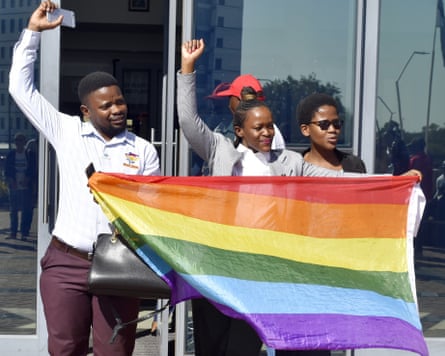
Legabibo, an LGBTQ+ rights campaign group, is running a campaign called “Lorato Ke Lorato” (Love Is Love) to try to change hearts and minds. “We want to show ourselves as ordinary citizens … We’re not asking for any special rights,” said Matlhongonolo Samsam, who is leading the campaign.
On the other side is the Dingwetsi Association, a traditional women’s group that promotes heterosexual marriage and is seeking to join the case. Grace Silver founded it in 2015, concerned at rates of divorce and family breakups. She said it now had about 2,000 members paying 20 pula (£1.10) a month.
Members often wear traditional headwraps and blue, white and black tartan blankets that signify they are married women. Several showed up wearing the attire to a hearing in March for Selelo and Kumile’s case. “This is our culture. We need to protect it,” Silver said.
Accompanying Silver was Moshe Morebodi, of the Botswana House of Prayer and Transformation. “Same-sex human rights are a subset of a satanic sect,” he said.
About 80% of Botswana’s population is Christian, according to the World Religion Database. Tshepo Ricki Kgositau runs the Ricki Kgositau Foundation to support transgender Botswanans and is also a member of an LGBTQ+ task team within the Methodist Church of Southern Africa. She said: “It has been really disappointing to see the very conservative and narrow interpretation by some conservative faith community members … If you do not know love, you cannot claim to know God.”
The lack of same-sex marriage in Botswana caused Kgositau her own difficulties. In 2017, she married her husband in South Africa. He was meant to come to Botswana for their traditional wedding but because she had not yet legally changed her gender (which requires a court ruling), he was barred from entering the country. They also lost the money they had spent planning the celebrations. “It was absolutely devastating,” she said.
For Brendon Tereki and his partner, Tashatha, the legal case brings hope. After connecting on Facebook two years ago, their first meeting at a popular bar in Gaborone was also Tereki’s first date with a man in public. By the end of the night, Tashatha had made him feel comfortable enough that they were able to kiss. “He has made me open up more than I ever thought,” Tereki said. “I really want to get married.”
Explore more on these topicsShareReuse this contentСхожі новини
Japanese tanker Idemitsu Maru arrives in Aichi after exiting Strait of Hormuz
Toshifumi Suzuki, pioneer of Japanese convenience stores, dies at age 93
Teachers struggle to support children who refuse to attend school