Scientists discover new little blue octopus in Galapagos Islands
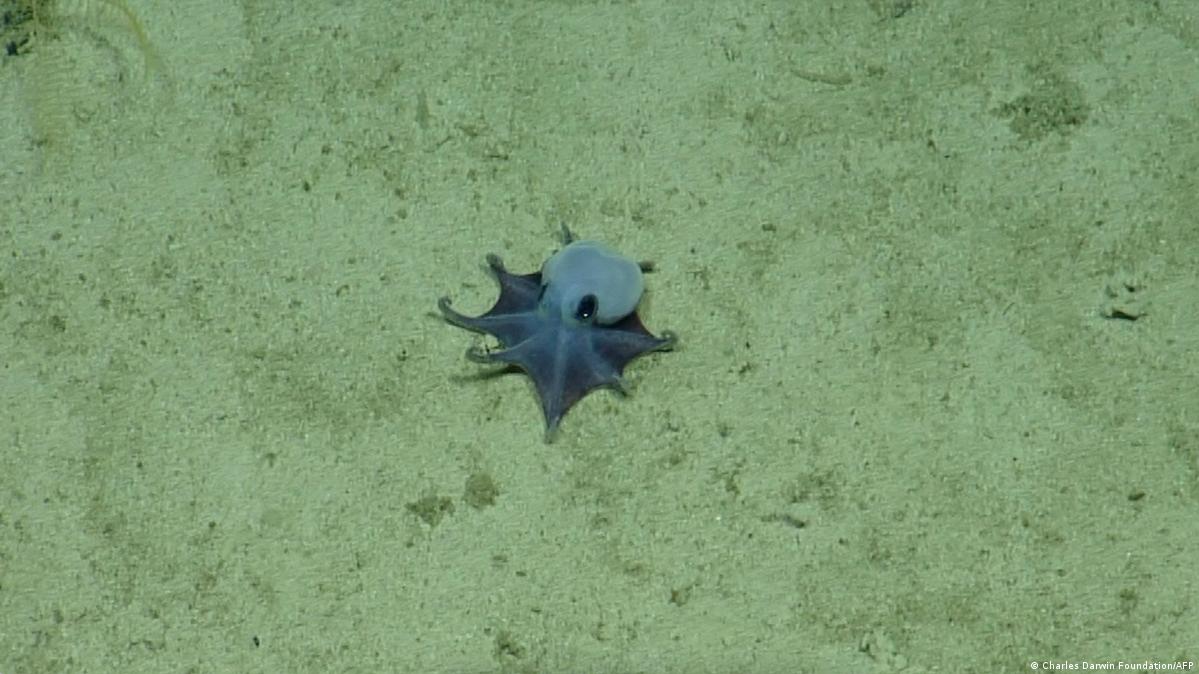
There's a new octopus on the ocean floors of Ecuador's Galapagos Islands that is tiny and blue (and cute) but with a long name — Microeledone galapagensis.
The news is exciting because the octopus is the size of a golf ball and because scientists know very little about octopuses that live deep in the tropical Pacific Ocean, as described in the study about the octopus published on Monday in the journal, Zootaxa.
And it must have been very exciting for the one person who knew there was something special about the octopus when she first saw it more than ten years ago — the scientist who led the study describing the new animal.
"Right away, I knew it was something really special. I'd never seen anything like it," said Janet Voight, the lead author of the study.
In 2015, scientists aboard the E/V Nautilus submersible were studying the ocean floor using the sub's remotely operated camera when they noticed the octopus, about 5,800 feet (1768 meters) below the water's surface.
"He's tiny!"
"It's blue!"
That's how researchers described the octopus when they first saw the animal, according to the study.
The crew aboard the submersible then collected the octopus and noted they saw two others that looked like it over the course of their deep-sea mission.
But when the octopus was brought back to the Charles Darwin Research Station on the Santa Cruz island in the Galapagos Islands, researchers were not sure what species it belonged to.
They then contacted Janet Voight and went out of their way to make sure she had the specimen.
Little octopus posed challenges for scientific research
The octopus was little and one of a kind, which meant that researchers had to take specific measures to make sure they could study it.
The octopus' body was preserved in alcohol and formalin and then sent from the Galapagos Islands to Chicago for Voight to examine the animal at the Field Museum, which is one of the world's largest natural history museums.
"When you describe a new species of octopus, you have to look at all the parts, including the mouth, the beak, and the teeth. And to see those things, you have to cut the specimen open. We only had the one specimen, so I didn't want to take it apart," Voight said.
She worked with a team to create micro CT scans of the octopus and put together a 3D model of the animal, inside and out.
That was the first time in her four-decade career on octopus evolution that she led a study that described a new species of octopus.
"These are little octopuses that live in the deep sea, and hardly anybody on Earth has ever gotten to see them. I just feel lucky that I got to work with them," she said.
Why discovering a new tiny octopus is this special
The Galapagos are an archipelago of 20 islands that was made famous by Charles Darwin, a biologist who used his trip to the island in the mid-1800s to formulate his theory of evolution.
The surrounding waters of the islands are home to creatures that aren't found anywhere else on Earth and there's a vast part that remains unexplored. Imagine how scientists felt when they saw a tiny octopus they had never seen before.
Edited by: Dmytro Hubenko
AdvertisementСхожі новини