Sanctioned Payments Platform A7 Plans Russia’s Largest 'Gold Bank'
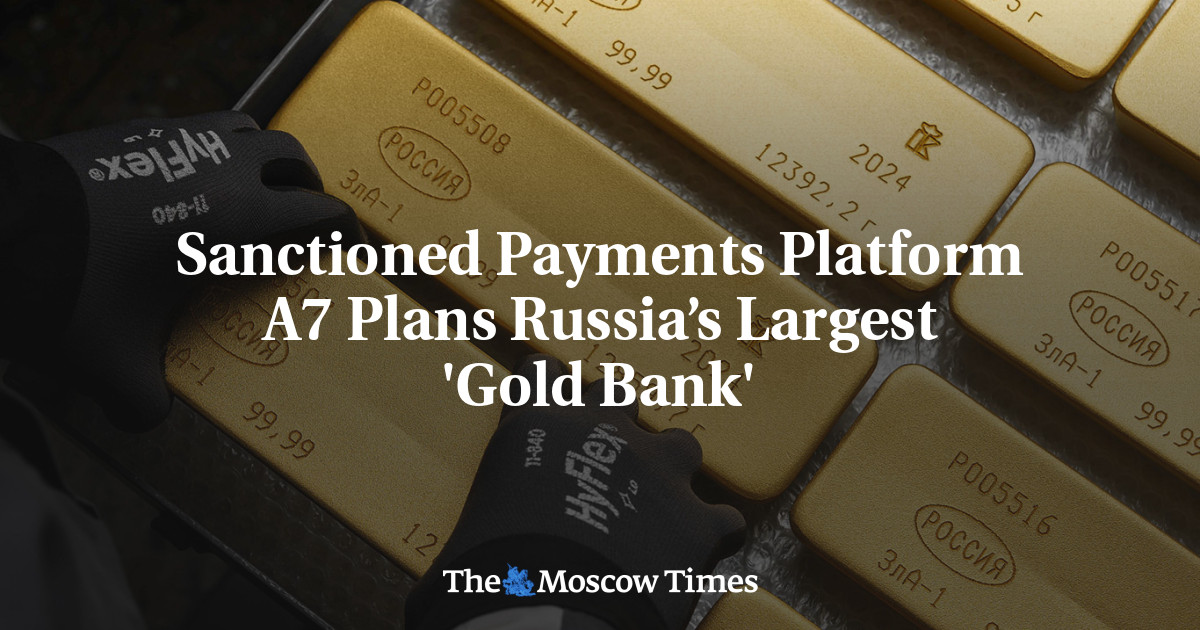


Russia-backed payments platform A7 plans to create the country’s largest “gold bank,” aiming to boost domestic gold ownership and potentially expand the use of gold-linked digital assets in cross-border transactions, Reuters cited company executives as saying Tuesday.
The project, launched jointly with Russia’s Finance Ministry, comes amid Moscow’s broader push to create alternative financial infrastructure and reduce reliance on foreign currencies and Western-dominated financial systems after sanctions imposed over the war in Ukraine.
A7 Deputy Chief Executive Irina Akopyan said the company plans to build the gold bank around a newly established state-backed entity called Rosveksel.
“Creating Rosveksel is a strategic step for A7 Group’s expansion into the retail segment,” Akopyan said at a presentation of the project, according to Reuters.
A7, a cross-border payments platform created by defense lender Promsvyazbank, is 51%-owned by Moldovan businessman Ilan Shor, who was sentenced in Moldova to 15 years in prison for money laundering following an appeal in a high-profile banking scandal.
Rosveksel was registered on May 4 and is 85% owned by A7, which has been under U.S. and European Union sanctions since mid-2025. The company is headed by former Russian Finance Ministry official Osman Kabaloyev.
Under the project, individuals and businesses will be able to purchase gold through A7’s online platform or at its physical offices, starting from as little as one gram.
“For every ruble spent by individuals and companies, gold will be purchased,” Reuters quoted Akopyan as saying. “We want to build the largest gold bank in our country.”
The company plans to store gold with Russia’s state mint and precious metals producer Goznak, though negotiations have not yet concluded. Rosveksel is also in talks with state-owned refining companies to provide customers with physical bullion storage services, Kabaloyev said.
The initiative follows years of efforts by the Finance Ministry to encourage domestic gold ownership. In 2022, authorities scrapped value-added tax on investment-grade gold bars sold to individuals in hopes of creating a stronger domestic market.
Despite a roughly tenfold increase in sales to retail investors since the tax change, gold turnover remains low, Reuters cited Deputy Finance Minister Alexei Moiseyev as saying.
Russian officials increasingly view gold as an alternative store of value as sanctions and capital controls have complicated access to foreign currencies.
Moiseyev acknowledged longstanding obstacles including low liquidity, wide bid-ask spreads and high entry costs, but said Rosveksel and A7 could help address those issues.
According to Moiseyev, customers could eventually buy gold-linked digital financial assets for as little as 120 rubles ($1.68) at current prices.
He also suggested such digital assets could play a role in international trade.
“The digital financial asset is linked to an internationally recognized asset while remaining independent,” he said. “I hope it will see broad use in foreign economic settlements.”
Shor, who fled Moldova first to Israel and later to Russia, has remained active in Moldovan politics through the Shor Party.
An investigation by The Washington Post reported that Russia’s Federal Security Service (FSB) worked closely with Shor and helped finance his political activities.
The United States sanctioned Shor and his wife, Russian singer Jasmin, in 2022 for activities Washington said were aimed at destabilizing Moldova. Shor is also under European Union and British sanctions.
Read this article in Russian at The Moscow Times' Russian service.
Read more about: Banks , Finance MinistrySign up for our free weekly newsletter
Our weekly newsletter contains a hand-picked selection of news, features, analysis and more from The Moscow Times. You will receive it in your mailbox every Friday. Never miss the latest news from Russia. Preview Subscribe Subscribers agree to the Privacy Policy We sent a confirmation to your email. Please confirm your subscription.A Message from The Moscow Times:
Dear readers,
We are facing unprecedented challenges. Russia's Prosecutor General's Office has designated The Moscow Times as an "undesirable" organization, criminalizing our work and putting our staff at risk of prosecution. This follows our earlier unjust labeling as a "foreign agent."
These actions are direct attempts to silence independent journalism in Russia. The authorities claim our work "discredits the decisions of the Russian leadership." We see things differently: we strive to provide accurate, unbiased reporting on Russia.
We, the journalists of The Moscow Times, refuse to be silenced. But to continue our work, we need your help.
Your support, no matter how small, makes a world of difference. If you can, please support us monthly starting from just $2. It's quick to set up, and every contribution makes a significant impact.
By supporting The Moscow Times, you're defending open, independent journalism in the face of repression. Thank you for standing with us.
Once Monthly Annual Continue Not ready to support today?
 Remind me later. ×
Remind me next month
Схожі новини

Was Nina Lin arrested? Twitch streamer claims missed $4 scissors scan led to night in jail

Tennessee man jailed for 37 days over Charlie Kirk meme to receive $835,000 settlement

Reward on absconding husband raised in Twisha Sharma death case