River Wye granted rights in UK first that could help in fight against pollution

Charter to be adopted along river’s entire catchment from Cambrian mountains to Chepstow and Bristol Channel
The entire catchment of the River Wye has been formally recognised as a living ecosystem with intrinsic rights in a charter, a UK first that campaigners hope will help save the highly polluted river.
The charter was celebrated at a community event at the Hay-on-Wye literary festival on Sunday. It includes the right to flow, to biodiversity, to be free from pollution, to be supported by a healthy catchment, to regenerate, and the right to be represented, described as a “significant step” towards protecting and restoring one of the UK’s most beloved rivers.
Herefordshire and Powys county councils have already implemented the charter and it is expected to be adopted soon by Gloucestershire and Monmouthshire, covering the entirety of the Wye’s 130-mile course from its source in the Cambrian mountains in mid Wales to Chepstow and the Bristol Channel.
Jackie Charlton, the county council’s cabinet member for a greener Powys, said: “The River Wye is central to our environment, communities and heritage. By adopting this charter, we are making a clear statement that the river’s health matters and must be protected.
“This is about working together with partners and communities to restore the river and safeguard it for generations to come.”
The initiative, developed collaboratively across the river catchment, is part of a growing rights of nature movement worldwide.
Rivers in Ecuador, Canada and New Zealand have been granted legal personhood in recent years, and the House of Lords is considering a proposal by the former leader of the Green party, Natalie Bennett, to change nature’s legal status from objects, property and resources to subjects with inherent rights.
While much of the Wye, or Gwy in Welsh, is protected as a special area of conservation, and the rights in the charter are already recognised across existing legislation and regulatory frameworks, the river has suffered near ecological collapse over the past decade.
Campaigners say excess nutrients from the rapid expansion of industrial chicken farming in the river’s catchment area – aggravated by sewage spills – have caused algae, fungus and weed growth that has suffocated the ecosystem.
The Wye is now at the heart of the biggest ever environmental pollution claim to reach the high court: more than 4,500 people who live or work near the Wye and the nearby Lugg and Usk have joined a case against Avara Foods, one of the UK’s largest chicken producers, and Dŵr Cymru (Welsh Water), demanding the companies clean up the rivers.
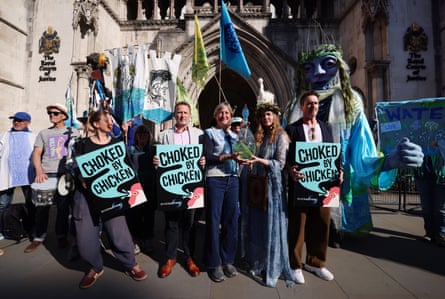
Avara and Dŵr Cymru deny claims they are responsible for pollution.
Angela Jones, a campaigner from Symonds Yat, said she welcomed the new charter for the Wye, but “the reality is that this river now stands on the cliff edge of ecological collapse”.
She said: “The charter is an important and historic statement of intent. What is needed now is urgent action: stronger regulation of intensive poultry operations, meaningful limits on nutrient pollution, proper enforcement against offenders, and a fully funded restoration strategy for the entire catchment. Without immediate intervention, future generations may inherit a biologically dead river instead of the living Wye that so many of us have fought to protect.”
In 2025, the ecologist Dr Louise Bodnar became the first-appointed voice of the River Wye, with a formal voting seat representing the river’s interests on the Wye catchment nutrient management board.
The Wye charter is the first for a river in Wales, and the first full river catchment charter in the UK. Last year, the Ouse, which runs through East and West Sussex, became the first river in the country to have its rights formally recognised, after Lewes district council agreed to adopt a charter to protect it.
Explore more on these topicsShareReuse this contentСхожі новини

Екстремальне мистецтво, сексуальні злочини та голова поміж гусениць – 5 книг про крайнощі
Drake Sets Album Charts Record as First Artist to Hold Top Three Positions With ‘Iceman,’ ‘Habibti’ and ‘Maid of Honour’

Житній ринок, «Книгарня Є», Hinaus. Які ще культурні об’єкти пошкоджено у Києві